
November 17, 2026

Pylon vs. Intercom: Which Support Platform Is Better in 2026?

WRITTEN BY
Happy Das
UPDATED ON
November 17, 2026
Pylon vs. Intercom: Which Support Platform Is Better in 2026?

Picking between Pylon and Intercom in 2026 is less a feature bake-off than a bet on where your customers actually talk to you. Pylon has quietly become the default answer for B2B SaaS teams whose highest-value customers live in shared Slack and Microsoft Teams channels. Intercom, meanwhile, has pushed almost all of its chips into the Fin AI Agent — a resolution-priced bot it says now handles 76% of customer conversations across 12,000+ customers.

Both are credible. Neither is universally "better." I spent the last couple of weeks inside both tools, pulled fresh pricing on November 17, 2026, read 100+ reviews on G2, Capterra, Gartner, Reddit, and third-party sites, and modeled two realistic cost scenarios a mid-market B2B SaaS team would face.

Here's the honest read, followed by the math.

‍

TL;DR

  • Pick Pylon if your customer conversations happen in Slack Connect, MS Teams shared channels, or on a mix of Slack/email/in-app for a B2B SaaS motion — and you want predictable, seat-based pricing with credits for AI.
  • Pick Intercom if the center of gravity for your product is the in-app messenger, you need proactive messaging/tours, and you're willing to trade cost predictability for best-in-class AI deflection.
  • Watch out for: Intercom’s $0.99-per-outcome Fin pricing can cause support costs to rise quickly. One team reported its monthly bill jumping from roughly $119 to $854 as resolutions increased.
  • Also worth looking at: ClearFeed Helpdesk if your team needs a Slack/Teams-native ticketing layer without Pylon's seat prices or Intercom's resolution roulette — we'll weigh it fairly in the section below.

Fast verdict: If more than 30% of your support happens in shared Slack or Teams channels, Pylon is the more natural pick. If you're a product-led, consumer-adjacent SaaS leaning on in-app messaging and want Fin's resolution rate at any cost, Intercom still wins. If you want the Slack-native setup without paying Pylon's $139/seat, that's where ClearFeed earns a look.

‍

Pylon vs. Intercom at a Glance

Criteria Pylon Intercom Winner
Best for B2B SaaS post-sales support in Slack/Teams Consumer + B2C/B2B2C with in-app messenger Depends on surface
Primary ticketing surface Shared Slack/Teams channel + inbox In-app Messenger + Inbox Pylon for B2B · Intercom for B2C
Slack Connect (native) Yes — core product No native Slack Connect Pylon
MS Teams channels Yes (Pro/Advanced) No Pylon
Discord / Telegram Discord native · Telegram beta (Pro/Enterprise) No Pylon
Flagship AI Assist Agent, Support Agent, Slack Agent Fin 4, Fin Voice, Copilot, Fin Operator Intercom (maturity)
Pricing model Seat + AI credits Seat + $0.99/outcome + add-ons Pylon (predictability)
Starting seat price $89/seat/mo (Professional, annual) $29/seat/mo (Essential, annual) Intercom (entry)
Enterprise seat price $139/seat/mo (Advanced) $132/seat/mo (Expert) Roughly even
Free trial Yes (sales-arranged) 14 days, no credit card Intercom
G2 rating 4.7–4.9 / 5 (~111 reviews) 4.5 / 5 (~3,890 reviews) Pylon (score) · Intercom (volume)

‍

Ticketing and Workflows: Slack Connect vs. the Inbox

In Pylon, the ticket is the Slack thread. A shared Slack Connect channel between you and your customer becomes a routed, SLA-governed queue, but your customer sees only a Slack conversation. Internal agents see triage fields, assignments, status, and automations layered on top. Teams running mid-market B2B SaaS motion routinely cite this as the reason they switch off of Zendesk or Intercom: customers don't have to log in anywhere.

Pylon supports the same pattern in MS Teams channels (Pro and Advanced plans), plus Email, WhatsApp, Telegram, Discord, and Phone (as an add-on at $35/seat/mo).

Intercom's ticketing lives inside the Inbox. Conversations arrive from the in-app Messenger, email, or Fin hand-offs and get worked as tickets with customizable fields, macros, and routing rules. It's a polished, mature queue, but it's not built around external shared channels. If your biggest customer is already screaming into a Slack Connect channel they set up with you, routing that into Intercom means an agent manually bridging the two, or a custom integration.

Intercom's recent ticketing upgrades added more structure (customer-facing ticket portal, SLAs, advanced routing). But as one Capterra reviewer put it, "the ticketing solution seems like an afterthought" — strong at conversational support, lighter than dedicated help desks at high-volume multi-touch queue management.

‍

AI Capabilities: Pylon Assist Agent vs. Fin 4

Intercom Fin 4 is the current generation of Intercom's resolution-first AI agent. It includes Fin Voice (native voice via Apex Flash 2.0), Procedures (multi-step workflow automation), Fin Operator (background automation), and a Customer Agent that spans Service, Sales, Ecommerce, and Success.

Billing for Fin is strictly outcome-based: $0.99 per confirmed resolution, which Intercom defines as the customer confirming the issue is resolved, not asking a follow-up for 24 hours, or Fin completing a workflow handoff.

Pylon's AI takes a different shape. There are four named products:

  • Assist Agent is a "personal AI operator" that investigates across your tools (Linear, Jira, Notion, Snowflake, BigQuery, Confluence) and can delegate to external agents via MCP.
  • Support Agent acts as the frontline resolver and answers questions across every channel.
  • Slack Agent is an in-Slack agent with the same context and tool access as the rest of Pylon.
  • Automations are repeatable workflows triggered by events or schedules.

Pylon doesn't publish a headline resolution rate, and its pricing is credit-based. The real difference is what the AI is for. Fin is a deflection engine. So its job is to close tickets your humans never see. Pylon's Assist Agent is more of an operator layer that cross-references systems, writes drafts, and surfaces account context for a human agent.

Teams with tight KBs, high ticket volume, and consumer-flavored support will squeeze more out of Fin. Teams with complex, product-engineering-adjacent B2B conversations tend to get more out of Pylon's operator model.

‍

Channel Coverage: Where Your Customers Live

Pylon's channel sweep is unusually wide for a B2B helpdesk:

Channel Pylon Intercom
Slack (shared/Connect) Native, core product Not native
MS Teams channels Supported (Pro/Advanced) Not supported
Email Supported Supported
In-app Messenger / chat Web chat widget Core product
WhatsApp Supported Supported
Discord Native ticketing Not supported
Telegram Beta (Pro/Enterprise) Not supported
Phone / Voice Add-on at $35/seat/mo Fin Voice (outcome-priced)

For a B2B SaaS where half your customers run their own Slack workspaces and the other half live in Teams, Pylon natively meets them where they are. For a product-led SaaS where in-app chat is the primary surface, Intercom's Messenger remains the gold standard.

That said, if you're a dev-tools or infra startup and your users live in Discord, Pylon is one of the few mature helpdesks that treats Discord as a real ticketing surface rather than a one-way notification channel.

‍

Knowledge Base and Self-Service

Intercom ships a native knowledge base called Articles, with Fin indexing it as the primary deflection source. It's tightly coupled: write an Article, Fin's resolution rate on related questions ticks up. This vertical integration is one reason Fin's resolution numbers are credible because the KB and the AI live in the same product.

Pylon doesn't ship a native authoring KB. Instead, it integrates with the places B2B teams already write documentation — Notion and Confluence — and the Assist Agent treats those as knowledge sources. For teams whose engineering docs already live in Notion, this is less work. For teams starting from zero, Intercom's Articles-first model is faster to stand up.

Either approach can work; the question is where your docs already live.

‍

Reporting, Analytics, and Account Intelligence

Intercom's dashboards cover the standard set, for example, first response time, resolution rate, CSAT, Fin outcome breakdown, and agent performance. Copilot ($29/agent/mo on annual) layers AI insights on top: it summarizes ticket trends, drafts responses, and surfaces coaching opportunities. Reviewers consistently call it polished but note the add-on math.

Pylon's analytics feature is Account Intelligence, which aggregates every conversation, CRM note, product-usage signal, log line, and (optionally) code reference into a single per-account view. For a B2B CS team prepping a QBR or a renewal conversation, this is the piece that tends to get called out by name in reviews. Pricing: $10 per customer account per month, with a 50-account minimum, i.e., a $500/mo floor. That's not trivial, and it's worth modeling if you have 20 named accounts but not 500.

Both platforms expose data warehouse integrations (Pylon to Snowflake and BigQuery; Intercom via its API). For custom analytics, you'll still want your own BI layer on top.

‍

Integrations and the B2B Stack

Pylon's integration catalog leans into the B2B SaaS stack:

  • CRM: Salesforce, HubSpot
  • Issue tracking: Linear, Jira
  • Docs: Notion, Confluence
  • Data warehouse: Snowflake, BigQuery
  • LLMs: Claude, ChatGPT
  • Observability/PLG: Gong, PostHog, Mixpanel, LaunchDarkly
  • MCP (Model Context Protocol) for custom tool wiring

Intercom's app store is larger and broader. You get 100+ integrations across marketing, commerce, and support categories, but the depth of integration with engineering tools (Linear, Jira, Snowflake) is lighter than Pylon's.

For a B2B SaaS CS team that files bugs in Linear, tracks accounts in HubSpot, and models usage in Snowflake, Pylon's wiring feels purpose-built. For a B2B2C or commerce team that needs deep hooks into Shopify, Klaviyo, or HubSpot Marketing, Intercom's catalog wins.

‍

Pylon vs. Intercom Pricing: The Full Breakdown

Base Plan Pricing

Plan Pylon Intercom
Entry Professional — $89/seat/mo (annual) Essential — $29/seat/mo (annual, billed monthly $29)
Mid Advanced — $139/seat/mo (annual) Advanced — $85/seat/mo (annual, incl. 20 free Lite seats)
Top Enterprise — custom Expert — $132/seat/mo (annual, incl. 50 free Lite seats)
Free trial Sales-arranged 14 days, no credit card
Minimum seats Required for new customers 1 full seat

‍

AI and Add-On Pricing

AI / Add-on Pylon Intercom
AI (agent) Credits — 6,800–14,000/mo typical (vendor estimator). Buy annual or pay-as-you-go Fin — $0.99/outcome
AI co-pilot for agents Included in Support/Assist Agent Copilot — $29/agent/mo (annual)
Proactive messaging / outbound Not offered Proactive Support Plus — $99/mo (500 messages)
Pro add-on — $100/mo (500 conversations + 6,000 credits)
Account analytics layer Account Intelligence — $10/account/mo (50-account min) Included in dashboards
Phone channel $35/seat/mo Fin Voice — outcome-priced
SSO (SAML) $125/mo on Professional (included on Advanced+) Included on Advanced+

‍

The Hidden Line Items Most Teams Miss

  • Pylon: Phone support costs $35 per seat, Account Intelligence starts at $500/mo, and SAML requires the Professional plan ($125/mo).
  • Intercom: Fin's definition of a billable outcome (24-hour no-follow-up window — documented complaints note customers are occasionally billed for resolutions Fin didn't close).
  • Both: Minimum commitments on annual AI purchases.

‍

Pylon vs. Intercom: What Should You Choose?

Choose Pylon If…

  • A meaningful share of your customer conversations happen in Slack Connect or MS Teams shared channels.
  • You run a B2B SaaS motion with named accounts and need Account Intelligence to prep QBRs and renewals.
  • Predictable, seat-based pricing matters more than extracting the last dollar of AI deflection.
  • You file bugs in Linear, and your docs live in Notion or Confluence.
  • You have a Discord community that doubles as a support surface.
  • You want a vendor whose roadmap is clearly B2B post-sales, not consumer messaging.
  • You're comfortable with sales-arranged trials rather than self-serve onboarding.

‍

Choose Intercom If…

  • Your product has a strong in-app Messenger, and most customer conversations start there.
  • You need proactive support surfaces — tours, banners, outbound campaigns.
  • Fin's deflection math pencils out: your KB is tight, and ticket volume is high enough to amortize outcome billing.
  • Your team is comfortable managing a variable AI cost line that can swing month to month.
  • You're a consumer or commerce-adjacent SaaS with Shopify/Klaviyo/HubSpot Marketing in the stack.
  • You want the broadest integration catalog without leaving the help desk.
  • Free trial speed matters. Intercom's self-serve 14-day trial is significantly faster to start.

‍

ClearFeed Helpdesk: A Slack/Teams-Native Alternative for B2B SaaS

A quick, honest aside before the choose-your-tool verdict.

If you're in the position of "my customers live in Slack and Teams channels, Intercom's Fin bill scares me, but Pylon's $139/seat feels high for an 8-person team," there's a third path worth checking: ClearFeed Helpdesk.

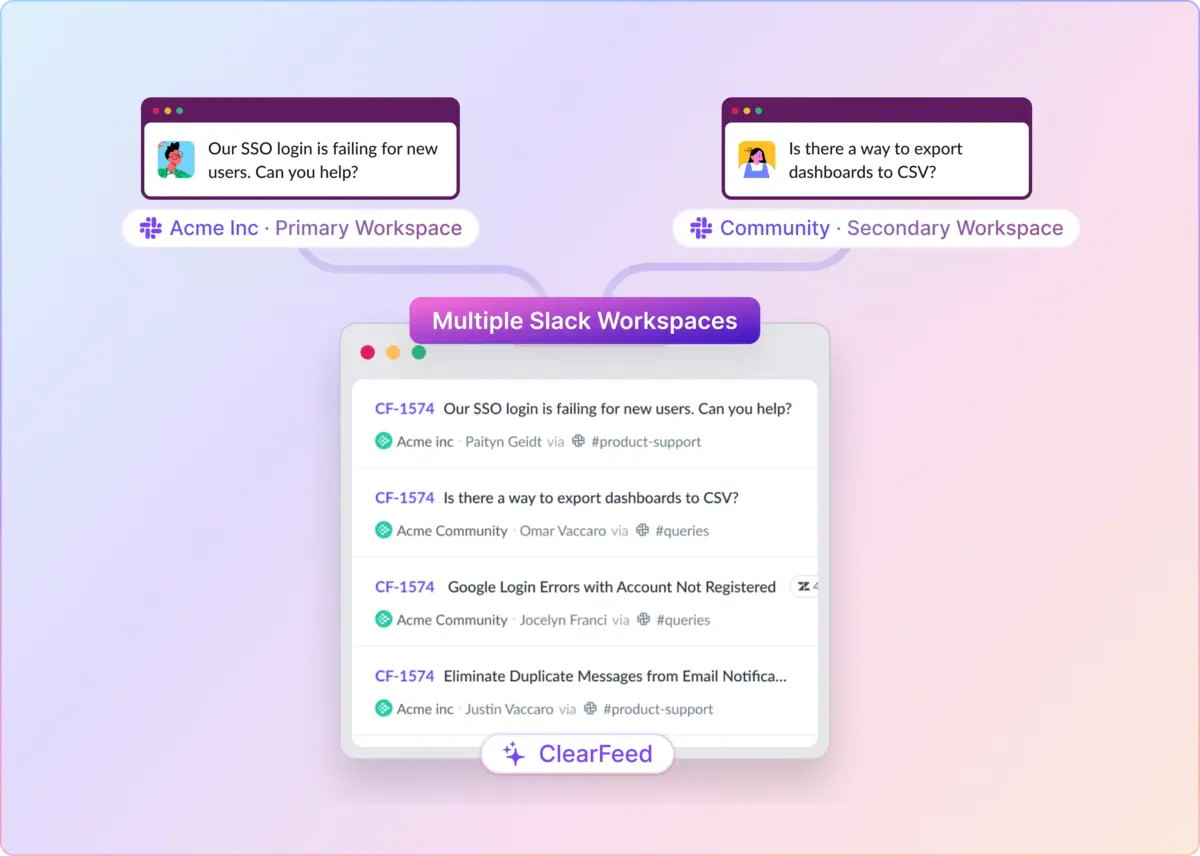
Support Customers in Shared Slack and Microsoft Teams Channels

ClearFeed Helpdesk turns Slack Connect channels, MS Teams shared channels, email, web chat, and a support portal into a unified ticketing queue. Agents work tickets from a single inbox; customers continue conversations in Slack or Teams without ever learning they're in a ticketing system. The MS Teams shared-channel support matters — Pylon has it on higher tiers, Intercom doesn't ship it at all, and much of the web still cites a stale "Teams limitation" that no longer applies to ClearFeed.

‍

Ticketing Without High Per-Seat Cost

ClearFeed Helpdesk starts at $24/agent/month on the Starter plan and $49/agent/month on the Professional plan, billed annually. Both come with a 14-day trial that doesn’t require a credit card. That’s roughly a third of Pylon Advanced’s per-seat price and in the same range as Intercom Essential, with a Slack-first ticketing model that Essential doesn’t offer.

‍

AI Agents With Transparent Credit Pricing

ClearFeed prices AI as a flat $20/mo per 100-credit pack on top of the Helpdesk plans (Professional includes 50 credits per agent). No $0.99-per-outcome dynamic that spikes when you succeed, no separate Copilot bill. The AI Agents resolve tickets using connected knowledge sources (Notion, Confluence, Zendesk KB, your own docs) and tools (Linear, Jira, Zendesk).

‍

Keep Intercom or Switch to ClearFeed

ClearFeed also ships an Integrations edition that syncs Slack and Teams conversations into Zendesk, Jira, JSM, ClickUp, Linear, and Intercom. Meaning: if your team has already invested in Intercom and doesn't want to migrate, ClearFeed can be the Slack/Teams layer on top of it rather than a replacement. That's a materially different posture from Pylon, which asks you to consolidate onto Pylon.

‍

When ClearFeed Is Not the Right Call

  • You need in-app Messenger, product tours, tooltips, banners, or outbound proactive campaigns; Intercom is better, and ClearFeed doesn't play there.
  • You're a consumer-facing marketplace or ecommerce brand; Intercom's app store is deeper on commerce integrations.
  • If your support model genuinely doesn't touch Slack, Teams, or email, you probably don't need any of the three.

See ClearFeed Helpdesk pricing →

Picking between Pylon and Intercom in 2026 is less a feature bake-off than a bet on where your customers actually talk to you. Pylon has quietly become the default answer for B2B SaaS teams whose highest-value customers live in shared Slack and Microsoft Teams channels. Intercom, meanwhile, has pushed almost all of its chips into the Fin AI Agent — a resolution-priced bot it says now handles 76% of customer conversations across 12,000+ customers.

Both are credible. Neither is universally "better." I spent the last couple of weeks inside both tools, pulled fresh pricing on November 17, 2026, read 100+ reviews on G2, Capterra, Gartner, Reddit, and third-party sites, and modeled two realistic cost scenarios a mid-market B2B SaaS team would face.

Here's the honest read, followed by the math.

‍

TL;DR

  • Pick Pylon if your customer conversations happen in Slack Connect, MS Teams shared channels, or on a mix of Slack/email/in-app for a B2B SaaS motion — and you want predictable, seat-based pricing with credits for AI.
  • Pick Intercom if the center of gravity for your product is the in-app messenger, you need proactive messaging/tours, and you're willing to trade cost predictability for best-in-class AI deflection.
  • Watch out for: Intercom’s $0.99-per-outcome Fin pricing can cause support costs to rise quickly. One team reported its monthly bill jumping from roughly $119 to $854 as resolutions increased.
  • Also worth looking at: ClearFeed Helpdesk if your team needs a Slack/Teams-native ticketing layer without Pylon's seat prices or Intercom's resolution roulette — we'll weigh it fairly in the section below.

Fast verdict: If more than 30% of your support happens in shared Slack or Teams channels, Pylon is the more natural pick. If you're a product-led, consumer-adjacent SaaS leaning on in-app messaging and want Fin's resolution rate at any cost, Intercom still wins. If you want the Slack-native setup without paying Pylon's $139/seat, that's where ClearFeed earns a look.

‍

Pylon vs. Intercom at a Glance

Criteria Pylon Intercom Winner
Best for B2B SaaS post-sales support in Slack/Teams Consumer + B2C/B2B2C with in-app messenger Depends on surface
Primary ticketing surface Shared Slack/Teams channel + inbox In-app Messenger + Inbox Pylon for B2B · Intercom for B2C
Slack Connect (native) Yes — core product No native Slack Connect Pylon
MS Teams channels Yes (Pro/Advanced) No Pylon
Discord / Telegram Discord native · Telegram beta (Pro/Enterprise) No Pylon
Flagship AI Assist Agent, Support Agent, Slack Agent Fin 4, Fin Voice, Copilot, Fin Operator Intercom (maturity)
Pricing model Seat + AI credits Seat + $0.99/outcome + add-ons Pylon (predictability)
Starting seat price $89/seat/mo (Professional, annual) $29/seat/mo (Essential, annual) Intercom (entry)
Enterprise seat price $139/seat/mo (Advanced) $132/seat/mo (Expert) Roughly even
Free trial Yes (sales-arranged) 14 days, no credit card Intercom
G2 rating 4.7–4.9 / 5 (~111 reviews) 4.5 / 5 (~3,890 reviews) Pylon (score) · Intercom (volume)

‍

Ticketing and Workflows: Slack Connect vs. the Inbox

In Pylon, the ticket is the Slack thread. A shared Slack Connect channel between you and your customer becomes a routed, SLA-governed queue, but your customer sees only a Slack conversation. Internal agents see triage fields, assignments, status, and automations layered on top. Teams running mid-market B2B SaaS motion routinely cite this as the reason they switch off of Zendesk or Intercom: customers don't have to log in anywhere.

Pylon supports the same pattern in MS Teams channels (Pro and Advanced plans), plus Email, WhatsApp, Telegram, Discord, and Phone (as an add-on at $35/seat/mo).

Intercom's ticketing lives inside the Inbox. Conversations arrive from the in-app Messenger, email, or Fin hand-offs and get worked as tickets with customizable fields, macros, and routing rules. It's a polished, mature queue, but it's not built around external shared channels. If your biggest customer is already screaming into a Slack Connect channel they set up with you, routing that into Intercom means an agent manually bridging the two, or a custom integration.

Intercom's recent ticketing upgrades added more structure (customer-facing ticket portal, SLAs, advanced routing). But as one Capterra reviewer put it, "the ticketing solution seems like an afterthought" — strong at conversational support, lighter than dedicated help desks at high-volume multi-touch queue management.

‍

AI Capabilities: Pylon Assist Agent vs. Fin 4

Intercom Fin 4 is the current generation of Intercom's resolution-first AI agent. It includes Fin Voice (native voice via Apex Flash 2.0), Procedures (multi-step workflow automation), Fin Operator (background automation), and a Customer Agent that spans Service, Sales, Ecommerce, and Success.

Billing for Fin is strictly outcome-based: $0.99 per confirmed resolution, which Intercom defines as the customer confirming the issue is resolved, not asking a follow-up for 24 hours, or Fin completing a workflow handoff.

Pylon's AI takes a different shape. There are four named products:

  • Assist Agent is a "personal AI operator" that investigates across your tools (Linear, Jira, Notion, Snowflake, BigQuery, Confluence) and can delegate to external agents via MCP.
  • Support Agent acts as the frontline resolver and answers questions across every channel.
  • Slack Agent is an in-Slack agent with the same context and tool access as the rest of Pylon.
  • Automations are repeatable workflows triggered by events or schedules.

Pylon doesn't publish a headline resolution rate, and its pricing is credit-based. The real difference is what the AI is for. Fin is a deflection engine. So its job is to close tickets your humans never see. Pylon's Assist Agent is more of an operator layer that cross-references systems, writes drafts, and surfaces account context for a human agent.

Teams with tight KBs, high ticket volume, and consumer-flavored support will squeeze more out of Fin. Teams with complex, product-engineering-adjacent B2B conversations tend to get more out of Pylon's operator model.

‍

Channel Coverage: Where Your Customers Live

Pylon's channel sweep is unusually wide for a B2B helpdesk:

Channel Pylon Intercom
Slack (shared/Connect) Native, core product Not native
MS Teams channels Supported (Pro/Advanced) Not supported
Email Supported Supported
In-app Messenger / chat Web chat widget Core product
WhatsApp Supported Supported
Discord Native ticketing Not supported
Telegram Beta (Pro/Enterprise) Not supported
Phone / Voice Add-on at $35/seat/mo Fin Voice (outcome-priced)

For a B2B SaaS where half your customers run their own Slack workspaces and the other half live in Teams, Pylon natively meets them where they are. For a product-led SaaS where in-app chat is the primary surface, Intercom's Messenger remains the gold standard.

That said, if you're a dev-tools or infra startup and your users live in Discord, Pylon is one of the few mature helpdesks that treats Discord as a real ticketing surface rather than a one-way notification channel.

‍

Knowledge Base and Self-Service

Intercom ships a native knowledge base called Articles, with Fin indexing it as the primary deflection source. It's tightly coupled: write an Article, Fin's resolution rate on related questions ticks up. This vertical integration is one reason Fin's resolution numbers are credible because the KB and the AI live in the same product.

Pylon doesn't ship a native authoring KB. Instead, it integrates with the places B2B teams already write documentation — Notion and Confluence — and the Assist Agent treats those as knowledge sources. For teams whose engineering docs already live in Notion, this is less work. For teams starting from zero, Intercom's Articles-first model is faster to stand up.

Either approach can work; the question is where your docs already live.

‍

Reporting, Analytics, and Account Intelligence

Intercom's dashboards cover the standard set, for example, first response time, resolution rate, CSAT, Fin outcome breakdown, and agent performance. Copilot ($29/agent/mo on annual) layers AI insights on top: it summarizes ticket trends, drafts responses, and surfaces coaching opportunities. Reviewers consistently call it polished but note the add-on math.

Pylon's analytics feature is Account Intelligence, which aggregates every conversation, CRM note, product-usage signal, log line, and (optionally) code reference into a single per-account view. For a B2B CS team prepping a QBR or a renewal conversation, this is the piece that tends to get called out by name in reviews. Pricing: $10 per customer account per month, with a 50-account minimum, i.e., a $500/mo floor. That's not trivial, and it's worth modeling if you have 20 named accounts but not 500.

Both platforms expose data warehouse integrations (Pylon to Snowflake and BigQuery; Intercom via its API). For custom analytics, you'll still want your own BI layer on top.

‍

Integrations and the B2B Stack

Pylon's integration catalog leans into the B2B SaaS stack:

  • CRM: Salesforce, HubSpot
  • Issue tracking: Linear, Jira
  • Docs: Notion, Confluence
  • Data warehouse: Snowflake, BigQuery
  • LLMs: Claude, ChatGPT
  • Observability/PLG: Gong, PostHog, Mixpanel, LaunchDarkly
  • MCP (Model Context Protocol) for custom tool wiring

Intercom's app store is larger and broader. You get 100+ integrations across marketing, commerce, and support categories, but the depth of integration with engineering tools (Linear, Jira, Snowflake) is lighter than Pylon's.

For a B2B SaaS CS team that files bugs in Linear, tracks accounts in HubSpot, and models usage in Snowflake, Pylon's wiring feels purpose-built. For a B2B2C or commerce team that needs deep hooks into Shopify, Klaviyo, or HubSpot Marketing, Intercom's catalog wins.

‍

Pylon vs. Intercom Pricing: The Full Breakdown

Base Plan Pricing

Plan Pylon Intercom
Entry Professional — $89/seat/mo (annual) Essential — $29/seat/mo (annual, billed monthly $29)
Mid Advanced — $139/seat/mo (annual) Advanced — $85/seat/mo (annual, incl. 20 free Lite seats)
Top Enterprise — custom Expert — $132/seat/mo (annual, incl. 50 free Lite seats)
Free trial Sales-arranged 14 days, no credit card
Minimum seats Required for new customers 1 full seat

‍

AI and Add-On Pricing

AI / Add-on Pylon Intercom
AI (agent) Credits — 6,800–14,000/mo typical (vendor estimator). Buy annual or pay-as-you-go Fin — $0.99/outcome
AI co-pilot for agents Included in Support/Assist Agent Copilot — $29/agent/mo (annual)
Proactive messaging / outbound Not offered Proactive Support Plus — $99/mo (500 messages)
Pro add-on — $100/mo (500 conversations + 6,000 credits)
Account analytics layer Account Intelligence — $10/account/mo (50-account min) Included in dashboards
Phone channel $35/seat/mo Fin Voice — outcome-priced
SSO (SAML) $125/mo on Professional (included on Advanced+) Included on Advanced+

‍

The Hidden Line Items Most Teams Miss

  • Pylon: Phone support costs $35 per seat, Account Intelligence starts at $500/mo, and SAML requires the Professional plan ($125/mo).
  • Intercom: Fin's definition of a billable outcome (24-hour no-follow-up window — documented complaints note customers are occasionally billed for resolutions Fin didn't close).
  • Both: Minimum commitments on annual AI purchases.

‍

Pylon vs. Intercom: What Should You Choose?

Choose Pylon If…

  • A meaningful share of your customer conversations happen in Slack Connect or MS Teams shared channels.
  • You run a B2B SaaS motion with named accounts and need Account Intelligence to prep QBRs and renewals.
  • Predictable, seat-based pricing matters more than extracting the last dollar of AI deflection.
  • You file bugs in Linear, and your docs live in Notion or Confluence.
  • You have a Discord community that doubles as a support surface.
  • You want a vendor whose roadmap is clearly B2B post-sales, not consumer messaging.
  • You're comfortable with sales-arranged trials rather than self-serve onboarding.

‍

Choose Intercom If…

  • Your product has a strong in-app Messenger, and most customer conversations start there.
  • You need proactive support surfaces — tours, banners, outbound campaigns.
  • Fin's deflection math pencils out: your KB is tight, and ticket volume is high enough to amortize outcome billing.
  • Your team is comfortable managing a variable AI cost line that can swing month to month.
  • You're a consumer or commerce-adjacent SaaS with Shopify/Klaviyo/HubSpot Marketing in the stack.
  • You want the broadest integration catalog without leaving the help desk.
  • Free trial speed matters. Intercom's self-serve 14-day trial is significantly faster to start.

‍

ClearFeed Helpdesk: A Slack/Teams-Native Alternative for B2B SaaS

A quick, honest aside before the choose-your-tool verdict.

If you're in the position of "my customers live in Slack and Teams channels, Intercom's Fin bill scares me, but Pylon's $139/seat feels high for an 8-person team," there's a third path worth checking: ClearFeed Helpdesk.

Support Customers in Shared Slack and Microsoft Teams Channels

ClearFeed Helpdesk turns Slack Connect channels, MS Teams shared channels, email, web chat, and a support portal into a unified ticketing queue. Agents work tickets from a single inbox; customers continue conversations in Slack or Teams without ever learning they're in a ticketing system. The MS Teams shared-channel support matters — Pylon has it on higher tiers, Intercom doesn't ship it at all, and much of the web still cites a stale "Teams limitation" that no longer applies to ClearFeed.

‍

Ticketing Without High Per-Seat Cost

ClearFeed Helpdesk starts at $24/agent/month on the Starter plan and $49/agent/month on the Professional plan, billed annually. Both come with a 14-day trial that doesn’t require a credit card. That’s roughly a third of Pylon Advanced’s per-seat price and in the same range as Intercom Essential, with a Slack-first ticketing model that Essential doesn’t offer.

‍

AI Agents With Transparent Credit Pricing

ClearFeed prices AI as a flat $20/mo per 100-credit pack on top of the Helpdesk plans (Professional includes 50 credits per agent). No $0.99-per-outcome dynamic that spikes when you succeed, no separate Copilot bill. The AI Agents resolve tickets using connected knowledge sources (Notion, Confluence, Zendesk KB, your own docs) and tools (Linear, Jira, Zendesk).

‍

Keep Intercom or Switch to ClearFeed

ClearFeed also ships an Integrations edition that syncs Slack and Teams conversations into Zendesk, Jira, JSM, ClickUp, Linear, and Intercom. Meaning: if your team has already invested in Intercom and doesn't want to migrate, ClearFeed can be the Slack/Teams layer on top of it rather than a replacement. That's a materially different posture from Pylon, which asks you to consolidate onto Pylon.

‍

When ClearFeed Is Not the Right Call

  • You need in-app Messenger, product tours, tooltips, banners, or outbound proactive campaigns; Intercom is better, and ClearFeed doesn't play there.
  • You're a consumer-facing marketplace or ecommerce brand; Intercom's app store is deeper on commerce integrations.
  • If your support model genuinely doesn't touch Slack, Teams, or email, you probably don't need any of the three.
See ClearFeed Helpdesk pricing →

Related Blogs

See all Blog Posts
TOC heading
Text LinkText Link Active
Get a Free consultation with a Support Expert
Learn how fast growing companies like Teleport, Chronosphere and Acryl Data have scaled Support processes with ClearFeed
Thank you for contacting us. Our team will reach out to you shortly.
Oops! Something went wrong while submitting the form.