
November 19, 2026

Intercom Fin Pricing in 2026: What Does $0.99 Buy You?

WRITTEN BY
Happy Das
UPDATED ON
November 19, 2026
Intercom Fin Pricing in 2026: What Does $0.99 Buy You?

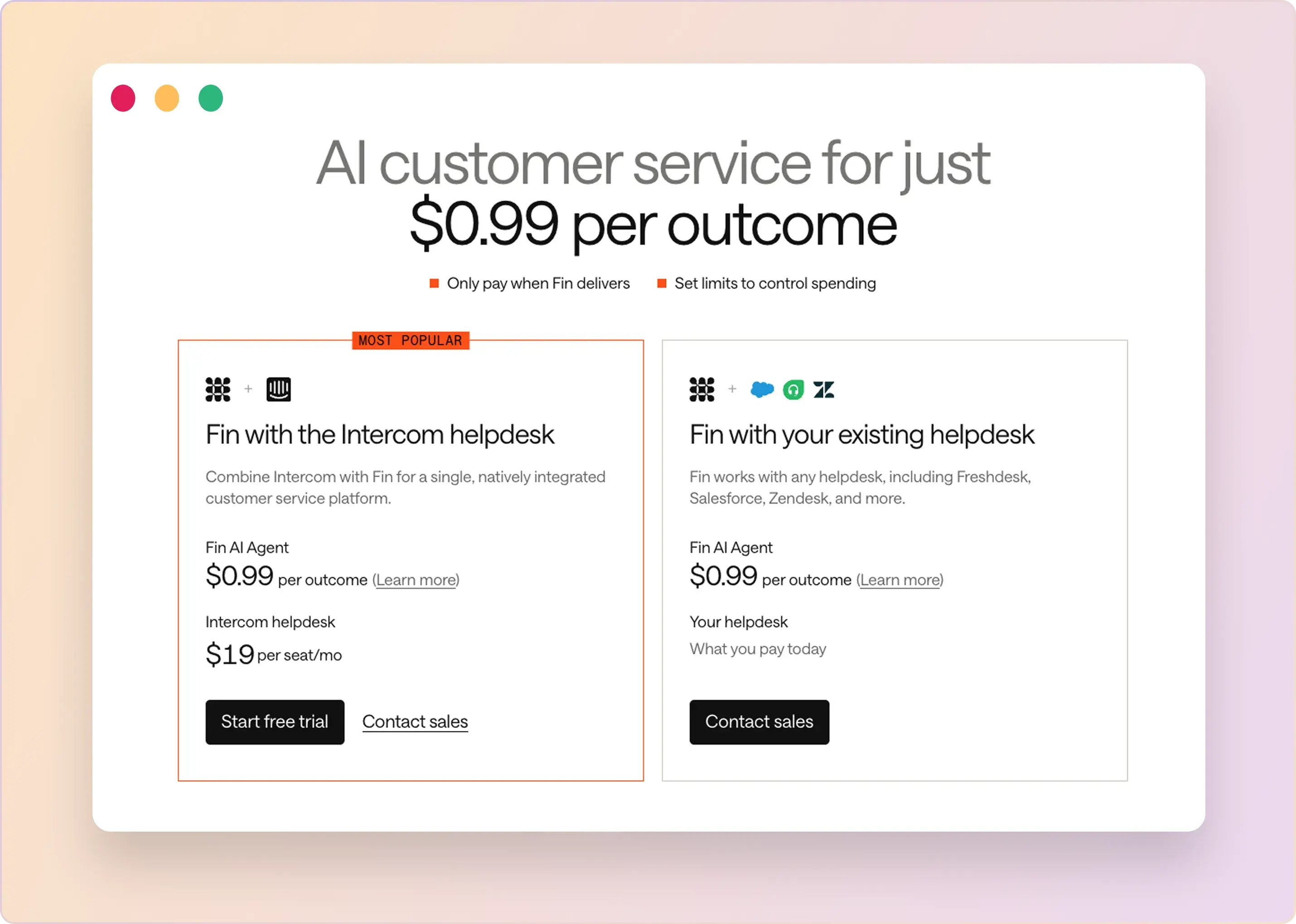
Fin charges $0.99 for every standard support outcome over chat or email. Sounds simple enough, right? Except paying for an outcome doesn’t always mean the customer’s problem is actually solved.

Some customers confirm Fin helped. Others leave without confirming. And some paid outcomes involve a handoff to a human agent who still needs to finish the work.

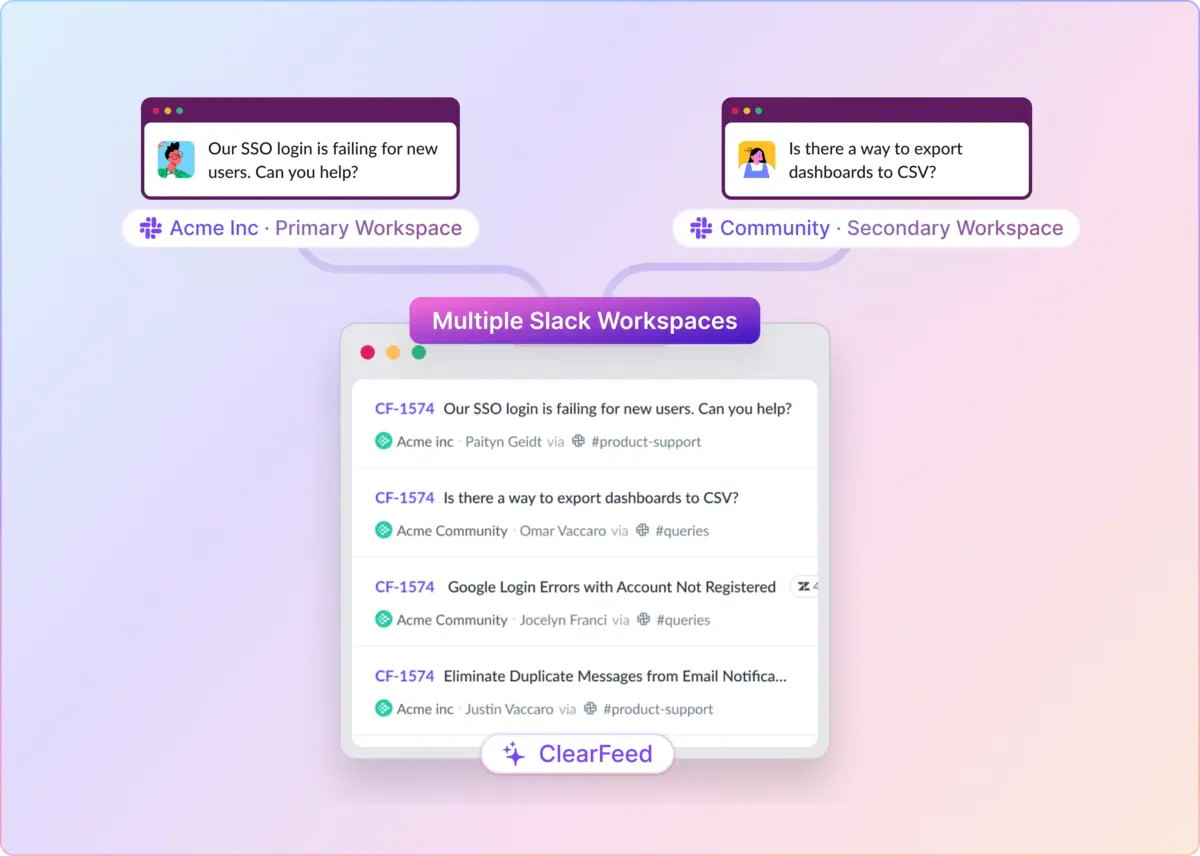
At ClearFeed, we hear about this challenge from B2B support teams. A customer asks for help in Slack, gets an initial response, but the request still needs another team to resolve. The question is no longer just whether someone replied, but who owns the request through resolution.

This article examines Fin's pricing through three questions: what you pay for, what customers actually get, and what work remains for your team.

Our analysis draws on Intercom's published pricing and billing rules, G2 reviews, Reddit discussions, and conversations with B2B support teams.

‍

Fin Pricing at a Glance

What you pay for Published price What to check
Chat or email support resolution $0.99/outcome A customer can confirm the answer or leave without asking for more help.
Configured Procedure handoff $0.99/outcome Fin completes a Procedure configured to hand off to a person or workflow.
Fin with another supported helpdesk $0.99/chat or email outcome No Fin seat or platform fee; minimum commitments and your existing helpdesk costs still apply.
Intercom Essential $29/seat/month annually; $39 monthly Fin usage is additional.
Intercom Advanced $85/seat/month annually; $99 monthly Check whether you need its workflows or other features.
Intercom Expert $132/seat/month annually; $139 monthly Check the features and seats your team needs.
Fin Voice Contact sales Do not assume the chat and email rate applies.

Intercom bills at most one outcome per conversation, even if Fin takes multiple actions. Sales outcomes have different definitions and rates; a qualifying sales outcome is $9.99.

‍

The $0.99 Question: What Counts as a Resolution?

A customer asks Fin how to update their billing details. Fin explains, and the customer replies, “That helped, thanks.”

Intercom counts that as a confirmed resolution and charges $0.99.

But customers don’t always reply. Sometimes they read the answer and leave. Intercom can count that as an assumed resolution and charge $0.99 because the customer didn’t ask for more help.

The answer might have worked. Or the customer might have given up and asked their account manager on Slack. The invoice won’t tell you.

If the customer comes back to the same conversation and asks for more help, Intercom says it deducts the earlier resolution, even across billing periods. Its rule refers to the same conversation, so don’t assume it covers a new chat or a message on another channel.

There are a couple of cases where Intercom won’t count a resolution: when Fin only sends a greeting, or when it asks a follow-up question and the customer doesn’t respond.

To see whether Fin is helping, review some conversations alongside your bill. You’ll be able to look at what Fin said and, where possible, whether the customer came back with the same problem.

‍

A Handoff Can Be a Paid Outcome Too

Let’s say a customer contacts support because their order is delayed.

You’ve set up Fin to ask for their order number, collect the details, and then pass the conversation to a support agent. Intercom calls this set of instructions a Procedure.

If Fin completes those steps and hands the conversation over as instructed, Intercom can charge you $0.99. Your agent may still need to investigate the delay and respond to the customer.

Now imagine a different situation. The customer asks Fin a question it can’t answer, so Fin passes them to a human. Or the customer asks to speak to a person. Intercom says it doesn’t charge for those ordinary escalations.

The difference comes down to why Fin handed over the conversation: it can be billable when Fin completes a Procedure you configured to end in a handoff.

‍

What Would Fin Cost Your Team Each Month?

Let’s say you have 10 support agents on Intercom’s Advanced plan. You pay annually, bringing the seat price to $85/agent/month.

During the month, Fin produces 2,000 billable support outcomes across chat and email. Here’s the starting cost:

Monthly cost Calculation Estimate
10 Advanced seats 10 Ă— $85 $850
2,000 Fin outcomes 2,000 Ă— $0.99 $1,980
Software subtotal — $2,830

That’s 2,000 billable outcomes, not 2,000 incoming conversations. Fin may take part in conversations that don’t result in a charge.

Now imagine you launch a product and support questions increase. Fin produces 4,000 billable outcomes that month. Your seat cost stays at $850, but your Fin charge rises to $3,960. Your software subtotal becomes $4,810.

That could be money well spent if Fin helps your team handle the extra demand. It’s still a good idea to budget for a busy month, not just an average one.

Account for Your Team’s Time, Too

Your team will also spend time reviewing Fin’s answers, updating help articles, and handling requests that need a person.

Suppose that work takes 20 hours a month. At an assumed employee cost of $40/hour, that represents $800 in staff time. Added to the $2,830 software subtotal, the combined estimate is $3,630 for the month with 2,000 outcomes.

That $800 isn’t an Intercom fee or necessarily an extra cash expense. It represents time your team could have spent elsewhere. Use your own estimates for the hours and employee cost.

‍

What If You Already Have a Helpdesk?

You can buy Fin for a supported existing helpdesk without buying Intercom seats. In that case, add Fin’s outcome charges to what you already pay for your helpdesk.

Intercom lists no Fin seat or platform fee for this setup, though minimum commitments apply. Ask for those terms in your quote.

These examples are estimates, not quotes. They exclude taxes, discounts, add-ons, channel charges, and implementation costs.

‍

What Do Fin Users Say About the Value?

So far, we’ve talked about the price. What do people using Fin say they get for it?

In a July 2026 G2 review, customer support professional Marianna A. said Fin gives customers quick answers and takes work off the team’s plate. That leaves agents more time for complicated interactions.

But she also described cases where Fin shared incorrect information, and the customer came back upset. In those situations, she wrote, she would prefer Fin to “just reroute immediately” rather than keep guessing.

That is the tradeoff a pilot should expose. An answer delivered in seconds can be valuable; an incorrect answer may leave an agent explaining and repairing the issue later. Marianna’s experience is one account, not a measure of how often Fin gets answers wrong.

Another reviewer, support manager Leor M., liked Fin’s natural language, workflows, and speed. But in a June 2026 G2 review, Leor also raised concerns about incorrect answers and plan changes that brought extra fees.

Both Fin users found things to like and things they wanted fixed. They suggested two useful demo questions: What happens when Fin is unsure? And what will the features we need cost after the trial?

Those questions become especially useful when you compare Fin’s pricing with another option, such as ClearFeed AI.

‍

Intercom Fin AI vs. ClearFeed AI: How Does Pricing Compare?

Fin charges for billable outcomes, such as a customer resolution. Our AI pricing includes an allowance of AI credits, with additional usage charged at tiered rates. Because outcomes and credits measure different things, your cost will depend on how your team uses each product.

Intercom Fin AI ClearFeed AI
Customer-facing AI Fin answers questions and can carry out configured Procedures. Our Virtual Agent answers supported questions using connected knowledge sources. Our AI Agents can also take actions in supported tools.
Agent assistance Copilot helps human agents; allowances and add-on terms depend on your plan. Our Agent Assistant suggests answers privately to your team; AI plan and product terms apply.
Billing unit Standard chat and email support outcomes cost $0.99 each. A completed Procedure handoff can also be billable. An AI Agent invocation to resolve a query typically consumes one credit. Multiple responses in a chat session can consume multiple credits, and complex tasks may use more than one.
AI access Fin is available on Intercom plans or with a supported external helpdesk. Minimum commitments apply to the latter. The AI Pack is an optional add-on for Starter Helpdesk and Integrations plans. It's included with Professional Helpdesk plans; Enterprise plans have custom credit allocations.
Where it fits Intercom or supported helpdesk workflows, especially chat and email. Voice pricing is separate. Slack-centered support and collaboration, including supported shared-channel workflows.
Other costs Intercom seats or your existing helpdesk, plus applicable add-ons and channel charges. Your ClearFeed Helpdesk or Integrations plan, plus applicable AI Pack and credit overage charges and any existing helpdesk costs.

‍

What Could ClearFeed’s AI Cost?

On a Starter Helpdesk or Integrations plan, you can add the AI Pack for $20/month, which includes 100 AI credits. Additional credits are billed at tiered rates based on total monthly usage. Your included credits count toward those tiers:

Credits 1–500: $2/10 credits

Credits 501–1,000: $1.50/10 credits

Credits 1,001 and above: $1/10 credits

Say your team uses 2,000 credits in a month. After the 100 included credits, the additional 1,900 would cost $255: $80 for credits 101–500, $75 for credits 501–1,000, and $100 for credits 1,001–2,000. With the $20 AI Pack, that comes to $275 in AI charges, before your ClearFeed plan and any other applicable costs.

Professional Helpdesk plans include the AI Pack, with 50 credits/agent or 100 credits/10 channels or 100 tickets on usage-based plans. Enterprise plans have a custom allocation. Unused credits don’t roll over, and subscription discounts don’t apply to credit overages.

The earlier Fin example used 2,000 billable outcomes. This example uses 2,000 AI credits, so the two figures don’t represent the same workload or results. To estimate what either product would cost your team, look at your own conversation volume, answer quality, expected usage, and full plan costs.

‍

Which AI Fits the Way Your Customers Ask for Help?

If customers mostly reach you through Intercom or another supported helpdesk, Fin is a natural product to evaluate. Its per-outcome model can be attractive when you want AI charges tied to the outcomes Intercom defines. Just make sure your pilot checks answer quality and what happens after a handoff.

If customers ask for help in shared Slack channels, consider ClearFeed. Our Virtual Agent can answer supported questions in the conversation, while our Slack triage workflow gives your team a place to track ownership and coordinate requests that need a person. Fin can hand work to humans too, and you’ll want to check whether we support every channel and integration you need. Bring your actual workflow to both demos.

‍

How To Decide if Fin Is Worth $0.99 to You

Start with a sample of your own conversations. Include routine questions, account-specific problems, requests that need an engineer, and customers who return after an initial answer. Then run a pilot long enough to review the following:

  • Useful answers: Did Fin answer the actual question accurately, using current information?
  • Repeat contact: Did the customer return in the same conversation or ask again through another channel?
  • Human work after the answer: Did an agent need to correct it, investigate, or coordinate a handoff?
  • Capacity and cost: How much agent time did the pilot free up, and did that create capacity or avoid a cost you would otherwise pay?
  • Customer experience: Could a customer reach a person when needed, and did that person have enough context to continue?

Compare those results with the actual bill, including seats, usage, and relevant add-ons. Avoid multiplying every AI outcome by an average human ticket cost and calling the result savings: a simple password question and a complicated escalation do not take the same amount of time. Freed-up time can still be valuable even if payroll does not change.

Intercom also provides usage alerts and hard limits. When a chat or email outcome limit is reached, Fin can stop and hand conversations over according to your configuration. Intercom says the limit may stop Fin slightly before or after the threshold, and a contracted minimum still applies. Make sure your team can handle the work if the limit is reached early.

‍

When Fin Makes Sense and When To Look at ClearFeed

Fin is worth evaluating if your team handles many repeat questions, has reliable knowledge content, and supports customers through Fin’s supported channels. It may also fit if you already use Intercom or a supported helpdesk and want to add an AI agent without changing platforms.

Consider ClearFeed if much of your support happens in shared Slack or Microsoft Teams channels and your team needs to track ownership and collaborate around customer requests. Check the integration and plan you need, then test the AI and handoff workflow against your support process.

For either demo, bring a straightforward question and a request that needs help from another team. Follow the second request through to the end. Who takes ownership? Who investigates? How does the customer get an update?

Then revisit the price with that workflow in mind. You’ll have a clearer picture of what the AI handles and where your team still needs to step in.

‍

Frequently Asked Questions

Is Fin Considered Good Value for Its Pricing?

Fin can be good value if it resolves a meaningful share of customer questions accurately and reduces agent workload. To assess ROI, compare your total bill with the number of issues actually resolved, answer quality, and time saved by your team.

‍

Who Is Fin’s Pricing Best Suited For?

Fin may suit teams with high volumes of repetitive questions, reliable help content, and predictable support demand. It can also benefit small businesses that need additional support capacity without expanding headcount.

Teams already using Intercom or a supported helpdesk may find it easier to adopt Fin. However, fluctuating support volumes can make per-outcome costs harder to forecast.

‍

How Much Does Fin AI Cost per Month?

Fin costs $0.99 per standard chat or email support outcome. Your monthly bill depends on the number of billable outcomes, plus any applicable subscription, add-on, and channel charges.

For example, 500 outcomes cost $495. A team with 10 Advanced seats at $85/seat/month on annual billing and 2,000 billable outcomes would pay approximately $2,830/month, excluding taxes and additional charges. Fin Voice and some sales outcomes have different pricing.

‍

Is Fin Expensive Compared to Other Customer Service Platforms?

It depends on your usage and the pricing model. Fin charges per defined outcome, while alternatives may charge per seat, conversation, AI request, or a combination.

For example, ClearFeed’s AI pricing uses credit allowances and tiered charges for additional usage. Since an AI credit and a Fin outcome measure different things, compare total costs, answer quality, and the work your team still needs to complete.

‍

Are There Discounts for Startups Using Fin AI?

Yes. Eligible startups can apply for Intercom's Early Stage program, which offers discounted pricing and includes 300 Fin outcomes per month in the first year. The included allowance decreases in subsequent years.

Eligibility depends on factors such as funding, team size, and new-customer status. Check the current program terms before applying.

‍

Is Fin Free, or Does It Offer a Free Trial?

Fin offers a 14-day free trial. According to Intercom, you can configure and test Fin before the trial begins, which starts when you set it live. Standard outcome-based billing applies afterward.

Customers enrolled in the Early Stage program do not receive the standard Fin trial while the program is active.

‍

What Are the Hidden Costs of Intercom Fin AI?

Beyond the $0.99 outcome fee, costs may include Intercom seats, an existing helpdesk subscription, add-ons, channel charges, and minimum commitments.

You should also account for maintaining help content, reviewing AI answers, and handling unresolved conversations. These activities consume team time even when Fin produces a billable outcome.

Fin charges $0.99 for every standard support outcome over chat or email. Sounds simple enough, right? Except paying for an outcome doesn’t always mean the customer’s problem is actually solved.

Some customers confirm Fin helped. Others leave without confirming. And some paid outcomes involve a handoff to a human agent who still needs to finish the work.

At ClearFeed, we hear about this challenge from B2B support teams. A customer asks for help in Slack, gets an initial response, but the request still needs another team to resolve. The question is no longer just whether someone replied, but who owns the request through resolution.

This article examines Fin's pricing through three questions: what you pay for, what customers actually get, and what work remains for your team.

Our analysis draws on Intercom's published pricing and billing rules, G2 reviews, Reddit discussions, and conversations with B2B support teams.

‍

Fin Pricing at a Glance

What you pay for Published price What to check
Chat or email support resolution $0.99/outcome A customer can confirm the answer or leave without asking for more help.
Configured Procedure handoff $0.99/outcome Fin completes a Procedure configured to hand off to a person or workflow.
Fin with another supported helpdesk $0.99/chat or email outcome No Fin seat or platform fee; minimum commitments and your existing helpdesk costs still apply.
Intercom Essential $29/seat/month annually; $39 monthly Fin usage is additional.
Intercom Advanced $85/seat/month annually; $99 monthly Check whether you need its workflows or other features.
Intercom Expert $132/seat/month annually; $139 monthly Check the features and seats your team needs.
Fin Voice Contact sales Do not assume the chat and email rate applies.

Intercom bills at most one outcome per conversation, even if Fin takes multiple actions. Sales outcomes have different definitions and rates; a qualifying sales outcome is $9.99.

‍

The $0.99 Question: What Counts as a Resolution?

A customer asks Fin how to update their billing details. Fin explains, and the customer replies, “That helped, thanks.”

Intercom counts that as a confirmed resolution and charges $0.99.

But customers don’t always reply. Sometimes they read the answer and leave. Intercom can count that as an assumed resolution and charge $0.99 because the customer didn’t ask for more help.

The answer might have worked. Or the customer might have given up and asked their account manager on Slack. The invoice won’t tell you.

If the customer comes back to the same conversation and asks for more help, Intercom says it deducts the earlier resolution, even across billing periods. Its rule refers to the same conversation, so don’t assume it covers a new chat or a message on another channel.

There are a couple of cases where Intercom won’t count a resolution: when Fin only sends a greeting, or when it asks a follow-up question and the customer doesn’t respond.

To see whether Fin is helping, review some conversations alongside your bill. You’ll be able to look at what Fin said and, where possible, whether the customer came back with the same problem.

‍

A Handoff Can Be a Paid Outcome Too

Let’s say a customer contacts support because their order is delayed.

You’ve set up Fin to ask for their order number, collect the details, and then pass the conversation to a support agent. Intercom calls this set of instructions a Procedure.

If Fin completes those steps and hands the conversation over as instructed, Intercom can charge you $0.99. Your agent may still need to investigate the delay and respond to the customer.

Now imagine a different situation. The customer asks Fin a question it can’t answer, so Fin passes them to a human. Or the customer asks to speak to a person. Intercom says it doesn’t charge for those ordinary escalations.

The difference comes down to why Fin handed over the conversation: it can be billable when Fin completes a Procedure you configured to end in a handoff.

‍

What Would Fin Cost Your Team Each Month?

Let’s say you have 10 support agents on Intercom’s Advanced plan. You pay annually, bringing the seat price to $85/agent/month.

During the month, Fin produces 2,000 billable support outcomes across chat and email. Here’s the starting cost:

Monthly cost Calculation Estimate
10 Advanced seats 10 Ă— $85 $850
2,000 Fin outcomes 2,000 Ă— $0.99 $1,980
Software subtotal — $2,830

That’s 2,000 billable outcomes, not 2,000 incoming conversations. Fin may take part in conversations that don’t result in a charge.

Now imagine you launch a product and support questions increase. Fin produces 4,000 billable outcomes that month. Your seat cost stays at $850, but your Fin charge rises to $3,960. Your software subtotal becomes $4,810.

That could be money well spent if Fin helps your team handle the extra demand. It’s still a good idea to budget for a busy month, not just an average one.

Account for Your Team’s Time, Too

Your team will also spend time reviewing Fin’s answers, updating help articles, and handling requests that need a person.

Suppose that work takes 20 hours a month. At an assumed employee cost of $40/hour, that represents $800 in staff time. Added to the $2,830 software subtotal, the combined estimate is $3,630 for the month with 2,000 outcomes.

That $800 isn’t an Intercom fee or necessarily an extra cash expense. It represents time your team could have spent elsewhere. Use your own estimates for the hours and employee cost.

‍

What If You Already Have a Helpdesk?

You can buy Fin for a supported existing helpdesk without buying Intercom seats. In that case, add Fin’s outcome charges to what you already pay for your helpdesk.

Intercom lists no Fin seat or platform fee for this setup, though minimum commitments apply. Ask for those terms in your quote.

These examples are estimates, not quotes. They exclude taxes, discounts, add-ons, channel charges, and implementation costs.

‍

What Do Fin Users Say About the Value?

So far, we’ve talked about the price. What do people using Fin say they get for it?

In a July 2026 G2 review, customer support professional Marianna A. said Fin gives customers quick answers and takes work off the team’s plate. That leaves agents more time for complicated interactions.

But she also described cases where Fin shared incorrect information, and the customer came back upset. In those situations, she wrote, she would prefer Fin to “just reroute immediately” rather than keep guessing.

That is the tradeoff a pilot should expose. An answer delivered in seconds can be valuable; an incorrect answer may leave an agent explaining and repairing the issue later. Marianna’s experience is one account, not a measure of how often Fin gets answers wrong.

Another reviewer, support manager Leor M., liked Fin’s natural language, workflows, and speed. But in a June 2026 G2 review, Leor also raised concerns about incorrect answers and plan changes that brought extra fees.

Both Fin users found things to like and things they wanted fixed. They suggested two useful demo questions: What happens when Fin is unsure? And what will the features we need cost after the trial?

Those questions become especially useful when you compare Fin’s pricing with another option, such as ClearFeed AI.

‍

Intercom Fin AI vs. ClearFeed AI: How Does Pricing Compare?

Fin charges for billable outcomes, such as a customer resolution. Our AI pricing includes an allowance of AI credits, with additional usage charged at tiered rates. Because outcomes and credits measure different things, your cost will depend on how your team uses each product.

Intercom Fin AI ClearFeed AI
Customer-facing AI Fin answers questions and can carry out configured Procedures. Our Virtual Agent answers supported questions using connected knowledge sources. Our AI Agents can also take actions in supported tools.
Agent assistance Copilot helps human agents; allowances and add-on terms depend on your plan. Our Agent Assistant suggests answers privately to your team; AI plan and product terms apply.
Billing unit Standard chat and email support outcomes cost $0.99 each. A completed Procedure handoff can also be billable. An AI Agent invocation to resolve a query typically consumes one credit. Multiple responses in a chat session can consume multiple credits, and complex tasks may use more than one.
AI access Fin is available on Intercom plans or with a supported external helpdesk. Minimum commitments apply to the latter. The AI Pack is an optional add-on for Starter Helpdesk and Integrations plans. It's included with Professional Helpdesk plans; Enterprise plans have custom credit allocations.
Where it fits Intercom or supported helpdesk workflows, especially chat and email. Voice pricing is separate. Slack-centered support and collaboration, including supported shared-channel workflows.
Other costs Intercom seats or your existing helpdesk, plus applicable add-ons and channel charges. Your ClearFeed Helpdesk or Integrations plan, plus applicable AI Pack and credit overage charges and any existing helpdesk costs.

‍

What Could ClearFeed’s AI Cost?

On a Starter Helpdesk or Integrations plan, you can add the AI Pack for $20/month, which includes 100 AI credits. Additional credits are billed at tiered rates based on total monthly usage. Your included credits count toward those tiers:

Credits 1–500: $2/10 credits

Credits 501–1,000: $1.50/10 credits

Credits 1,001 and above: $1/10 credits

Say your team uses 2,000 credits in a month. After the 100 included credits, the additional 1,900 would cost $255: $80 for credits 101–500, $75 for credits 501–1,000, and $100 for credits 1,001–2,000. With the $20 AI Pack, that comes to $275 in AI charges, before your ClearFeed plan and any other applicable costs.

Professional Helpdesk plans include the AI Pack, with 50 credits/agent or 100 credits/10 channels or 100 tickets on usage-based plans. Enterprise plans have a custom allocation. Unused credits don’t roll over, and subscription discounts don’t apply to credit overages.

The earlier Fin example used 2,000 billable outcomes. This example uses 2,000 AI credits, so the two figures don’t represent the same workload or results. To estimate what either product would cost your team, look at your own conversation volume, answer quality, expected usage, and full plan costs.

‍

Which AI Fits the Way Your Customers Ask for Help?

If customers mostly reach you through Intercom or another supported helpdesk, Fin is a natural product to evaluate. Its per-outcome model can be attractive when you want AI charges tied to the outcomes Intercom defines. Just make sure your pilot checks answer quality and what happens after a handoff.

If customers ask for help in shared Slack channels, consider ClearFeed. Our Virtual Agent can answer supported questions in the conversation, while our Slack triage workflow gives your team a place to track ownership and coordinate requests that need a person. Fin can hand work to humans too, and you’ll want to check whether we support every channel and integration you need. Bring your actual workflow to both demos.

‍

How To Decide if Fin Is Worth $0.99 to You

Start with a sample of your own conversations. Include routine questions, account-specific problems, requests that need an engineer, and customers who return after an initial answer. Then run a pilot long enough to review the following:

  • Useful answers: Did Fin answer the actual question accurately, using current information?
  • Repeat contact: Did the customer return in the same conversation or ask again through another channel?
  • Human work after the answer: Did an agent need to correct it, investigate, or coordinate a handoff?
  • Capacity and cost: How much agent time did the pilot free up, and did that create capacity or avoid a cost you would otherwise pay?
  • Customer experience: Could a customer reach a person when needed, and did that person have enough context to continue?

Compare those results with the actual bill, including seats, usage, and relevant add-ons. Avoid multiplying every AI outcome by an average human ticket cost and calling the result savings: a simple password question and a complicated escalation do not take the same amount of time. Freed-up time can still be valuable even if payroll does not change.

Intercom also provides usage alerts and hard limits. When a chat or email outcome limit is reached, Fin can stop and hand conversations over according to your configuration. Intercom says the limit may stop Fin slightly before or after the threshold, and a contracted minimum still applies. Make sure your team can handle the work if the limit is reached early.

‍

When Fin Makes Sense and When To Look at ClearFeed

Fin is worth evaluating if your team handles many repeat questions, has reliable knowledge content, and supports customers through Fin’s supported channels. It may also fit if you already use Intercom or a supported helpdesk and want to add an AI agent without changing platforms.

Consider ClearFeed if much of your support happens in shared Slack or Microsoft Teams channels and your team needs to track ownership and collaborate around customer requests. Check the integration and plan you need, then test the AI and handoff workflow against your support process.

For either demo, bring a straightforward question and a request that needs help from another team. Follow the second request through to the end. Who takes ownership? Who investigates? How does the customer get an update?

Then revisit the price with that workflow in mind. You’ll have a clearer picture of what the AI handles and where your team still needs to step in.

‍

Frequently Asked Questions

Is Fin Considered Good Value for Its Pricing?

Fin can be good value if it resolves a meaningful share of customer questions accurately and reduces agent workload. To assess ROI, compare your total bill with the number of issues actually resolved, answer quality, and time saved by your team.

‍

Who Is Fin’s Pricing Best Suited For?

Fin may suit teams with high volumes of repetitive questions, reliable help content, and predictable support demand. It can also benefit small businesses that need additional support capacity without expanding headcount.

Teams already using Intercom or a supported helpdesk may find it easier to adopt Fin. However, fluctuating support volumes can make per-outcome costs harder to forecast.

‍

How Much Does Fin AI Cost per Month?

Fin costs $0.99 per standard chat or email support outcome. Your monthly bill depends on the number of billable outcomes, plus any applicable subscription, add-on, and channel charges.

For example, 500 outcomes cost $495. A team with 10 Advanced seats at $85/seat/month on annual billing and 2,000 billable outcomes would pay approximately $2,830/month, excluding taxes and additional charges. Fin Voice and some sales outcomes have different pricing.

‍

Is Fin Expensive Compared to Other Customer Service Platforms?

It depends on your usage and the pricing model. Fin charges per defined outcome, while alternatives may charge per seat, conversation, AI request, or a combination.

For example, ClearFeed’s AI pricing uses credit allowances and tiered charges for additional usage. Since an AI credit and a Fin outcome measure different things, compare total costs, answer quality, and the work your team still needs to complete.

‍

Are There Discounts for Startups Using Fin AI?

Yes. Eligible startups can apply for Intercom's Early Stage program, which offers discounted pricing and includes 300 Fin outcomes per month in the first year. The included allowance decreases in subsequent years.

Eligibility depends on factors such as funding, team size, and new-customer status. Check the current program terms before applying.

‍

Is Fin Free, or Does It Offer a Free Trial?

Fin offers a 14-day free trial. According to Intercom, you can configure and test Fin before the trial begins, which starts when you set it live. Standard outcome-based billing applies afterward.

Customers enrolled in the Early Stage program do not receive the standard Fin trial while the program is active.

‍

What Are the Hidden Costs of Intercom Fin AI?

Beyond the $0.99 outcome fee, costs may include Intercom seats, an existing helpdesk subscription, add-ons, channel charges, and minimum commitments.

You should also account for maintaining help content, reviewing AI answers, and handling unresolved conversations. These activities consume team time even when Fin produces a billable outcome.
Related Blogs

See all Blog Posts
TOC heading
Text LinkText Link Active
Get a Free consultation with a Support Expert
Learn how fast growing companies like Teleport, Chronosphere and Acryl Data have scaled Support processes with ClearFeed
Thank you for contacting us. Our team will reach out to you shortly.
Oops! Something went wrong while submitting the form.