Table of Contents

If your support team uses Zendesk but spends most of the day in Slack, a Zendesk–Slack integration can help. It keeps requests visible without constant tab switching.
The Zendesk Slack app (also called the Zendesk Slack connector) links the two tools. Your team can work on tickets right where conversations already happen.
With the integration, you can:
- Create and manage tickets directly in Slack
- Add internal notes for teammates
- Get ticket updates in the right Slack channel
This guide shows how to connect Zendesk with Slack for notifications, ticket creation, and simple workflows.
It focuses on integrating Slack with Zendesk Support. It does not cover Zendesk Chat (live chat) or Zendesk Sell (CRM).
Let’s get started.
TL;DR
Slack-Zendesk integration helps support teams manage tickets from Slack, but the native app is basic, while ClearFeed adds deeper ticket workflows and two-way sync.
The gist
- Zendesk's native Slack app supports ticket creation, internal notes, and ticket update notifications.
- Teams can create Zendesk tickets from Slack using slash commands, message actions, or @zendesk mentions.
- ClearFeed adds full thread context capture, two-way comment sync, SLA alerts, imported Zendesk forms, CSAT sync (2-point through 5-point), Slack Connect support, and a reverse flow that pulls Zendesk-native tickets (email, Help Center, chat) into Slack.
- ClearFeed's Zendesk ticketing supports two trigger modes — Emoji (manual) or Automatic — plus AI-driven selective ticket creation via Automations for teams that want to keep some Slack chatter out of Zendesk.
- Common setup risks include noisy notifications, duplicate workflows, and unclear ticket ownership.
Does Slack Integrate With Zendesk?
Yes. With the Zendesk–Slack integration, you install the Zendesk app in your Slack workspace and add it to the channels your team uses. Once it’s set up, you can work with tickets directly in Slack. You can create tickets, add internal comments, and receive updates when new tickets arrive or important changes occur.
If you only need basic ticket creation and notifications, the Zendesk app is usually enough. But some teams need more. Things like capturing more context from Slack, using forms, or syncing conversations both ways. For those workflows, teams often use tools like ClearFeed, Zapier, or Unito.
Why Should You Connect Slack With Zendesk?
Here's a breakdown of the key reasons to connect Slack with Zendesk Support:
- Real-Time Ticket Notifications: Agents stay close to ticket updates and customer inquiries through instant notifications in Slack, so nothing slips through the cracks while your team is already working in their main communication hub.
- Faster Response Times: Agents can reply to customer support tickets and engage with customers directly from Slack, reducing the need to switch to Zendesk for each interaction. Less context-switching means quicker resolutions.
- Create Tickets Without Leaving Slack: Your team can receive ticket notifications, create new tickets, start conversations, and post internal comments and notes in Zendesk directly from Slack. This is especially useful for internal teams reporting issues on the fly.
- Better Cross-Team Collaboration: The collaborative nature of Slack enables teams to quickly discuss tickets and share insights, making it easier to resolve complex customer issues. Support agents can loop in engineers, product, or sales without leaving their workflow.
- Turn Slack Messages into Tickets: You can turn Slack messages or mentions into Zendesk tickets, ensuring no issue goes unnoticed. This is great for catching informal requests that come in through Slack channels.
- AI-powered Assistance in the Channel: Zendesk's own AI features (autoreply, article recommendations) can surface answers inside Slack via the native app, and richer AI answers grounded in your own knowledge sources are available through ClearFeed AI Agents.
- Approval Workflows in Slack: You can view and respond to approval requests in the connected Slack workspace, keeping decision-making fast without requiring stakeholders to log into Zendesk.
What Is the Best Way To Integrate Zendesk With Slack?
Method #1: Using the Zendesk Slack Connector (Official Slack Zendesk App)
The simplest way to connect Zendesk to Slack is to install the free Zendesk Slack app in the Slack workspace where your support team works. Add the app to the channels where you want to create or track tickets.
How To Create Zendesk Ticket From Slack (3 Ways)
Once the app is set up, you can create Zendesk tickets from Slack tickets in three common ways:
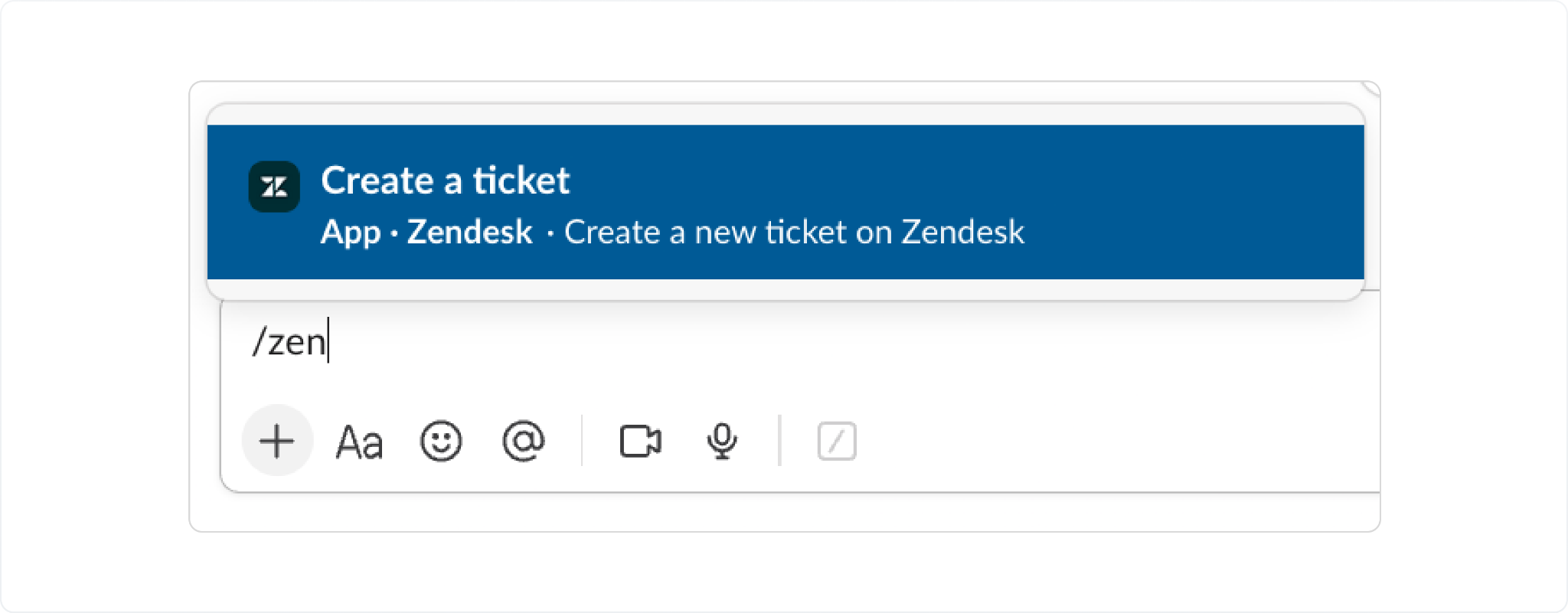
- Slash command: Use a Zendesk slash command to create a ticket
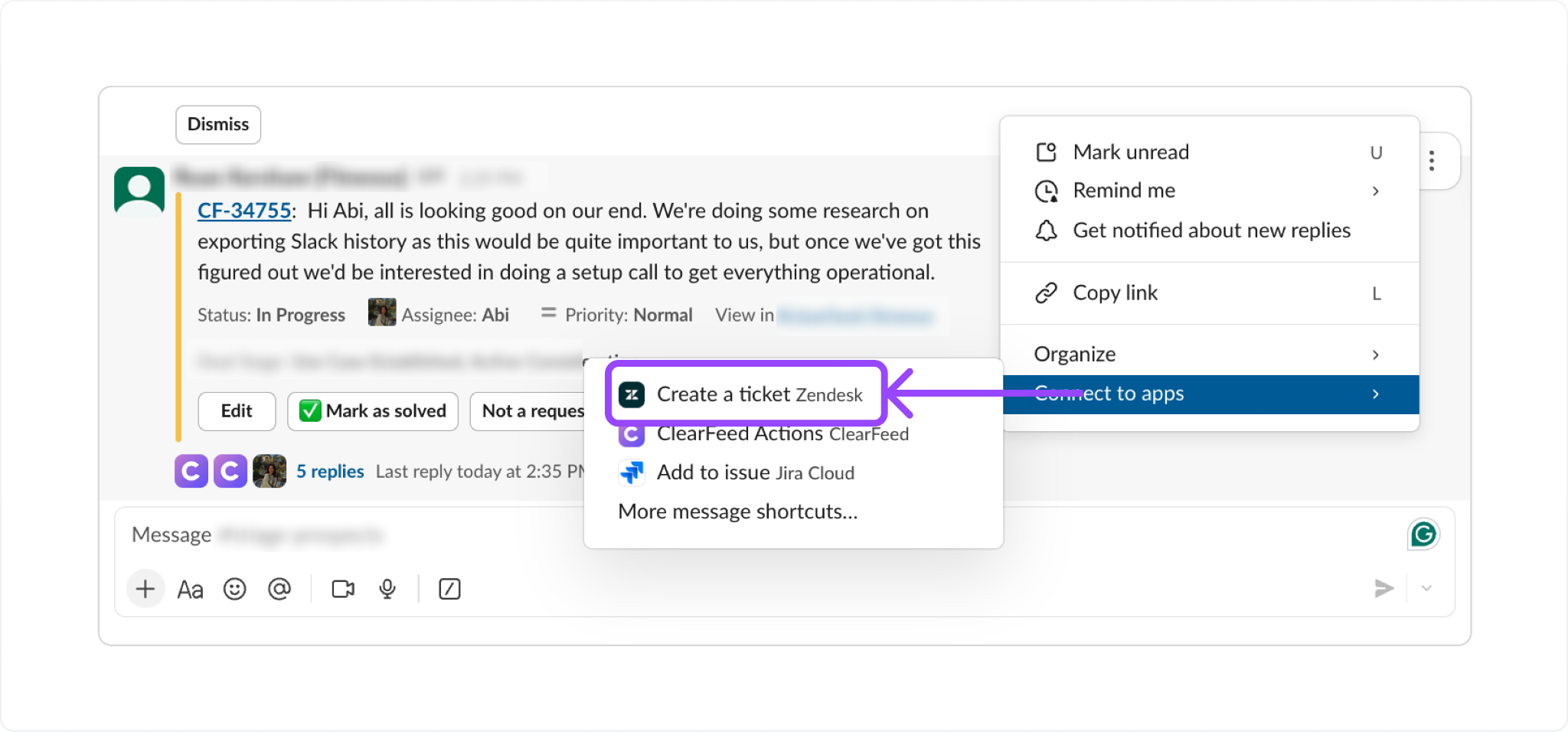
- Message actions: Convert an existing Slack message into a ticket using Slack actions
- @mention the bot: Tag @zendesk in a message to start ticket creation
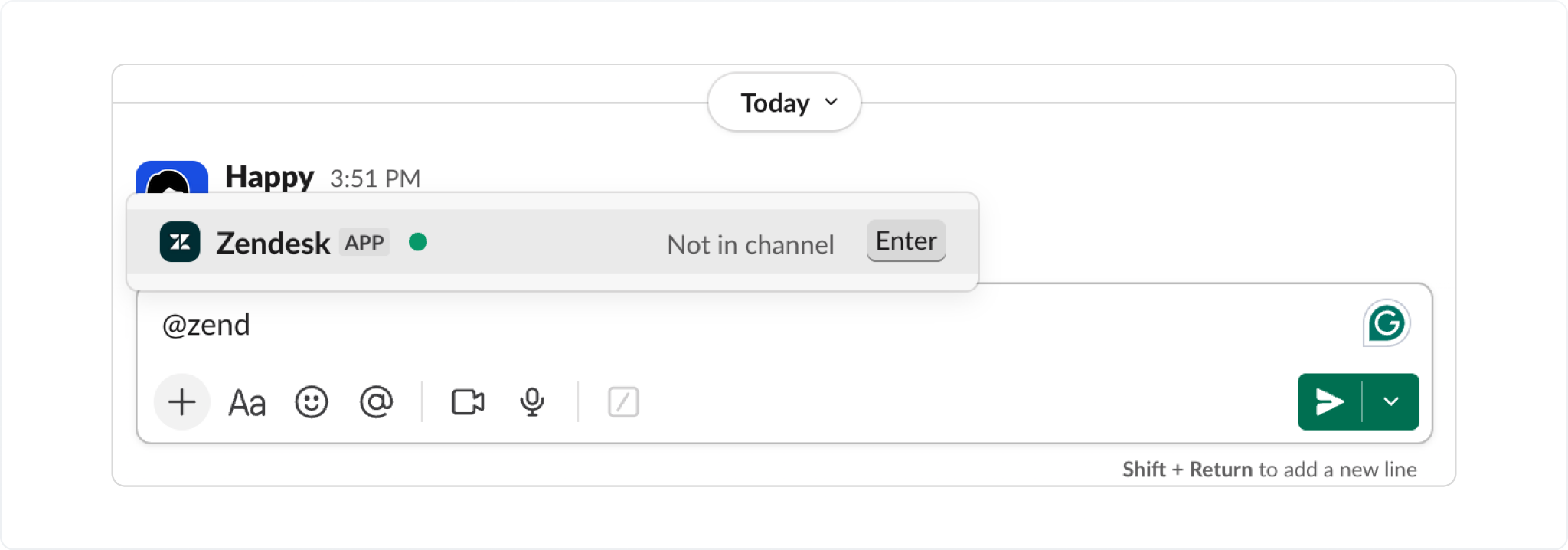
Slack Connect: In a Slack Connect channel, external users usually can’t use Zendesk slash commands or message actions. Those options only work in the workspace where the Zendesk app is installed, which is usually your agents’ workspace. There’s a simple workaround. Use the @zendesk mention method. Both agents and customers can tag @zendesk in the channel to create a ticket. This works without slash commands or extra menus.
Steps (mention method):
- Post a message in the channel and include @zendesk
- Click Create a ticket in the Zendesk bot reply
- Fill in ticket details and click Submit
Method #2: ClearFeed (When You Need More Than the Zendesk Slack Connector)
The official Slack–Zendesk app works well for basic ticket creation and notifications. But many teams want more. They want to run real ticket workflows in Slack without losing ownership, context, or follow-ups. That's where a support-grade layer helps.
ClearFeed adds that layer. It connects Slack and Zendesk, so Slack threads serve as a structured intake point, while Zendesk remains the system of record. This setup works well for support, IT, and engineering teams that live in Slack but still rely on Zendesk workflows behind the scenes.
What ClearFeed Adds to Your Slack Zendesk Integration
- Create and sync Zendesk tickets from Slack. Convert any Slack thread into a Zendesk ticket and automatically capture context — full thread history, attachments, links, and (optionally) an AI-generated description summary. ClearFeed tags each ticket with
clearfeed, the Slack channel name, and the form used, so you can filter and route them in Zendesk. - Two-way comment and status sync (configurable). Choose per collection (or per ticket) between 2-way sync, forward-only, backward-only, or no sync. Public Slack replies land as public comments in Zendesk; internal notes and message edits sync as internal notes.
- Emoji, Automatic, or AI-driven ticket creation. Pick Emoji (manual, reaction-triggered) or Automatic (every new Slack thread becomes a ticket) at the collection level. For selective automation, keep the collection on Emoji mode and use an Automation with an AI Auto-fill classifier so tickets are created only when a message matches criteria you set — for example, "reports a bug" or "reports an outage."
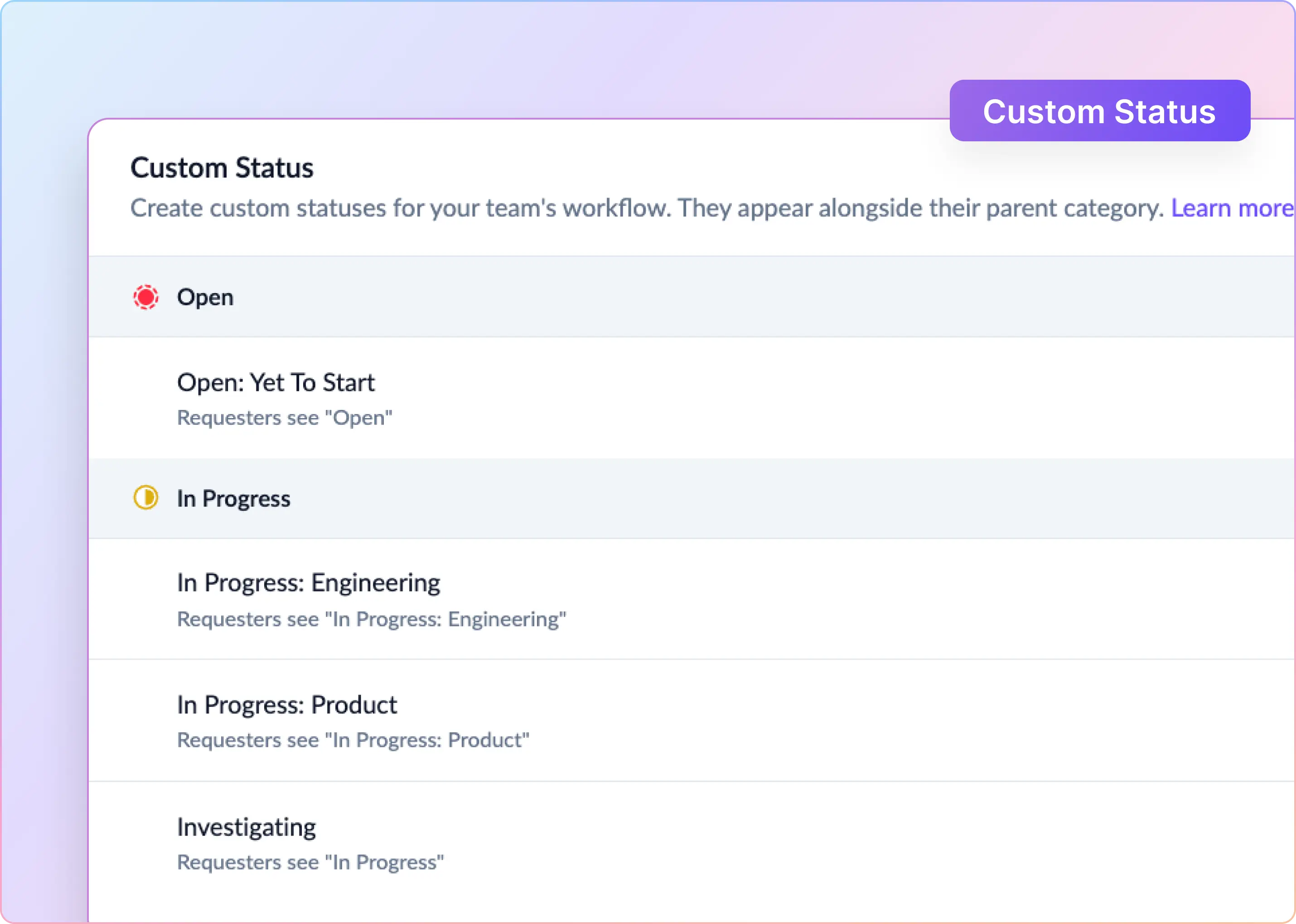
- SLA and status alerts in Slack. Get notified when tickets are updated, escalated, or moved to Solved, with support for Zendesk custom statuses.
- Auto-assignment and AI-driven status transitions. Auto-assign both the ClearFeed request and the linked Zendesk ticket to the first responder in the Slack thread. Optionally let ClearFeed move tickets to Pending on responder replies and reopen them on customer replies.
- Imported Zendesk forms. Import any active Zendesk form into ClearFeed, then map specific forms to specific Slack channels. ClearFeed keeps the fields structurally in sync with the parent Zendesk form.
- CSAT sync (2-point through 5-point). Sync ClearFeed CSAT survey responses back to the linked Zendesk ticket. The survey format in ClearFeed must match the format configured in Zendesk, and the Zendesk trigger must fire first so the CSAT record exists before ClearFeed populates it.
- Slack Connect support. Handle external customer requests in Slack Connect channels while Zendesk remains the system of record.
- Reverse Zendesk flow. Bring Zendesk tickets that started outside Slack — email, Help Center, chat — into a Slack channel via a Slack Workflow Builder webhook and a Zendesk trigger, with bi-directional sync from then on.
- Follow-up ticket on reopen. If a Zendesk ticket is closed and the linked Slack thread receives a non-responder reply, ClearFeed automatically opens a follow-up ticket in Zendesk.
Edition note. Creating tickets privately from Slack DMs, the File Ticket button, or the /cf-file shortcut requires the Internal Helpdesk or Integrations product edition. External Helpdesk accounts should contact ClearFeed Support if a DM collection is not visible.
How To Integrate Zendesk With Slack Using ClearFeed?
If you want more than the native Slack–Zendesk integration, ClearFeed helps you create Slack-to-Zendesk tickets with better context capture and two-way syncing between the Slack thread and the Zendesk ticket.
Setup (Quick Steps)
To set up ClearFeed for Zendesk ticketing in Slack:
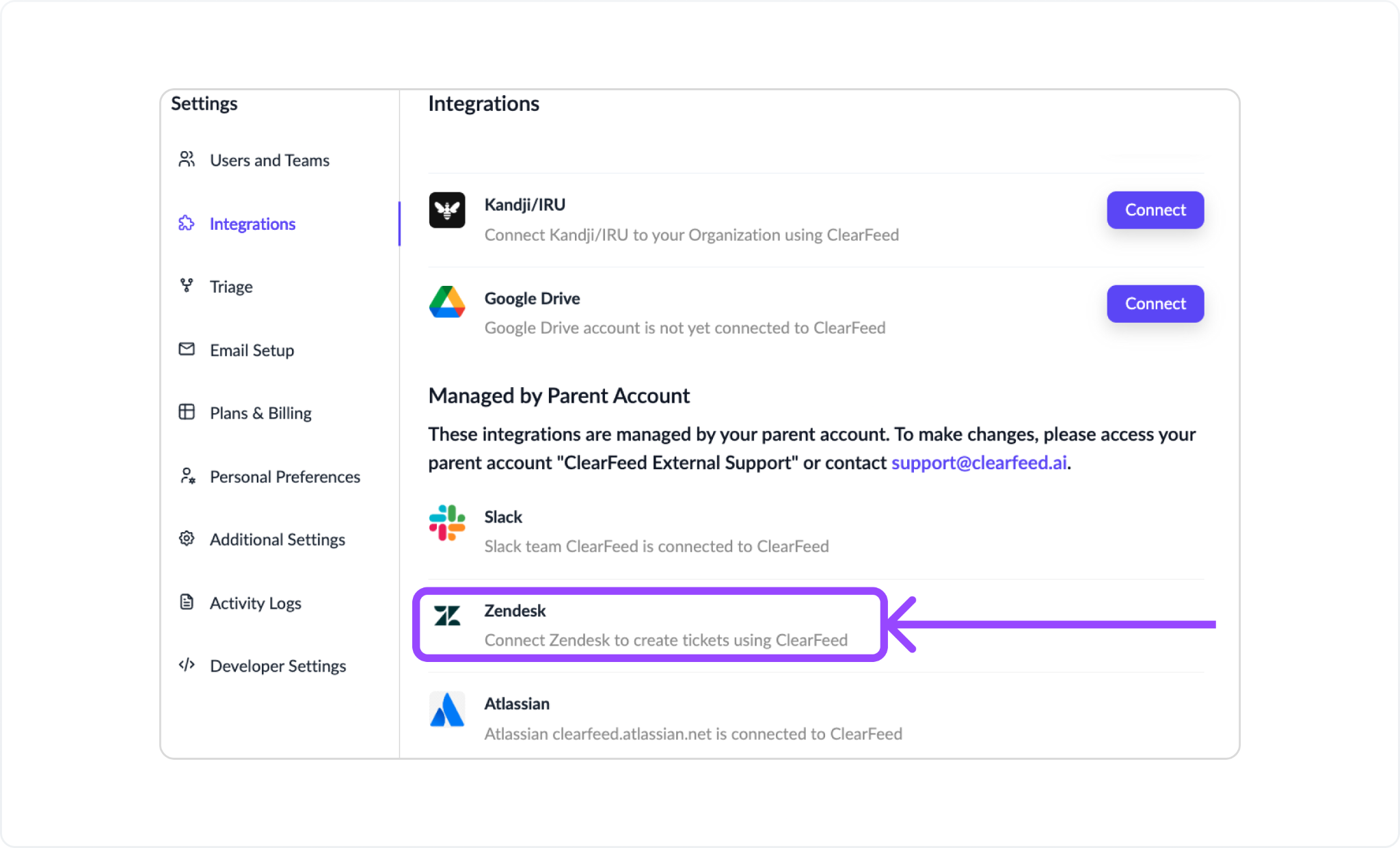
- In ClearFeed, go to Settings → Integrations and click Connect next to Zendesk. Enter your Zendesk subdomain and sign in. The integration must be authorized by a Zendesk Admin, and the same email address must exist in both Zendesk and Slack.
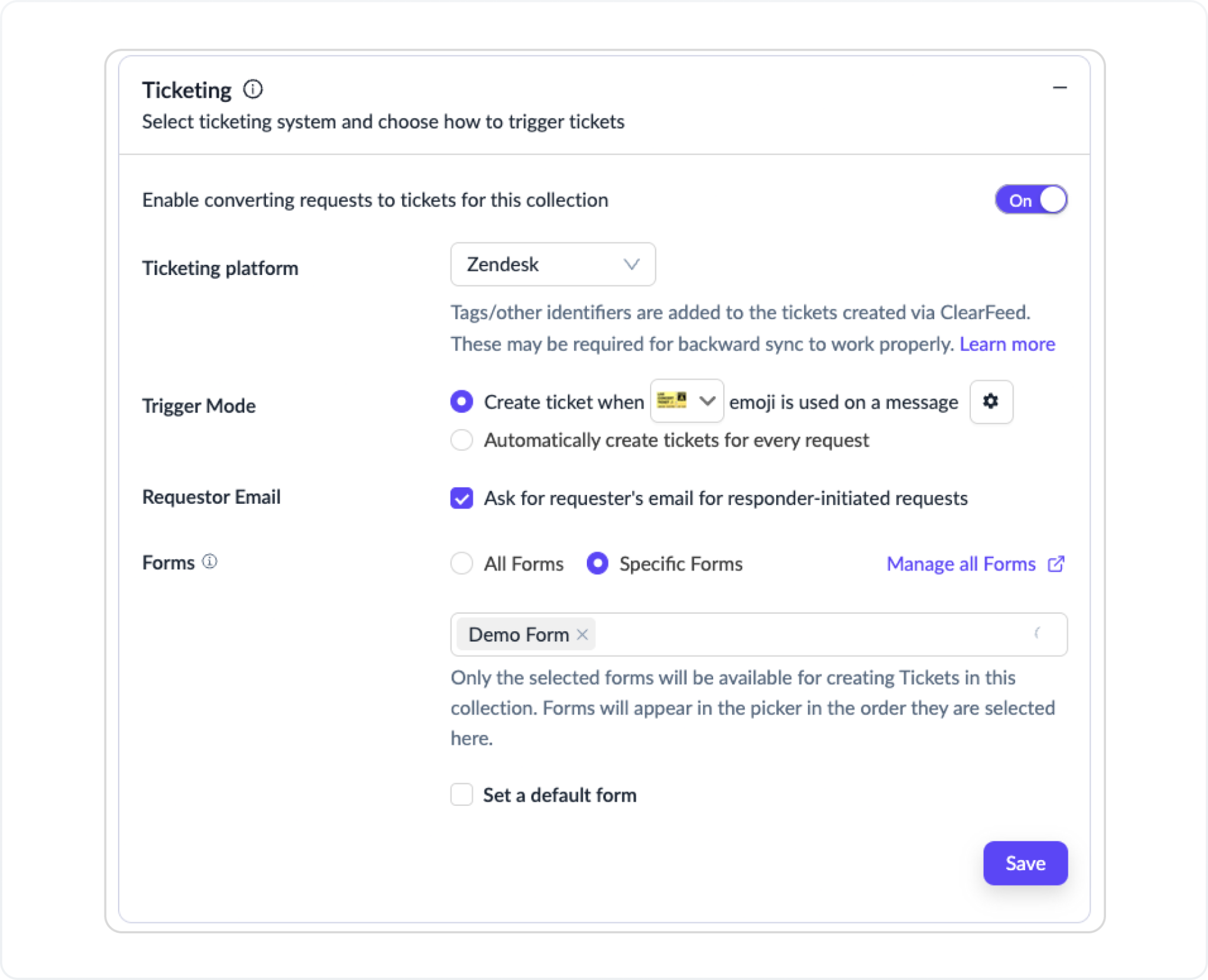
- Open the Collection where you want to enable ticketing, go to Settings → Ticketing Settings, enable the toggle, and select Zendesk as the ticketing integration.
- Choose your trigger mode: Emoji (tickets are created when a configured emoji reaction is used) or Automatic (every new Slack thread becomes a ticket). If you want AI to decide which threads become tickets, keep Emoji mode and add an Automation with an AI Auto-fill classifier — see Method 3 below.
- Optionally set up Forms to control what fields get captured at ticket creation, and configure Sync Settings — the message sync mode (2-way, forward, backward, none) and the status sync mode — to decide how comments and status updates flow between Slack and Zendesk.
How To Create a Zendesk Ticket From Slack in ClearFeed (4 Ways)
Method 1: Emoji Reaction
React to any message with the configured emoji (e.g. 🎫) to create a ticket. ClearFeed generates the ticket and displays key details — ticket number, title, and status — directly on the Slack thread. Thread messages and attachments are uploaded into Zendesk, and the thread and ticket stay in sync automatically.
Method 2: Automatic Ticket Creation
When set to Automatic mode, every new thread in a monitored Slack channel is converted into a Zendesk ticket. ClearFeed posts a message on the thread confirming the ticket details as soon as it's created — no manual trigger needed.
Method 3: Selective Ticket Creation Using AI (via Automations)
If you want AI to decide which Slack threads become Zendesk tickets — instead of ticketing every conversation — keep the collection on Emoji mode and add a ClearFeed Automation. The Automation triggers on request creation, calls an AI Auto-fill action that classifies the message (for example, into is_important: true/false), and creates a ticket only when the classifier returns your target category. This is the recommended pattern for detecting outages, bug reports, or genuine support requests in busy Slack channels while suppressing conversational noise.
Method 4: From the Triage Channel
Agents can file tickets from the Triage channel using the More Actions button on any request, then selecting File a Zendesk Ticket. This lets agents convert requests into Zendesk tickets with greater control, and the corresponding Slack thread is updated with the ticket title, ID, and status once the ticket is filed.
The Smartest Way To Run Zendesk Without Leaving Slack
Your support team works in Slack, but your tickets live in Zendesk. The native integration links them, but it breaks down when you're managing requests from multiple channels or your team has to keep switching tabs just to update a ticket.
ClearFeed connects Slack threads directly to Zendesk tickets. Your team works in Slack. Zendesk keeps the official record. You can turn a Slack message into a ticket by reacting with an emoji. Internal notes written in Slack sync to Zendesk as private comments. Email tickets from Zendesk show up in Slack, so the team can respond without leaving the app. Both systems get updated automatically.
After the initial setup, your team handles fewer administrative tasks and spends more time resolving issues.
Ready to try it? Book a ClearFeed demo or explore the Slack × Zendesk integration page.
Frequently Asked Questions
1. How Do I Use Slack With Zendesk?
Using Slack with Zendesk depends on your integration method. With the native Zendesk app, you can receive ticket notifications in Slack channels and create basic tickets using slash commands or message actions. With ClearFeed, you get more control: create tickets by reacting with an emoji, sync conversations in both directions, and manage tickets without leaving Slack. Most teams get the native app running in 5–15 minutes and a first ClearFeed Zendesk collection in 15–30 minutes; full custom workflows, forms, and reverse-flow setups take longer.
2. How Does Zendesk Ticketing in Slack Work?
When you enable Zendesk ticketing in Slack (via ClearFeed or the native app), you can convert Slack messages or threads into Zendesk tickets. The process captures the context—thread history, attachments, and participant info—and creates a ticket in Zendesk. Both systems stay synchronized: when agents reply in Slack, those updates appear in Zendesk. When someone updates the ticket in Zendesk, the Slack thread reflects those changes. This keeps everything in one place while maintaining Zendesk as your system of record.
3. What Are Slack Zendesk Integration Features?
The features available depend on your integration choice:
Native Zendesk Slack App:
- Ticket notifications in Slack channels
- Create tickets via slash commands or message actions
- Add internal notes
- Update ticket status
- Basic escalation support
ClearFeed (Enhanced Integration):
- All native features plus:
- Two-way comment sync between Slack and Zendesk, configurable per collection or per ticket
- Emoji, Automatic, or AI-driven (via Automations) ticket creation
- SLA and status alerts
- Imported Zendesk forms with channel-specific mapping and conditional fields
- CSAT survey sync from 2-point up to 5-point formats
- Slack Connect support for external collaboration
- Triage channel for request management
- Thread context capture with full conversation history
- Reverse Zendesk flow that brings email- or Help Center-originated tickets into Slack
4. How To Bridge Slack and Zendesk?
Bridging Slack and Zendesk means creating a connection where both systems work together seamlessly. Here's how:
- Install the integration - Add the Zendesk app to your Slack workspace (native) or set up ClearFeed
- Configure channels - Choose which Slack channels should connect to Zendesk
- Set up triggers - Define when and how tickets should be created (emoji reaction, automatic, AI-based, or manual)
- Enable syncing - Turn on two-way comment and status syncing if available
- Test the workflow - Create a test ticket to verify everything works
The goal is to make Slack the intake point for customer requests while keeping Zendesk as your ticketing system of record. This gives agents a single Slack-first workflow without duplicating work.
5. How To Create a Slack Zendesk Workflow?
Creating workflows between Slack and Zendesk involves setting up automated or manual processes:
With Zendesk Native App:
- Use slash commands to trigger ticket creation from Slack
- Set up message actions to convert Slack messages into tickets
- Route ticket notifications to specific channels
- Use approval workflows for certain request types
With ClearFeed (More Advanced):
- Choose your trigger mode: Emoji or Automatic, and layer an AI Auto-fill Automation if you only want to ticket certain messages.
- Map Slack channels to Zendesk ticket queues
- Set up form-based intake to standardize ticket creation
- Configure two-way sync for comment and status updates
- Use the Triage channel for request prioritization
- Create custom fields mapping between Slack and Zendesk
For best results, align your Slack workflow with your support process: define which channels create tickets, who handles triage, and how escalations work.
6. What Are the Common Pitfalls When Setting Up This Integration?
Common setup mistakes include creating too many channels (which leads to confusion), setting all ticket updates to notify Slack (which causes notification fatigue), and failing to define clear ticket creation rules (which results in duplicate or missed tickets).
Others include failing to train your team on the workflow and failing to choose the right integration for your support style. Start simple, document your workflow, and avoid automating things you don't fully understand.
7. How To Automate Zendesk and Slack?
Automation saves your support team hours each week. Here's how to automate the Slack-Zendesk connection:
- Auto-ticket creation: Set up automatic ticket creation from specific Slack channels or use AI to detect requests that need tickets
- Status syncing: Automatically update Slack threads when ticket status changes in Zendesk
- SLA alerts: Get notified in Slack when tickets approach SLA thresholds
- Comment syncing: Replies in Slack automatically post to Zendesk as public comments or internal notes
- CSAT automation: Sync customer satisfaction surveys from Zendesk back to Slack
- Escalation alerts: Automatically flag high-priority tickets in designated Slack channels
- Assignment notifications: Alert assignees in Slack when they get a new ticket
Tools like ClearFeed enable deep automation. The more you automate, the less manual work your team does, and the fewer tickets slip through the cracks.
8. How Does ClearFeed Improve on the Native Slack-Zendesk Integration?
ClearFeed adds a full support workflow layer on top of the native integration. While Zendesk's native app handles basic ticket creation and notifications, ClearFeed manages entire ticket lifecycles in Slack. Key improvements include configurable two-way syncing (updates in Slack push to Zendesk and vice versa, including message edits as internal notes), SLA alerts, imported Zendesk forms with channel-specific mapping, AI-powered selective ticket creation via Automations, triage management, Slack Connect support, CSAT sync from 2-point up to 5-point, and a reverse flow that pulls email- or Help Center-originated Zendesk tickets into Slack. ClearFeed also captures the full thread context, maintains clarity of ticket ownership, and prevents duplicate tickets.
9. How Long Does It Take To Set Up a Slack-Zendesk Integration?
The native Zendesk Slack app takes 5-15 minutes to install and configure basic channels. ClearFeed takes 15-30 minutes for initial setup plus additional time to configure custom workflows, forms, and sync rules. Zapier integrations take 20-40 minutes, depending on workflow complexity. Most teams have their first integration working within an hour and are fully optimized within a week.
10. What Are the Best Practices for Slack Zendesk Integration?
To get the most from your Slack-Zendesk integration, follow these best practices:
- Avoid notification overload - Don't send every update to Slack. Instead, configure alerts only for high-priority tickets (urgent, escalated, near the SLA threshold).
- Maintain a clear channel structure: Use dedicated channels for customer-facing requests, internal triage, and escalations. Avoid mixing contexts.
- Define ticket creation rules - Decide upfront which messages become tickets. Too many tickets from Slack clutter Zendesk; too few means requests get missed.
- Keep Zendesk as the source of truth - Slack is the intake and collaboration point, but Zendesk remains your system of record. Never create a ticket in Zendesk and only reference it in Slack without syncing.
- Use internal notes for collaboration: Reply in Slack threads for internal team discussion, but post public comments in Zendesk only when responding to customers.
- Monitor SLAs closely - Set up SLA alerts in Slack so agents know when tickets are at risk of breaching targets.
- Train your team - Make sure everyone knows how to create tickets, update status, and distinguish between internal notes and customer-facing comments.
- Review and refine regularly - Check your workflow monthly. Are tickets getting lost? Is Slack too noisy? Adjust your rules and channels as needed.
11. What Is the Best Slack Zendesk App?
The "best" app depends on your needs:
- Best for simplicity: Zendesk's native Slack app. It's free, requires minimal setup, and covers the basics (notifications, simple ticket creation).
- Best for advanced workflows: ClearFeed. It handles two-way syncing, triage management, form integration, and AI-powered ticket creation.
- Best for flexible automation: Zapier. It connects Slack and Zendesk with hundreds of conditional workflows.
- Best for enterprise: Unito or similar platforms that offer deep syncing and custom field mapping.
For most support teams starting out, the native Zendesk app is enough. As your team grows and requests become more complex, upgrade to ClearFeed or similar for richer collaboration.