Table of Contents

Customer expectations in B2B support have shifted. Teams run on Slack, but most customer service infrastructure lives in Zendesk, and connecting the two cleanly is harder than it looks.
Slack handles real-time communication well. What it lacks is ticket management, SLA tracking, and the structured workflows support teams depend on. Zendesk covers all of that, but it sits outside the conversation, forcing agents to context-switch every time they need to act.
Zendesk's native Slack integration doesn't solve this. Creating a ticket means interrupting a live conversation to trigger a shortcut, adding friction at exactly the wrong moment. Information also flows in one direction: activity in Zendesk rarely surfaces back into Slack, so conversations drift to email and lose continuity.
A stronger integration keeps agents in Slack while exposing full Zendesk workflows where the work is already happening. This piece covers the features worth prioritizing when evaluating vendors for Slack-Zendesk integration.
TL;DR
A strong Zendesk-Slack integration should let teams create, sync, manage, collaborate on, automate, and report on Zendesk tickets without breaking Slack workflows.
The gist
- Key features include easy ticket creation, two-way Slack-Zendesk sync, ticket management from Slack, and Zendesk forms inside Slack.
- Larger teams should look for support across multiple Zendesk domains from one Slack workspace.
- Good integrations need private internal collaboration, AI answers for repeated questions, Slack-specific reporting, and CSAT in Slack.
- Zendesk’s native Slack integration supports shortcuts, tagging, side conversations, notifications, and basic form fields.
- Native gaps include no emoji ticket creation, no automatic ticket creation from every Slack message, limited forms, weak AI deflection, and limited customer-message sync.
Worth knowing: ClearFeed is the fuller layer for Slack-based Zendesk support, with one-click ticket creation, full-thread upload, two-way status and comment sync, importable Zendesk forms, multi-instance support via child accounts, and GPT-powered answers grounded in your Zendesk knowledge base.
8 Important Features To Look for in a Slack Zendesk Integration
When integrating Slack and Zendesk, the following 8 features are important:
- Easy ticket creation from Slack
- Bi-directional sync between Slack and Zendesk
- Ticket management from Slack
- Use Zendesk forms from Slack
- Connect to multiple Zendesk domains from a single Slack workspace
- Collaborate with internal teams in Slack on Zendesk tickets
- Automated answers to tackle repeat queries in Slack
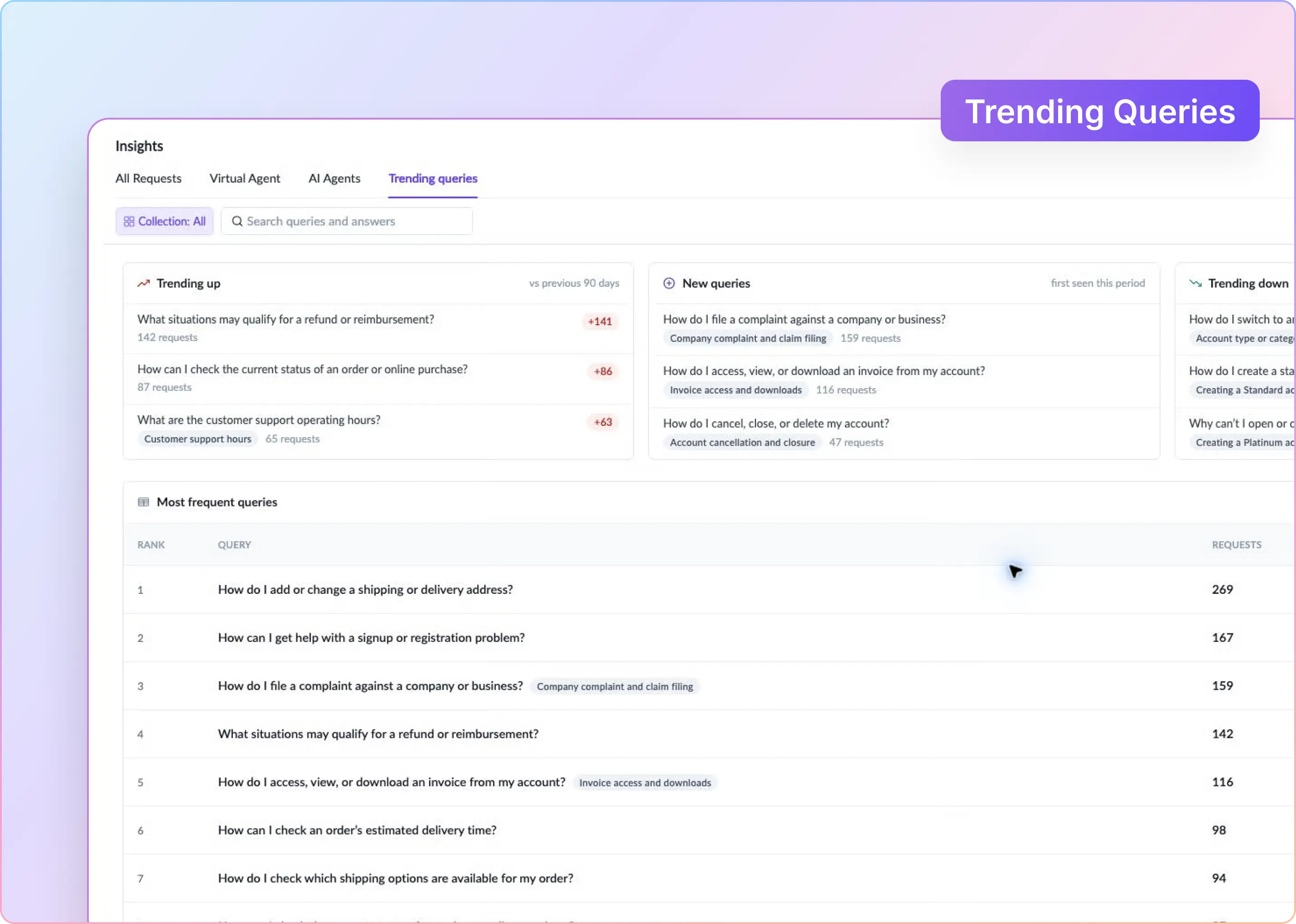
- In-depth tracking and reporting
Let's look at these features in greater detail below:
1. Easy Ticket Creation From Slack
Users and admins will want different ways to create tickets from Slack. As we described in detail on our blog on ticket creation from Slack, these methods include:
- Manual Ticket creation from channels using Emojis or tagging
- Automatic Ticket creation from channels - including using Workflow Actions
- Private Ticket creation using Slack shortcuts & private actions
- Conversion of private direct messages to Tickets using Message Actions in Slack
It is also useful when the integration provides requesters with more natural entry points within Slack, such as a slash command, a persistent “file ticket” action in the channel, or a private ticket flow for sensitive requests. These options matter because not every support conversation starts the same way: some begin in a busy customer channel, some in a DM, and some need to be filed quietly without posting a public ticket message.
2. Bi-Directional Sync Between Slack and Zendesk
Bidirectional synchronization ensures that any action taken in Zendesk (such as ticket updates, comments, attachments, status changes, or new ticket creation) is automatically and instantly reflected in Slack, and vice versa.
For instance, if a ticket is resolved in Zendesk, the Slack thread linked to that ticket is updated in real time, keeping all stakeholders informed. This feature eliminates redundant tasks, reduces the chances of oversight, and ensures a unified view of customer interactions.
Furthermore, it allows team members to work confidently from their platform of choice. Support team members who prefer using Zendesk can stay on that platform, while internal teams like Engineering, Product Support, and others can operate from Slack.
A strong integration should also allow teams to link an existing Zendesk ticket to an active Slack thread, not just create new tickets from Slack. This is especially important when a customer follows up in Slack about an issue that already exists in Zendesk, or when an agent wants to bring ticket context back into the customer conversation without duplicating work.
For mature support teams, sync control is just as important as sync itself. Depending on the workflow, teams may want full two-way syncing, Slack-to-Zendesk updates only, Zendesk-to-Slack updates only, or no message sync on a specific ticket. The same applies to status updates, where teams may want only key transitions, such as Solved or Reopened, to appear in Slack.
3. Comprehensive Ticket Management From Slack
Look for the ability to manage Zendesk tickets within Slack. This allows agents to perform various ticket management tasks within Slack - creating new tickets from Slack messages, updating existing tickets, setting priorities, and closing tickets.
The integration can also enable Slack notifications for ticket updates, ensuring that agents stay informed about ticket progress without constantly checking Zendesk. This functionality streamlines the support process, significantly reducing response times and improving overall customer satisfaction.
Day-to-day ticket management should also include lightweight Slack actions such as assigning a Zendesk ticket with an emoji, marking a ticket as solved in the Slack thread, editing ticket fields from a triage channel, and unlinking a ticket when the conversation has moved on. These small actions save agents from constantly switching tabs while still keeping Zendesk as the system of record.
Another important consideration is how the integration handles closed tickets. If a customer replies in Slack after a Zendesk ticket has already been closed, the system should preserve the original history while creating the appropriate follow-up flow in Zendesk, rather than silently reopening the wrong work item or losing the new customer reply.
The best Slack-first workflows also use context to intelligently automate status changes. For example, a meaningful customer reply can reopen a ticket, while a simple “thanks” does not need to create unnecessary work for agents. Similarly, an agent reply can move the Zendesk ticket to Pending when the conversation is awaiting the customer's response.
4. Import and Use Forms From Zendesk to Slack
The integration should allow importing and using Zendesk forms within Slack. This allows support agents to access and populate Zendesk forms without leaving Slack, ensuring that all necessary customer information is captured accurately and efficiently. Furthermore, users should be able to modify ticketing forms to include both standard and custom Zendesk fields, ensuring a streamlined ticketing process aligned with your requirements.
For example, when a customer initiates a support request in Slack, the ticketing filing flow can immediately pull up a relevant Zendesk form, so the user can fill it out in real time and submit it without switching between apps. This seamless process saves time and ensures detailed customer information is directly funneled into Zendesk for comprehensive ticket management.
For teams that rely heavily on Zendesk forms, it is worth checking whether the integration supports separate create and edit forms, required fields, hidden fields, default values, requester email fallbacks, field permissions for requesters versus responders, and form mapping by Slack collection or channel. These details determine whether forms feel native in Slack or become another source of friction.
5. Create Tickets From Multiple Zendesk Domains With a Single Slack Workspace
For businesses with multiple Zendesk domains, the integration should enable ticket management from these domains within a single Slack workspace, centralizing support across various departments.
It simplifies customer support management across different departments or product lines, ensuring a cohesive and efficient support process. This multi-domain connectivity is particularly beneficial for larger organizations or those with diverse customer support needs, as it centralizes ticket management in a familiar Slack environment.
6. Collaborate With Internal Teams on Tickets
The integration between Slack and Zendesk should enable collaboration (including private collaboration) in Slack with internal teams on tickets. This feature allows team members to rapidly come together to discuss customer issues and is crucial for fostering a secure, focused environment where teams can discuss sensitive information, strategize on complex issues, or provide specialized input without the conversation being visible in public customer support channels.
Internal collaboration is also stronger when private Slack comments can be converted into Zendesk internal notes, and when Zendesk internal comments can be returned to the support team’s Slack triage channel. This keeps the agent-side discussion complete without exposing internal reasoning to the customer-facing Slack thread.
7. Automated Answers in Slack
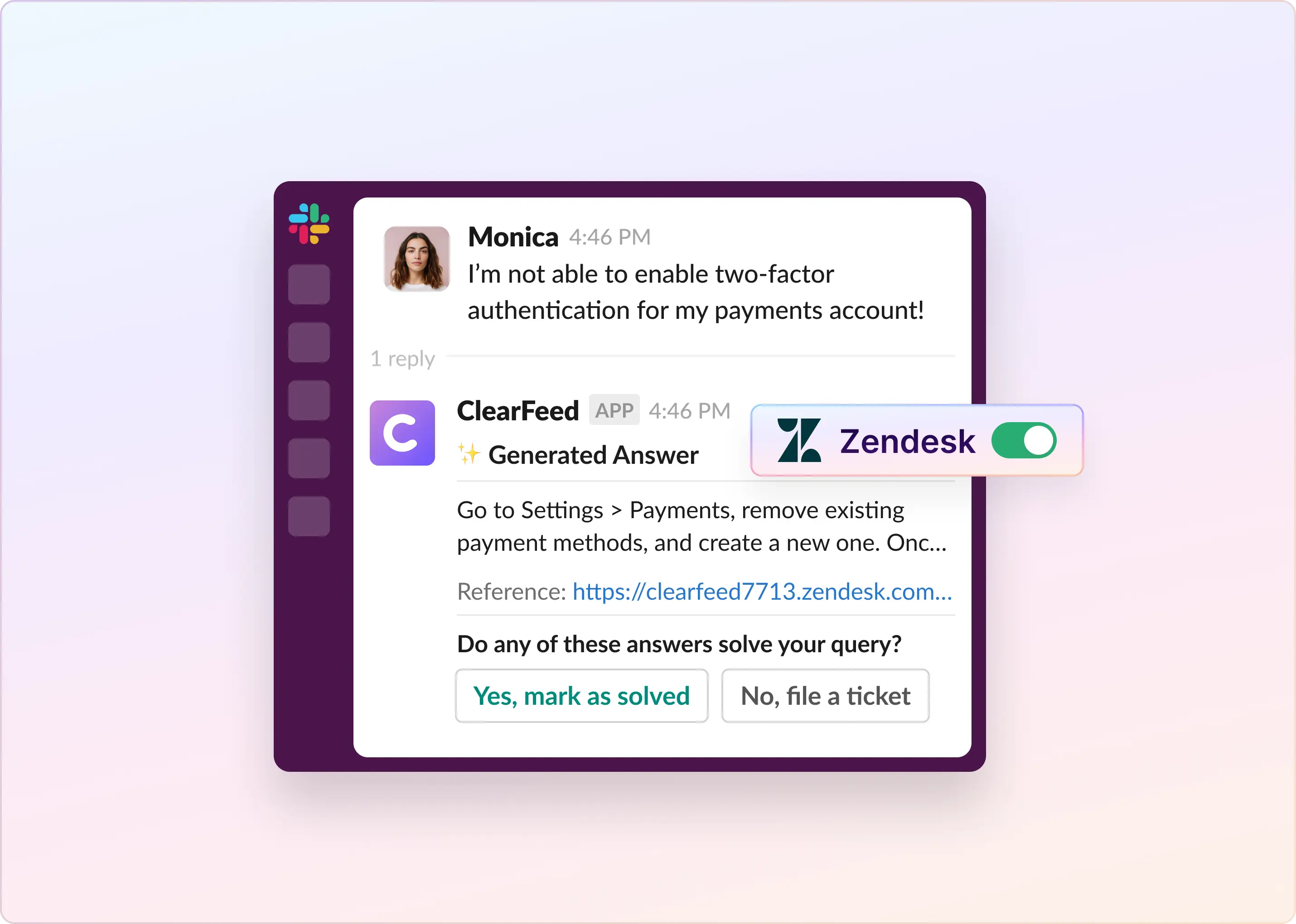
One of the challenges with Slack-based helpdesks is getting a lot of repeat queries - simply because it's so easy to raise queries. AI-powered virtual assistance can suggest responses based on existing Zendesk knowledge base, historical ticket data, or other documentation, enabling customer-facing teams to respond more quickly and accurately from Slack.
AI can also improve the ticket itself, not just the answer. For example, thread summaries can be added to the Zendesk ticket description so agents opening the ticket later do not have to reconstruct the full Slack conversation from scratch.
8. In-Depth Tracking and Reporting
Zendesk, while robust in traditional customer support metrics, falls short of providing insights tailored to Slack-based interactions. That means tracking and reporting in Slack, not just those captured in Zendesk. This, in turn, depends on accurately identifying customers and agents in Slack and accurately maintaining response times and other metrics accordingly. When customer interactions occur in Slack, CSAT surveys and other methods of gathering customer feedback should also take place there, in a manner that suits the chat interface.
The customer-facing ticket block in Slack is part of this experience, too. Teams should be able to control what customers see, such as ticket status, priority, assignee, Zendesk URL, form name, and editable form fields, while also deciding who can mark a ticket solved or unlink it from the thread.
For organizations that already measure CSAT in Zendesk, Slack-native feedback should not live in isolation. A good integration should collect feedback where the conversation happened and sync the rating back to the associated Zendesk ticket.
How Does Zendesk Evaluate for Slack-Based Support?
Over the years, Zendesk has released many features to support customers and employees on Slack. And it meets some of the critical feature requirements for a Slack-based support system. But in many other cases, it is lacking. Here's a quick synopsis of its current capabilities and weaknesses:
Pros:
- Supports a variety of ways to create tickets: via shortcuts in Slack, private "Create Ticket" actions, converting direct messages to tickets via "More Actions" in Slack, and by tagging the @zendesk app.
- Supports bidirectional conversation sync between Slack and Zendesk via Side conversations.
- Provides a highly configurable system for sending notifications to Slack based on various Slack triggers.
- Provides support for basic Form fields like Subject, Description, and Requester.
Cons:
- Cannot create tickets automatically from each Slack message. Also doesn't support emoji-based ticket creation.
- Tickets created in Slack are not bidirectionally synced with Zendesk.
- Limited forms support - custom fields and even form type selection are not supported.
- No support for AI-deflection in Slack prior to ticket creation.
- Side conversations do not allow syncing of customer messages or replying directly to customers from Slack.
In addition, managing a large number of customer Slack channels presents challenges that are completely beyond the scope of Zendesk's Slack Integration. Users looking for a more fully functional ticketing and support solution in Slack, while using Zendesk as their ticketing system, should consider third-party solutions like ClearFeed to fill this gap.
How To Use ClearFeed To Enhance Slack-Zendesk Integration for Slack-Based Support
At ClearFeed, we specialize in helping companies run Slack-based helpdesks. While you can use ClearFeed to run a full omnichannel helpdesk in Slack, we have also built a robust, comprehensive Slack-Zendesk integration that brings the utility and power of Zendesk ticketing to your Slack workspace. Here's how this works:
Single-click Zendesk ticket creation
Create tickets by reacting with the ticket emoji, or turn on Automatic mode so every new Slack thread in a monitored channel becomes a Zendesk ticket. Either way, the full Slack thread—messages and attachments—is uploaded to the ticket, and the description can include an AI-generated summary of the conversation.
ClearFeed also supports ticket creation from the Triage Channel's More Actions menu, the /cf-file shortcut, the Message Bar in monitored channels, and Slack Message Actions. Private ticket flows via DMs, the File Ticket button, or shortcuts require a DM Collection, which is available on the Internal Helpdesk and Integrations product editions.
Bidirectional syncing of status and comments
Replies in Slack sync to Zendesk, and Zendesk comments—including internal comments—sync back into the Slack thread in real time. Attachments posted on either side are transferred to the other, and Slack message edits appear in Zendesk as internal notes so agents can see what was corrected.
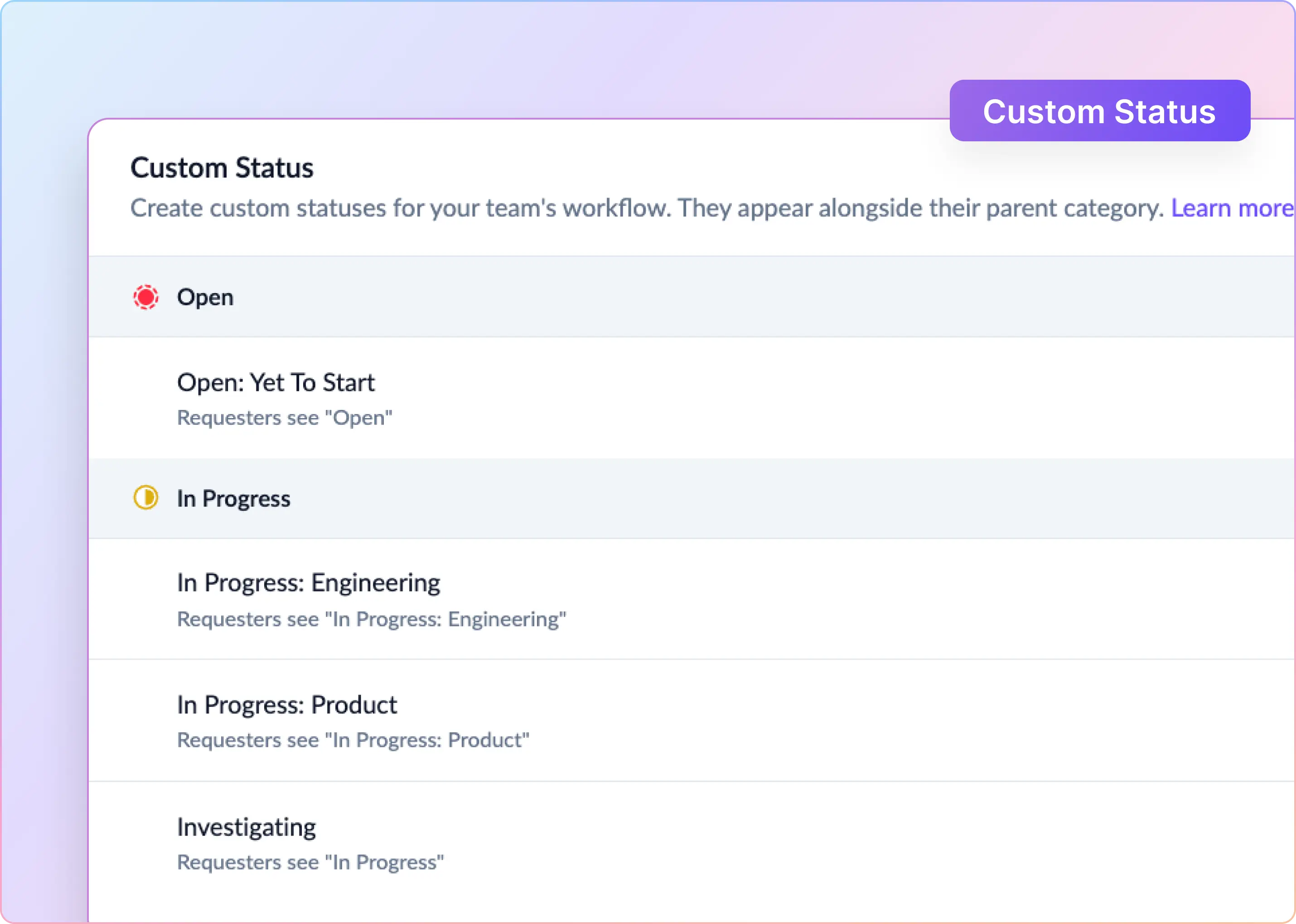
Teams can link an existing Zendesk ticket to a Slack thread, pick a Message Sync Mode (two-way, Slack to Zendesk only, Zendesk to Slack only, or no sync) at the global or per-ticket level, and choose whether to sync key status changes—Solved and reopened—into the thread. Zendesk custom statuses are supported. To stop syncing entirely, add the cf-disabled tag to the ticket in Zendesk.
When a Zendesk ticket is closed, and a customer replies again in Slack, ClearFeed opens a Follow-up ticket in Zendesk instead of silently reopening the wrong work item. New tickets are also tagged with the Slack channel name, a ClearFeed tag, and the name of the form used, so Zendesk triggers and reporting can key off ClearFeed-created tickets.
Respond to customers from both Slack and Zendesk simultaneously
Internal teams can keep responding to customers in Slack and hold private discussions in the Triage Channel, while Zendesk-based agents work the same ticket from Zendesk. ClearFeed posts comments under the author's own Zendesk identity when Zendesk permits it, and only falls back to posting as the integrator (prefixed with "Sent by…") when the author's Zendesk role cannot author that comment, for example, a Light Agent posting a public reply.
Ticket management from Slack
Track, edit, and close Zendesk tickets from the Triage Channel or the request thread. The customer-facing ticket block is configurable—show or hide Status, Priority, Assignee, URL, Form name, and Create/Edit form fields, and set Mark as Solved and Unlink Ticket permissions to All or Responder. If Zendesk requires custom fields before a ticket can be marked as Solved, ClearFeed displays a Solve dialog in Slack that collects those fields before closing the ticket.
Emoji rules cover assignment and resolution: reacting with 👀 assigns the Zendesk ticket to the responder, and reacting with ✅ moves it to Done. Emoji rules apply when a responder reacts on the request in the Request Channel.
Auto-assignment on Zendesk aligned with Slack
When a Slack request is auto-assigned to an agent by ClearFeed's assignment rules, the linked Zendesk ticket is also assigned to that agent. ClearFeed can also use conversation context to update Zendesk status intelligently—reopening tickets in response to meaningful customer replies, ignoring simple thank-yous, and moving a ticket to Pending when a responder's reply is awaiting the customer.
Import existing Zendesk forms to Slack
Import active Zendesk forms into ClearFeed—including default fields and custom fields—and create or edit Zendesk tickets from Slack using the same structure. ClearFeed supports separate Create and Edit forms, required and hidden fields, default values, requester email handling with per-user "remember" and Slack User ID fallback, responder-only fields, one-level conditional fields, form-to-collection mapping, and automatic sync when fields are added or removed on the parent Zendesk form.
Field types supported for creation and editing include Text, Multi-line Text, Drop-down, Multi-select, Checkbox, Integer and Decimal numbers, Date, Date & Time, Email, Phone Number, Tags, and Attachments (per-file cap of 50 MB and 750 MB total; oversized files have their URLs appended to the description).
GPT-powered automated answers
Index your Zendesk knowledge base as a Knowledge Source in ClearFeed and let ClearFeed's AI Agents generate grounded answers directly in Slack for common questions before a ticket is filed. Knowledge Sources auto-reindex daily when enabled, and you can trigger a manual reindex from the Knowledge Sources page. AI Agent usage is billed via the AI Pack.
Multiple Zendesk instances on one Slack workspace
Each ClearFeed account connects to a single Zendesk domain. To serve multiple Zendesk instances from the same Slack workspace, create a child account under your parent ClearFeed account and connect the additional Zendesk domain there—child accounts share the same Slack workspace and can share other integrations with the parent while keeping Zendesk connections separate.
Reverse Zendesk flow for tickets that start outside Slack
If tickets are created in Zendesk from email, the Help Center, or another channel, ClearFeed's reverse Zendesk flow brings them into a monitored Slack channel via a Slack Workflow webhook and a Zendesk trigger. Once the ticket appears in Slack, ClearFeed enables the same two-way comment and status sync, and agents can edit ticket properties from the Triage Channel. If a Zendesk form was used, you can import that form to display its values in Slack.
Slack-native CSAT synced back to Zendesk
Collect Slack-native CSAT in either 5-point emoji or 2-point thumbs format directly in the request thread, and sync ratings back to the linked Zendesk ticket so both systems report the same score. Configure the ClearFeed survey format to match the Zendesk survey (2-point or 5-point), enable "Sync CSAT responses to Zendesk," and let Zendesk fire its CSAT trigger first so ClearFeed can populate the resulting Zendesk CSAT record.
Wrapping Up
ClearFeed simplifies Slack and Zendesk integration, offering a straightforward process to help you get started quickly. Check out this step-by-step guide to seamlessly integrate Slack and Zendesk using ClearFeed. If you are interested in learning more about how to leverage ClearFeed's Zendesk-Slack integration and provide Slack-based support for your business, you can reach out to us at support@clearfeed.ai or book a demo with our support specialists.