Zendesk Side Conversations lets an agent branch off a separate discussion — via email, Microsoft Teams, or Slack — from inside a ticket. The Slack option is the one most support teams reach for: an agent working a Zendesk ticket pings a Slack channel (say, #engineering-escalations) or a specific teammate, without cluttering the customer-facing conversation on the ticket itself. This guide walks through the full setup, how to actually start a Slack side conversation, and the workflow gaps most teams hit once they start using it seriously.
Please note that Side Conversations aren’t available on every Zendesk plan. The feature is included with Zendesk Suite Professional, Enterprise, and Enterprise Plus. It is not part of the standalone Support plans.
Before you rebuild your Slack workflow around this: Zendesk Side Conversations is designed for agents whose day starts in Zendesk and who occasionally need to pull Slack in. If your team already lives in Slack — customer Slack Connect channels, an internal IT / HR / Ops help channel, DMs to a support bot — the Zendesk-out-to-Slack direction inverts the way your team already works. In that case, skip to where ClearFeed fits before you invest a lot of setup effort.
What you’ll set up in this guide
- Install and configure the Zendesk Slack integration in Admin Center.
- Turn on Side Conversations as an agent tool in the Zendesk workspace.
- Open a ticket and create a Slack side conversation to a channel or user.
- Understand what happens on both sides once you hit Send.
Zendesk keeps the authoritative version of each screen in its own Help Center. Label names and menu paths shift over time — use Zendesk’s docs as the source of truth if any of the labels below have moved.
Prerequisites
- A Zendesk account on Suite Professional, Enterprise, or Enterprise Plus.
- Zendesk Admin permissions to enable the Slack integration and turn on the Side Conversations agent tool.
- Slack workspace admin permission to install the Zendesk Slack app.
- The Slack channels or Slack users you plan to reach from side conversations should already exist. The Zendesk Slack app must be invited into any private channel you want to target.
Step 1: Install and configure the Zendesk Slack integration
If your workspace doesn’t already have the Zendesk Slack app installed, do this first — Side Conversations to Slack won’t appear as an option until the integration is connected. Follow this guide to add the Zendesk app to your Slack workspace.
Step 2: Enable the Side Conversations agent tool in your workspace
Slack availability alone isn’t enough — the Side Conversations pane also has to be turned on in the agent workspace so it actually appears above tickets.
- In the Admin Center, open Workspaces → Agent tools (Zendesk labels this area as “Workspaces” on some plans).
- Open the Side conversations settings.
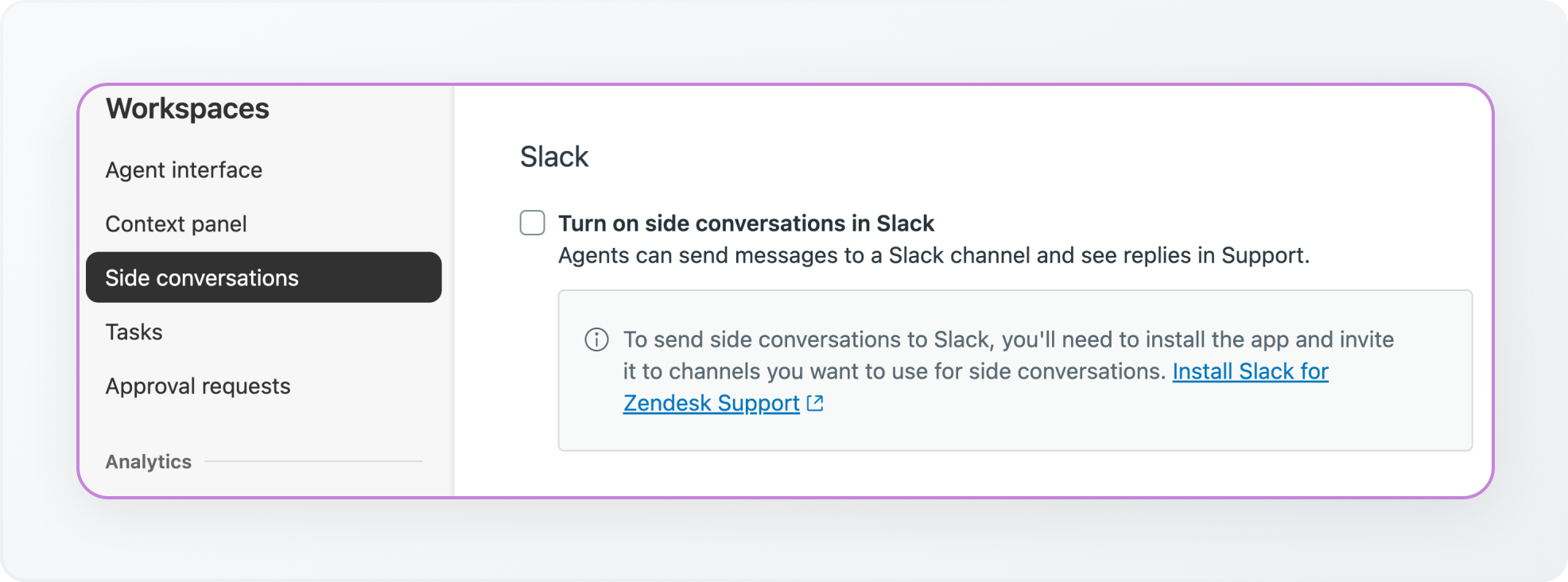
- Toggle Side Conversations on and save the settings.
Some Zendesk plans expose per-workspace controls; others expose the toggle account-wide. Either way, the toggle is what surfaces the Side Conversations tab on the ticket view.
Step 3: Create a Slack side conversation from a ticket
- Open any ticket in the Agent Workspace.
- In the right navigation bar of the ticket, click Side Conversations.
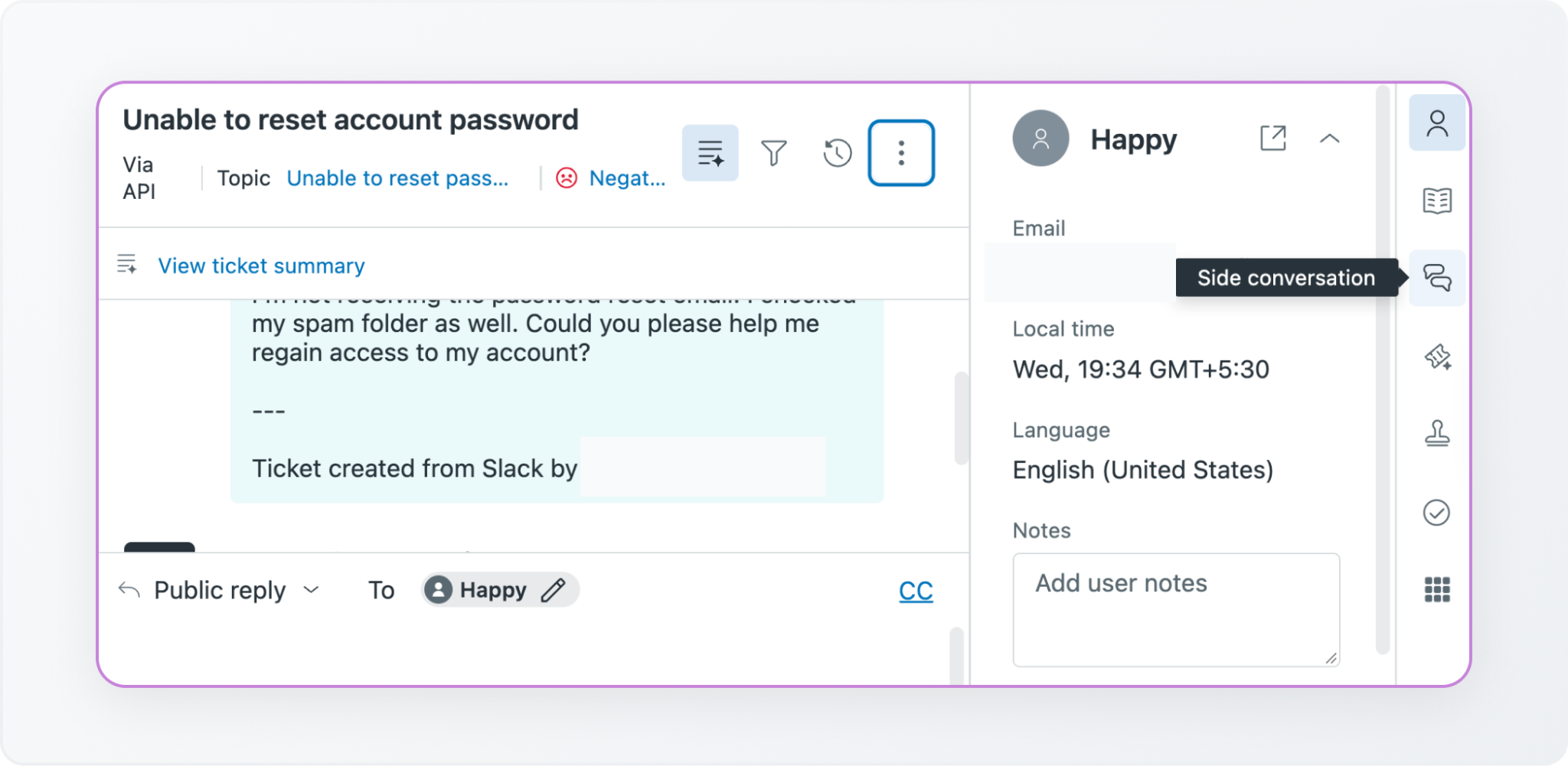
- Click the + button to start a new conversation.
- Type your message. You can reference the ticket, paste the requester’s original problem, ask a specific question, or add an attachment.
- Click Send.
Your teammates in that Slack channel or DM see the message appear as a normal Slack post and can reply in-thread — they don’t need a Zendesk seat to participate.
What happens after you hit Send
- The side conversation is pinned to the ticket in Zendesk as its own thread. Replies from Slack land back inside that side-conversation card.
- The main ticket conversation (public replies to the requester) stays untouched. Nothing typed inside the side conversation is visible to the customer.
- The agent can mark the side conversation as Open, Pending, or Closed to track whether the collaborator still owes a reply.
- Zendesk does not, by default, cross-post ticket status changes or comments from the main ticket into the Slack thread. Slack participants only see what the agent explicitly relays.
Limitations to know before you scale this workflow
Side Conversations solves a narrow problem well: a one-off Slack question from an agent to a collaborator, kept attached to the ticket. It starts to strain in the workflows most B2B support teams actually run:
- Non-agent visibility. The Slack participants (engineering, product, an account owner) only see what the agent typed into the side conversation. They don’t see the ticket status, new customer replies, or SLA state — so they often ping the agent for an update the ticket already has.
- No bi-directional ticket sync. Comments added to the Zendesk ticket — public or internal — don’t automatically flow back to the Slack thread. If engineering asks “did the customer come back?” the agent has to relay by hand.
- Agent-license bound. Side Conversations lives inside Zendesk. Every action — opening, replying, closing — is done by a Zendesk agent, which shapes where and how you can grow the workflow.
- Zendesk out to Slack, not Slack in to Zendesk. When the request originates in Slack (a customer Slack Connect channel, an internal help channel, or a DM to a support bot), Side Conversations doesn’t help you file that thread as a Zendesk ticket in the first place.
- Plan gate. The feature isn’t available on standalone Zendesk Support plans; teams below Suite Professional can’t use it at all.
Zendesk’s own Side Conversations documentation and our deep-dive on what Zendesk Side Conversations are both call out the last two limitations as the most common friction points.
Where ClearFeed fits alongside (or instead of) Slack Side Conversations
ClearFeed is a Slack-first conversational helpdesk that plugs into Zendesk (and other ticketing systems) as a bridge. Where Zendesk pushes a single message out to Slack, ClearFeed makes the Slack thread itself the collaboration surface for the ticket — and closes the gaps above. Here’s the mapping to the Side Conversations workflow.
Bi-directional Slack ↔ Zendesk sync on the ticket, not a card
ClearFeed keeps a Slack thread and its linked Zendesk ticket in sync both ways. Replies typed in Slack post to the Zendesk ticket (public replies as comments, private ones as internal notes when configured). Comments and status changes on the Zendesk side — including custom Zendesk statuses — surface back in the Slack thread. Sync mode is configurable per ticket: two-way, Slack-to-Zendesk only, Zendesk-to-Slack only, or off.
Private triage channels — the real replacement for “side conversations”
Every ClearFeed request can have a paired private triage channel in Slack where responders discuss the ticket without the requester seeing it. Public triage comments sync to Zendesk as public replies; private triage comments sync as Internal Notes when configured. This is the closest analogue to Zendesk Side Conversations, with two differences: the collaborators see the full ticket context, and they can act on the ticket (edit fields, change priority, mark solved) directly from Slack.
Edit Zendesk ticket fields from Slack
Responders can update the linked Zendesk ticket — title, priority, assignee, custom fields exposed on the Edit form — from the Slack triage channel using an Edit Ticket action. They can also mark tickets solved directly from Slack; a Solve dialog captures any Zendesk-mandatory fields before the transition. Non-agent Slack participants get context without needing a Zendesk seat.
Create Zendesk tickets from Slack in the first place
If the request originates in Slack — a customer Slack Connect channel, an internal help channel, or a DM to the ClearFeed app — ClearFeed converts it into a Zendesk ticket automatically, on emoji reaction, on @ClearFeed mention, from a triage channel, via a form, or privately via DM. The Slack thread stays the working surface; the Zendesk ticket stays the record.
Reverse Zendesk Flow: work on email and Help Center tickets from Slack
Tickets that originated outside Slack — email, Zendesk Help Center, web form — can be surfaced into a designated Slack channel using a Slack webhook workflow and a Zendesk trigger. Once surfaced, ClearFeed treats them like any other request: bi-directional comment sync, agents responding from Slack, edits from the triage channel, and optional form imports so Zendesk form values render in Slack.
AI Agents and bots: reducing the need for a side conversation at all
A lot of side conversations exist because someone on the support team is asking “how does this work?” or “has anyone hit this before?” If the answer is in a Zendesk Help Center, a Notion wiki, Confluence, or a past Slack thread, an AI answer is faster than a Slack ping to a human. ClearFeed’s AI Agents cover both the customer-facing and internal-facing cases.
- Virtual Agent answers the requester in Slack (or Slack Connect) grounded in Zendesk Help Center, Notion, Confluence, Google Drive, Slack channels, Slack Canvas, GitHub, Freshdesk, Intercom, Salesforce, Atlas, site search, uploaded files, and prior ClearFeed request history. When the AI is confident, the customer never waits on an agent — and no side conversation is needed.
- Agent Assistant runs the same answer engine privately for support agents inside triage channels: summarize the thread, suggest a reply, surface similar past tickets, or draft an internal note.
- Doc Updater Agent flags questions the AI couldn’t answer confidently and suggests where docs are missing — so the next similar side conversation doesn’t need to happen.
- Insights Agent answers ad-hoc reporting questions (“how many escalations last week?”) in Slack without an agent building a Zendesk view.
- AI-driven status transitions and summarization can move a Zendesk ticket to Pending when a responder replies, re-open it on a substantive requester reply, and generate a summarized Title and Description for the Zendesk ticket when the source Slack thread is long.
Explore the ClearFeed Slack + Zendesk integration or book a 20-minute demo to see private triage channels, bi-directional sync, and AI Agents in action on a real Zendesk ticket.