Table of Contents

Zendesk and Freshdesk offer powerful tools for managing customer inquiries, support tickets, and overall communication. But which one is right for your business? While both help desk platforms have their unique strengths, they also have limitations.
In this comparison, we break down how Zendesk and Freshdesk stack up in 2026 across features, ease of use, pricing, AI, and B2B fit, and where a Slack-first alternative like ClearFeed changes the shape of the decision.
TL;DR
Zendesk suits complex enterprise support, Freshdesk favors simplicity and value, while ClearFeed serves B2B teams operating support from Slack.
The gist
- Zendesk offers stronger analytics, automation, customization, integrations, and enterprise scalability.
- Freshdesk provides quicker setup, simpler workflows, and more accessible pricing for smaller teams.
- Zendesk Suite starts at near $55 per agent monthly; Freshdesk includes a two-agent free plan.
- Both platforms charge extra for advanced AI, through per-agent add-ons or usage-based session packs.
- ClearFeed adds Slack-first triage and can operate independently or synchronize conversations with either platform.
Worth knowing: Zendesk’s complexity and cost can burden smaller teams. Freshdesk may struggle with highly customized workflows and large ticket volumes.
Key Factors To Consider When Choosing a Customer Support Solution
When selecting the right customer service platform, it's essential to consider a range of factors to ensure the solution meets your business's specific needs. Here are some key factors to keep in mind when choosing a customer service platform:
- Business Size and Scalability: Consider whether the platform can grow with your business. Small businesses need simplicity and affordability, while larger companies may require more robust features and scalability.
- User-Friendliness: Ease of use is important for quick implementation and efficient use. A user-friendly platform reduces training time and helps support teams work more effectively.
- Features and Functionality: Look for essential features like ticket management, automation, live chat, and reporting. Choose a platform that meets your specific customer service needs.
- Integration Capabilities: Ensure the platform integrates well with your business's tools, such as CRM systems or social media, to streamline workflows.
- Pricing: Compare the platform's pricing with its features. Ensure it fits your budget while providing good value for your business needs.
- Channel Coverage: Check where your customers actually reach out — email, web chat, portal, phone, Slack Connect, or Microsoft Teams — and whether the platform treats those channels as first-class or as bolt-ons.
- AI Depth: Look past marketing labels. Compare what the AI actually does — deflect questions, draft replies, take actions in connected tools, or just auto-classify — and how it is priced.
By focusing on these factors, you’ll be able to choose the platform that best supports your customer service goals.
Zendesk: Unified Customer Support Solution
What Is Zendesk?
Zendesk is a well-established customer support platform designed to help businesses manage and resolve customer inquiries. Known for its comprehensive feature set, Zendesk provides tools that help companies streamline customer service operations across multiple channels.
Key Features of Zendesk:
- Ticketing and Multi-Channel Support: Centralizes customer inquiries across channels on a single dashboard. This unified ticketing system allows support agents to manage and prioritize tickets while allowing customers to reach out through their preferred communication channels.
- Live Chat: Zendesk Live Chat enables real-time assistance for customers visiting your website, providing immediate support and enhancing the customer experience.
- Help Center: Offers a self-service knowledge base where customers can find articles, guides, and FAQs, allowing them to solve issues independently.
- AI and Automations: Zendesk includes AI agents, ticket automations, and macros to handle repetitive requests such as auto-triage, assignment, and follow-ups. Higher tiers add Copilot for admin and agent assistance, generative replies, and intelligent triage.
- Analytics and Reporting: Zendesk’s Explore tool provides deep insights into customer interactions and team performance, helping businesses make data-driven decisions for continual improvement.
Pricing Plan
Zendesk offers various pricing plans based on features and user requirements:
- Support Team: Starts at $19 per agent per month when billed annually.
- Suite Team: Starts at around $55 per agent/month (billed annually).
- Suite Professional: Starts at around $115 per agent/month (billed annually).
- Suite Enterprise: Custom pricing — Zendesk directs enterprise buyers to sales for a quote and lists the Copilot add-on separately at around $50 per agent per month, billed annually.
Please note that the pricing outlined above serves as a general guide. Actual costs may vary depending on agents, promotions, or specific agreements.
Who Uses Zendesk?
Zendesk is particularly popular among large enterprises and businesses with extensive customer service operations. Its scalability and extensive feature set make it a good fit for companies with high volumes of customer inquiries and complex support workflows.
Zendesk User Ratings:
- G2: 4.3/5 with over 7,300 reviews.
- Capterra: 4.4/5 with over 4,000 reviews.
- Software Advice: 4.4/5 with over 4,079 reviews.
While Zendesk excels in many areas, its complexity and pricing can be a barrier for smaller teams or those with simpler support needs.
Freshdesk: Simplifying Customer Support Management
What Is Freshdesk?
Freshdesk is a cloud-based customer support platform designed to simplify customer service operations and boost user experience. It provides a range of powerful features that help businesses efficiently manage and resolve customer issues, all from a single platform.
Key Features of Freshdesk:
- Freddy AI: Freshdesk bundles Freddy AI Agent (with a session allowance on paid plans) for automated customer conversations, and offers Freddy AI Copilot as a paid add-on for agent-side drafting, summarization, and assistance.
- Shared Inbox – Centralize all customer conversations in one inbox, allowing agents to collaborate and resolve issues faster with shared notes and task management.
- Multilingual Support – Engage customers in their preferred language by offering multilingual conversation support, ensuring a personalized experience for a global audience.
- Ticket Dispatch & Automations – Automate ticket routing and manage workflows based on custom business rules, enabling faster response times and reducing manual workload for agents.
- Customer Portal – Customers can submit tickets, track resolutions, and access help articles without requiring direct support intervention, streamlining the self-service experience.
- Knowledge Base & Self-Service Tools – Empower customers to find solutions on their own with a comprehensive knowledge base, along with community forums, article versioning, and ticket templates for a quick support experience.
Pricing Plan
Freshdesk offers multiple pricing tiers to cater to different business sizes:
- Free Plan: Basic features for up to two agents/users
- Growth Plan: Starts at $19 per agent/month (billed annually) and includes essential features like ticket management.
- Pro Plan: Costs around $55 per agent/month (billed annually), with advanced automation and reporting tools.
- Enterprise Plan: Starts at $89 per agent/month (billed annually), offering extensive customization and dedicated support.
- Freddy AI Copilot: Available on Pro and Enterprise plans as an add-on priced around $29 per agent per month. Additional Freddy AI Agent sessions beyond the plan's included allotment are sold in packs.
The pricing mentioned above is intended as a starting point and may vary based on factors such as the number of agents, required features, and business needs.
Who Uses Freshdesk?
Freshdesk is ideal for small to mid-sized businesses, startups, and organizations with limited resources that need a straightforward yet effective support tool. Its ease of use, affordability, and flexibility make it a go-to choice for teams looking to improve customer support without unnecessary complexity.
Freshdesk User Ratings:
- G2: 4.4/5 with over 3,700 ratings.
- Software Advice: 4.5/5 from over 3,400 reviews.
- Capterra: 4.5/5, with 90% of users recommending it.
While Freshdesk excels at being user-friendly, it may lack advanced customization and scalability features needed by large enterprises with complex workflows.
Key Features Comparison: Zendesk vs. Freshdesk
Zendesk's analytics and automation are a highlight, whereas Freshdesk stands out for its quick setup and intuitive design. This comparison explores their key features, helping you determine which platform aligns best with your support needs.
Ultimately, the right choice depends on your team's specific requirements and priorities. By understanding each platform's strengths, you can make an informed decision for your customer support strategy.
Zendesk vs. Freshdesk: Common Limitations
Zendesk and Freshdesk offer powerful customer service tools, but they are not without challenges. Reviewers consistently call out a few limitations that can bite as teams scale.
Limitations of Zendesk (Based on User Reviews)
- Subscription Restrictions: Transitioning from annual to monthly subscriptions is reportedly prohibited under certain contracts, causing frustration among users.
- Slow Response Times: Support responses often take weeks or months, with unresolved issues despite repeated follow-ups.
- Export Bug: Exporting data in certain formats is unreliable and requires either an upgrade to the subscription plan or the use of third-party apps at an additional cost.
- AI paywalled behind higher tiers: Most of the newer Zendesk AI capabilities — Copilot, generative replies, intelligent triage — sit on Suite Professional and Enterprise plans plus paid add-ons, so smaller teams end up paying a premium to get to the AI features that appear in the marketing.
These limitations highlight areas where Zendesk could improve to better meet user expectations.
Limitations of Freshdesk (Based on User Reviews)
- Complex Setup for Advanced Features: Advanced features, such as automation and workflows, can be difficult to configure and may require additional training or external support.
- High Ticket Volume Issues: When ticket volumes are high, the platform may experience slower loading times, and manual reassignment of tickets can increase resolution times.
- Dependency on Other Freshworks Products: For optimal functionality (e.g., sales integration), users may need to purchase complementary Freshworks products, such as Freshsales, which can increase costs.
- AI session caps and add-ons stack up: Freddy AI Agent is bundled with a fixed session allowance, and additional sessions are sold in packs, while Freddy AI Copilot is a separate per-agent add-on — so the AI story can look inexpensive on paper but grow with usage.
Zendesk and Freshdesk are broad help desk suites. But for many B2B teams, the harder day-to-day problem is different: customers ask for help in Slack Connect, Microsoft Teams, email, portal, or web chat, while agents still need triage, ticket discipline, SLAs, routing, reporting, and AI assistance across all of those channels.
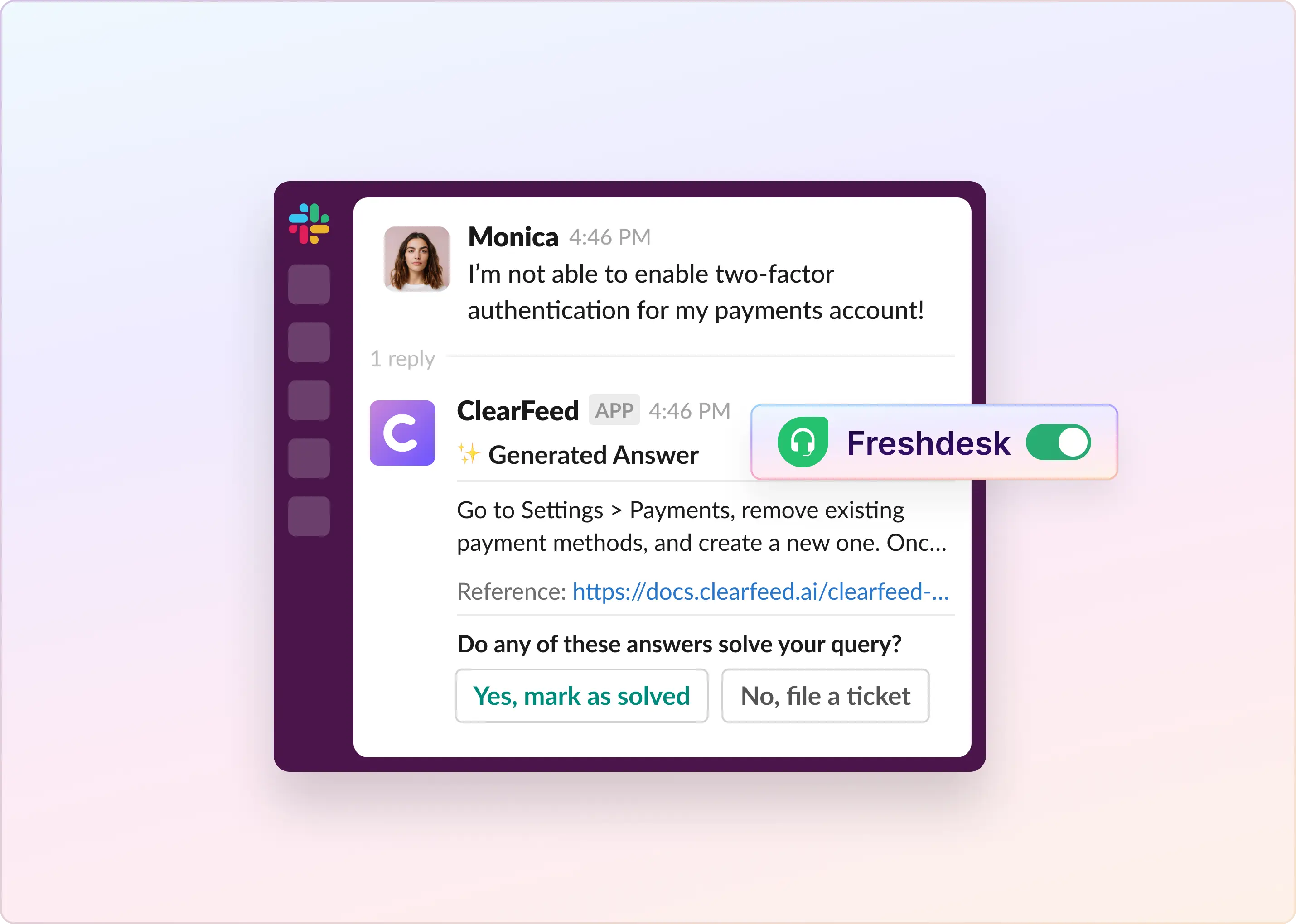
That is where ClearFeed fits differently. It can act as a standalone Slack-first helpdesk with ClearFeed tickets, or as a controlled bridge between Slack and existing systems like Zendesk and Freshdesk when you want to keep your current ticketing backend.
ClearFeed: A Slack-First Alternative to Zendesk and Freshdesk for B2B Support Teams
ClearFeed is a Slack-first conversational helpdesk and support operations platform for B2B teams that support customers and employees across Slack, Slack Connect, email, Microsoft Teams, a customer portal, web chat, and API. It gives teams a central triage layer in Slack, plus native tickets or external ticket sync, SLAs, forms, automations, AI Agents, customer context, and reporting.
What makes ClearFeed different from Zendesk and Freshdesk:
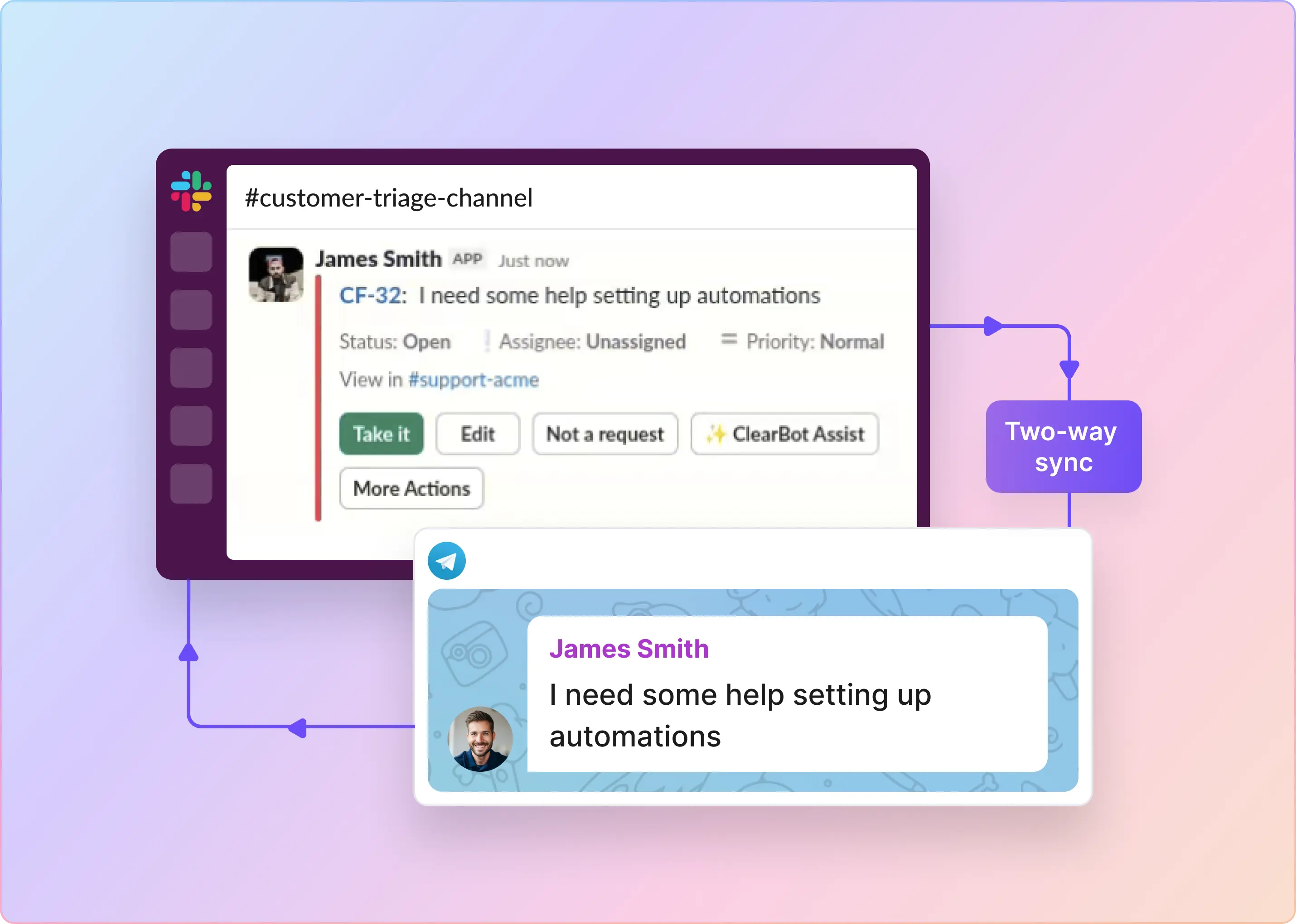
- Slack-first omnichannel triage: ClearFeed routes requests from Slack Connect, Microsoft Teams, email, portal, web chat, Discord, Telegram, and API into Slack triage channels and ClearFeed views, so agents can work from one queue without forcing requesters into a new tool. Discord collections use ClearFeed-native ticketing only, and Telegram is in beta on Professional and Enterprise plans with ClearFeed-native ticketing.
- Flexible ticketing: Teams can use ClearFeed tickets with public IDs, status tracking, forms, portal, email, and web chat, or create and link external tickets in systems such as Zendesk and Freshdesk. For those two systems specifically, ClearFeed supports configurable bidirectional sync of Slack thread replies, ticket comments, status updates, and selected private/internal notes.
- AI Agents for customers and responders: ClearFeed Answer Agents can run in public Virtual Agent mode or private Agent Assistant mode, answer from Knowledge Sources such as Zendesk, Freshdesk, Confluence, Notion, Google Drive, Intercom, Salesforce, Slack channels, files, and websites, and take actions in tools like Jira, Zendesk, HubSpot, Okta, JumpCloud, BambooHR, and Kandji. A separate Doc Updater Agent reviews tickets to surface documentation gaps, and ClearBot Assist helps responders summarize threads, suggest replies, and take action from triage.
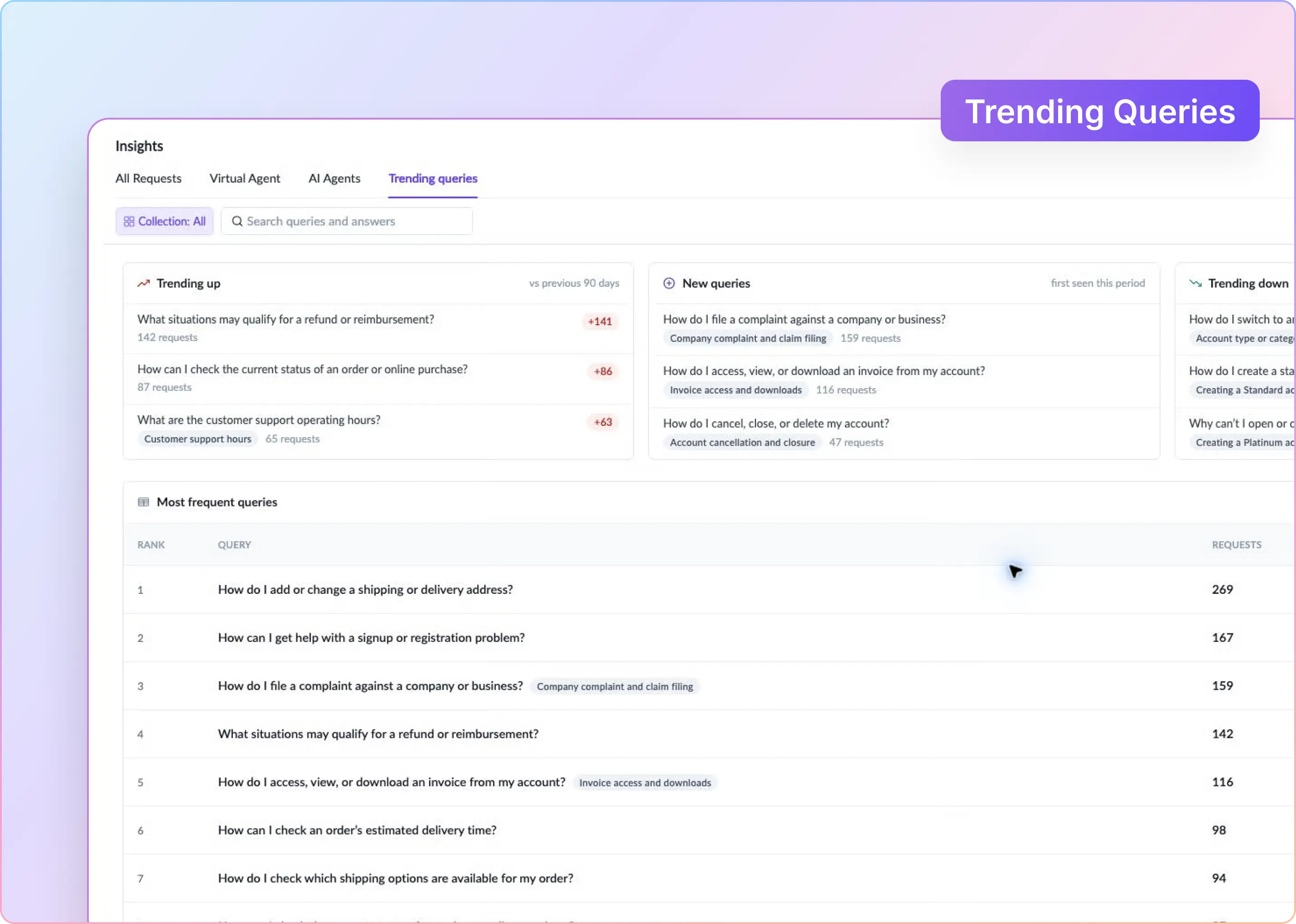
- Support operations built around Slack: ClearFeed adds business-hour SLAs, First Response and Resolution Time targets, assignment and rotation-based rules, customer owner fallback, automations, reminders, digests, CSAT (2-point or 5-point, syncable to Zendesk), and Insights reporting across requests, tickets, CSAT, SLAs, and Virtual Agent sessions.
- Customer-facing options beyond Slack: On supported Helpdesk plans, customers can file and track tickets through the Customer Portal, start conversations through Web Chat, or use email. Agent replies can be handled from Slack triage or the ClearFeed web app, with responses syncing back to the customer's original channel.
- Transparent, edition-based pricing: ClearFeed offers External Helpdesk, Internal Helpdesk, and Integrations editions on Starter, Professional, and Enterprise plans, with agent-based or usage-based (channels or tickets) pricing and a 15% annual discount. The AI Pack, which powers AI Agents and Knowledge Sources, is included on the Professional and Enterprise Helpdesk plans and is available as a $20-per-month add-on for the Starter and Integrations editions.
In short, Zendesk or Freshdesk may be the better fit when you need a traditional, broad customer-service suite as your primary workspace. ClearFeed is worth considering when Slack is already where your customers, employees, or responders work and you want either a native Slack helpdesk or a controlled bridge into your existing ticketing system. Start a free trial or book a demo to evaluate the workflow against your actual support channels.