Table of Contents

Support teams live inside Slack. Customer questions, internal escalations, engineering handoffs, and project updates all land in threads — and without a dedicated task layer, they disappear into the scrollback. The right Slack task management app captures those threads as trackable work, assigns owners, and keeps status visible without pulling the team into a second tool.
Slack acknowledged the gap when it launched Slack Lists in 2024, but a native list is only part of the picture. Support teams also need multi-channel intake, two-way sync with ticketing or project tools, SLA visibility, and a clean separation between internal notes and customer-facing replies.
This guide compares the five Slack task management apps we see support teams shortlist most often in 2026 — ClearFeed, ClickUp, Asana, Notion, and Jira. For each, you'll get who it's for, standout features, honest limitations, current pricing, and G2 ratings.
TL;DR
- Support work in Slack lives or dies on whether tasks stay attached to the conversation that created them. Copy-paste workflows always break.
- ClearFeed is the Slack-native pick for support and ops teams: triage channels, AI categorization, SLA tracking, private-vs-public replies, and two-way sync with Jira, Linear, ClickUp, and Asana. Intake covers Slack, MS Teams, Discord, Telegram (beta), Email, Web Chat, and Portal.
- ClickUp and Asana fit teams that want a full project-management suite with boards, timelines, dashboards, and automations — Slack lives at the edge, not the center.
- Notion works best for docs-heavy teams that want customizable databases, wikis, and lightweight task tracking in one workspace.
- Jira is the strongest fit for engineering and agile issue tracking; it's usually too heavy for a pure support workflow unless engineering is already there.
- Pick based on where work already starts: Slack-native tools if tasks emerge in conversations, full PM tools if the work needs roadmaps, dependencies, and planning depth.
What To Look For in a Task Management App for Slack?
Before comparing tools, be clear on the features that separate a real Slack task manager from an app that only "integrates" with Slack:
1. Capture Tasks Directly From Slack Conversations
If you can't turn a message into a task without copy–pasting, it's not a Slack-first app. Look for one-click message-to-task conversion, support for converting multi-message threads into a single task, and the ability to capture context, including attachments, user details, and thread history. This solves the most significant operational pain point: tasks that disappear into Slack's scrollback.
2. Two-Way Sync
Most tools "integrate" with Slack the way a screenshot integrates with reality. You want true, bidirectional sync. Update a task in Slack, and it updates in Asana, Jira, or Linear. Update it in the app, and the Slack thread reflects it. Comments sync both ways automatically. This prevents teams from living in different versions of the truth.
3. Clear Ownership and Assignment
Slack channels are noisy. If you don't assign ownership, everyone assumes someone else is handling it. Your tool should support assigning tasks from Slack, auto-assigning based on keywords, channel, or requester, and providing visibility into who's on it without leaving Slack. Ownership is 80% of support for hygiene.
4. Status Tracking in Slack
Support teams shouldn't need a second tab to see whether something is open, in progress, or blocked. Look for status updates that post back into Slack, easy ways to change status from Slack, and automated status changes based on workflow events. Status visibility means fewer "any update?" messages.
5. AI That Reduces Manual Triage
The best Slack task apps use AI to remove decisions that don't need a human. Look for auto-categorization of incoming requests, sentiment or urgency detection, summarization of long threads into a clean task description, and rules that route work by keyword, channel, or requester. AI works well here because Slack messages are unstructured — a good model turns "hey is anyone seeing 500s on checkout?" into a categorized, assigned, prioritized task.
6. Multi-Channel or Multi-Team Support
Most teams don't have one channel. They have internal support, customer success, engineering escalations, vendor channels, and Slack Connect channels with customers. Your task tool should centralize intake without forcing people to join every channel — and, increasingly, should also handle requests that arrive over MS Teams, Discord, Telegram, email, a customer portal, or a web chat widget, not just Slack. A unified triage view solves this exact mess.
7. Support for Private Notes vs Public Replies
Especially for support or customer-facing teams, you need private internal notes that aren't visible to customers, as well as public replies sent back to Slack Connect or shared channels. This is operationally crucial. Otherwise, your Slack task system becomes unusable for real-world customer conversations.
Best Slack Task Management Apps at a Glance
5 Best Slack Apps for Task Management in 2026
1. ClearFeed
ClearFeed is an AI-native support platform built inside Slack. It turns conversations into tracked requests, groups related messages into a single task, and lets responders reply, escalate, or file external tickets without leaving the thread. Support, IT, HR, and operations teams use it as their primary Slack helpdesk; product and engineering teams use it as a two-way bridge into Jira, Linear, ClickUp, or Asana.
Key Features
- Slack-native task intake: Capture requests directly from Slack channels, threads, and DMs — no forms or copy-paste required. Emoji reactions (👀 to assign, ✅ to solve, 🚨 to mark urgent, and a configurable :ticket: reaction to create a task) trigger actions from the request channel itself.
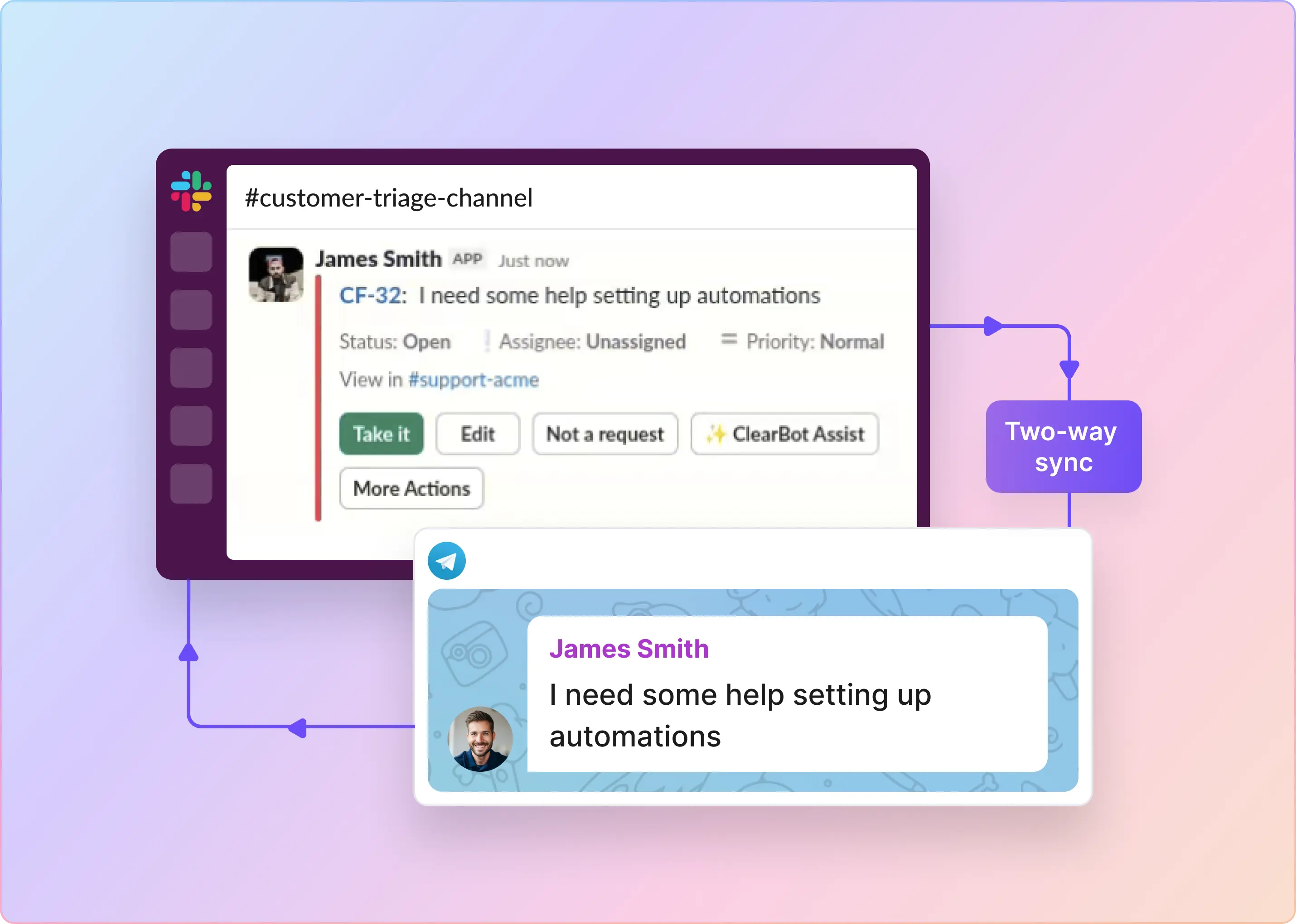
- Triage channels: A dedicated Slack channel that becomes the team's central command center. All requests from every monitored source flow into one place, with buttons to assign, change status, edit fields, and file or link tasks in Jira, GitHub, Linear, or other external systems.
- Two-way sync with Jira, Linear, and ClickUp: Replies, comments, and status changes stay in sync between Slack and the external system. Each of these three can be configured either as a ticketing system (external tool owns SLAs) or as a task management system (ClearFeed owns SLAs and only selectively escalates to the external tool). Asana is supported as a task-management filing target from ClearFeed requests.
- AI categorization and summarization: System-defined AI fields tag each request with Auto-Category (Bug, Feature Request, How-to, Problem Report, Request), Auto-Emotion (Positive, Neutral, Negative), and Auto-CSAT. AI-Summarization can turn a long Slack thread into a clean ticket description in Jira, Linear, or ClickUp. Custom AI Fields let you define your own auto-populated fields — product area, urgency, order number — driven by natural-language instructions and used to route or filter tickets.
- Multi-channel intake: Requests can originate from Slack, Slack Connect, MS Teams (including shared channels on the Professional plan), Discord (native ticketing only), Telegram (beta, on Professional/Enterprise plans), Email, Web Chat, a customer portal, or the ClearFeed API — and land in the same triage channel and inbox.
- Internal notes vs public replies: Triage channels have a Comment Visibility setting. In public mode, all triage replies are pushed back to the requester except messages prefixed with 🔒. In private mode, no triage replies are pushed back except messages prefixed with 📢. Internal notes from Freshdesk (as private notes) and Zendesk (as internal comments) can be synced into the triage channel as private comments.
- SLA tracking and business schedules: Set First Response Time, Resolution Time, and One Touch Resolution targets per collection, based on business hours and holidays. Optionally pause resolution timers while tickets sit in Pending or On Hold.
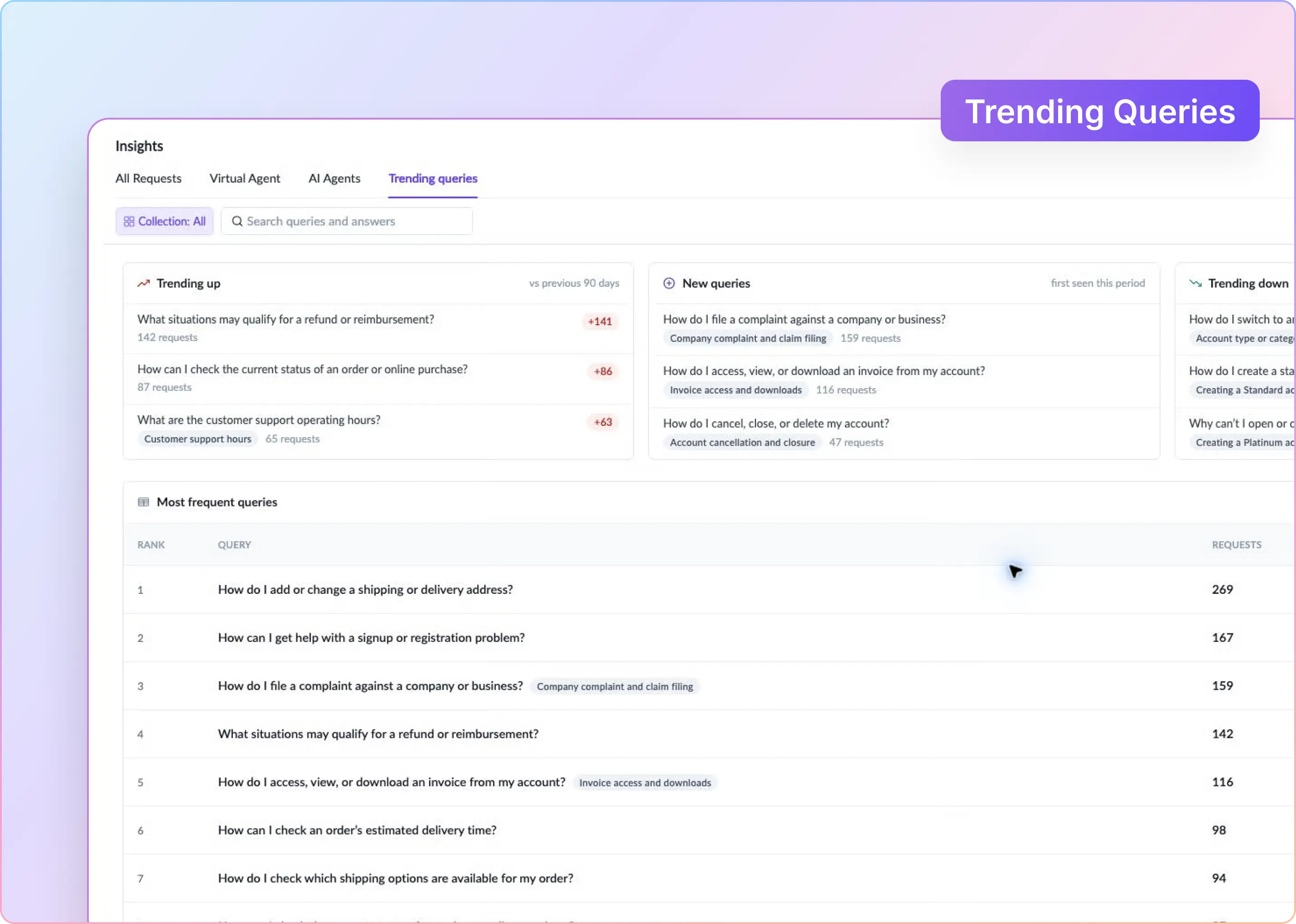
- Web app with queues, Insights, and Kanban: A full Insights dashboard covers request volume, first response time, resolution time, SLA breach percentage, CSAT, and AI Agent deflection — with breakdowns by collection, channel, assignee, customer, and custom fields.
- Insights Agent (beta): A natural-language AI agent that answers questions about your ClearFeed data — "how many high-priority requests are still open from last week?" — instead of forcing you into filters and dashboards.
Pros
- Meets support teams where the work actually happens: inside Slack, in threads, without a second UI to check.
- Triage channels, AI categorization, and rule-based automations turn noisy Slack chatter into an organized queue.
- Handles Slack Connect intake with clean external replies and private internal discussion in the same thread.
- Works across support, engineering escalations, IT, HR, ops, and finance — each team gets its own collection, triage channel, automations, and reporting.
- Two-way sync means Jira, Linear, or ClickUp stay authoritative for engineering while support keeps SLAs and customer context in Slack.
- Omnichannel intake — Slack, MS Teams, Discord, Telegram, Email, Web Chat, Portal — without stitching together separate tools for each source.
Cons
- Not a project management suite: no sprint planning, epics, dependencies, estimates, or roadmap views. Use Jira, Linear, or ClickUp for that and let ClearFeed sync to them.
- Not a personal to-do list. If you need Todoist-style personal task capture, ClearFeed is overkill.
- Best fit when Slack is where work starts. Teams whose intake is dominated by email portals, CRM tickets, or non-Slack sources will get less lift.
- Discord collections currently support ClearFeed-native ticketing only — external ticketing systems are not available for Discord sources.
- Filing Jira, JSM, or Linear tickets privately from a Direct Message or the /File command is not supported today; private ticket creation is available with ClearFeed-native ticketing and select external systems.
- Only Atlassian-hosted Jira Cloud and Jira Service Management are supported; self-hosted Jira Server and Data Center are not.
G2 Rating
4.6 out of 5 stars (144+ reviews)
Pricing
ClearFeed offers three product editions — External Helpdesk (for supporting external customers), Internal Helpdesk (for IT, HR, Finance, Engineering service teams), and Integrations Edition (for teams whose primary ticketing system is Jira, Zendesk, or similar and who only need to route Slack messages into it).
Each edition can be billed either agent-based (unlimited channels, priced per agent) or usage-based (unlimited agents, priced by channels or ticket volume — the Integrations Edition is usage-based only and is not available for Slack Connect channels).
Plan tiers:
- Starter — from $24/agent/month. Slack, Email, and Web Chat intake, basic AI, CSAT surveys, automations, limited forms, webhooks, triage channels.
- Professional — from $49/agent/month. Everything in Starter plus SLAs, Portal, Assignment Rules, MS Teams shared channels, GPT-powered answers, knowledge-source sync, and unlimited forms.
- Usage-based plans — from $40/month. Scale by monitored channels or ticket volume rather than agents.
- Enterprise — custom pricing. SSO/SAML, security review, data residency options, white-labeling, API access, and concierge onboarding.
GPT-Powered Answers and AI Agents are included on Professional and Enterprise Helpdesk plans. On Starter or the Integrations Edition, the AI Pack is an add-on starting at $20/month for 100 GPT requests. See the latest details on the Helpdesk pricing and Integrations pricing pages.
2. ClickUp
ClickUp is a comprehensive productivity and project management platform that unifies tasks, docs, goals, and communications in a single customizable workspace. It helps teams of all sizes streamline their workflows and collaborate efficiently.
Key Features
- Task, project, and document management in one place
- Custom fields, statuses, automations, and ClickApps for workflow tailoring
- Real-time chat, collaborative docs, and whiteboards
- Time tracking, sprint management, resource, and workload views
- Multiple visualizations: Lists, Boards, Gantt charts, Calendars, Timelines
- Integrates with 1,000+ apps (Slack, Google Drive, GitHub, etc.)
Pros
- Rich customization and scalability
- Extensive built-in views (List, Board, Calendar, Gantt, Timeline)
- All-in-one hub for tasks, docs, and communications
- Time tracking and detailed reporting
Cons
- Steep learning curve once you turn on the advanced surface area.
- Interface can feel slow at scale, especially in larger workspaces.
- Several capabilities gated behind the Business tier or above.
- Mobile app is thinner than the desktop and web experience.
- Slack integration is a plugin, not the primary workspace — support workflows that live in threads need a dedicated Slack-first layer on top.
G2 Rating
4.7 out of 5 stars (10,700+ reviews)
Pricing
- Free: Unlimited tasks & users, 100MB storage, basic task management
- Unlimited: $7/user/month—unlimited storage, integrations, dashboards, and more
- Business: $12/user/month—advanced automations, advanced time tracking, and workloads
- Enterprise: Custom pricing—custom roles, advanced security, live onboarding
3. Asana
Asana is a leading work management and team collaboration platform. It enables users to organize projects, delegate tasks, set deadlines, visualize progress, and automate workflows—aimed at aligning organizations and accelerating impact.
Key Features
- Multiple project views: List, Board, Calendar, Gantt/Timeline
- Task assignment, dependencies, and custom fields
- Workflow builder and automations to streamline tasks
- Real-time dashboards, charts, and advanced reporting
- Goal and portfolio tracking, workloads, and approvals
- AI features for automation and suggestion
- Deep integrations with 300+ apps (Slack, Zoom, Google Workspace, Salesforce)
Pros
- Intuitive project and task management
- Multiple views (List, Board, Calendar, Timeline)
- 300+ app integrations (Slack, Teams, Google Drive)
- Robust reporting and dashboards
Cons
- Timeline, dashboards, and workflow builder are locked to Starter and above.
- Advanced features add up quickly as team size grows.
- Mobile experience trails the desktop app for planning workflows.
- Slack-native support workflows — triage channels, SLAs, private-vs-public replies — aren't Asana's core competency; pair with a Slack-first layer if the support team lives in Slack.
G2 Rating
4.4 out of 5 stars (12,600+ reviews)
Pricing
- Personal: Free for up to 2 users, core task/project management features
- Starter: $10.99/user/month—timeline view, dashboards, workflow builder, automation
- Advanced: $24.99/user/month—portfolios, workload management, advanced integrations
- Enterprise & Enterprise+: Custom pricing—enhanced security, admin, compliance controls
4. Notion
Notion is a connected workspace for teams and individuals to create docs, take notes, manage databases, track projects, and collaborate—all in one highly customizable platform. It also offers built-in AI to help with content generation and workflow automation.
Key Features
- Rich note-taking and documentation with hierarchical organization
- Custom databases: tables, kanban, lists, calendars, galleries
- Collaborative docs with comments and multi-user editing
- AI-powered content generation, summaries, and automations
- Custom forms, sites, and analytics (Plus/Business/Enterprise tiers)
- Templates for wikis, project planning, task tracking, and more
- 70+ integrations (Slack, GitHub, Google Calendar, and others)
Pros
- Highly customizable pages, databases, and views
- Real-time team collaboration
- Extensive content support: docs, tasks, kanban, embeds
- Robust free plan and tiered options
Cons
- Large databases can lag as records and views scale.
- Offline behavior is limited compared with document tools built for it.
- Steep learning curve for teams new to database-driven workspaces.
- Task-management ergonomics (dependencies, workload, portfolios) are lighter than Asana or ClickUp.
- Not designed for Slack-first support workflows — better as the knowledge base a support tool queries than as the support tool itself.
G2 Rating
4.6 out of 5 stars (8,700+ reviews)
Pricing
- Free: Individual use, basic docs, databases, and calendar/mail
- Plus: From $10/user/month—unlimited blocks, file uploads, charts, custom forms
- Business: From $20/user/month—SAML SSO, private teamspaces, conditional forms, advanced integrations, unlimited AI
- Enterprise: Custom pricing—advanced controls, provisioning, audit logs, security & compliance
5. Jira Software
Jira is a collaborative project management and issue-tracking platform widely adopted for agile and traditional workflows. It helps teams plan, track, and execute projects of any size through boards, goals, reports, and deep integration.
Key Features
- Boards for Scrum, Kanban, and custom workflows
- Backlog management, milestones, and dependency mapping
- Goals linking and alignment to company objectives
- Custom automation rules and approval processes
- Detailed reports, analytics, and dashboards
- Advanced permission, compliance, and security controls
- Real-time collaboration, comments, file sharing, and notifications
Pros
- Highly customizable workflows
- Powerful for agile (Scrum/Kanban) and cross-team projects
- Extensive reports and real-time dashboards
- 3,000+ integrations with dev and collaboration tools
Cons
- Steep learning curve and heavy admin overhead for smaller teams.
- Overkill for pure support workflows that don't need sprint planning.
- Advanced permissions, cross-team planning, and AI features are on Premium or higher.
- Performance can degrade in very large or heavily customized instances.
- Slack-first support work is best handled by a Slack-native layer that syncs into Jira, rather than by asking customers or non-technical teammates to work directly in Jira.
G2 Rating
4.3 out of 5 stars (7,000+ reviews)
Pricing
- Free: Up to 10 users, basic project management, 2 GB storage
- Standard: $7.91/user/mo—For 300 agents, advanced permissions, 250 GB storage, external collaboration
- Premium: $14.54/user/mo—For 300 agents, AI features, cross-team planning, unlimited storage, 24/7 support
- Enterprise: Contact for pricing—Advanced analytics, enterprise security, unlimited automation, and sites
The Best Slack Task Manager Depends on Your Team's Needs
The best Slack task management app is the one that matches where work already starts in your team:
- If tasks begin in Slack threads and you need SLAs, ownership, and clean customer replies, choose a Slack-native support platform like ClearFeed.
- If work lives in a project plan with sprints, roadmaps, and dependencies, choose ClickUp, Asana, or Jira and let Slack act as a notification layer.
- If documents and lightweight tracking are your center of gravity, Notion keeps both in one place.
Support teams in particular don't have to pick one and lose the other. A Slack-native support layer can own triage, SLAs, and customer replies while syncing engineering escalations two ways into Jira, Linear, or ClickUp — so the customer conversation stays in Slack and the engineering work stays in the system engineering already lives in.
Frequently Asked Questions
1. What Are the Best Slack Task Management Apps for Support Teams in 2026?
For teams whose work starts in Slack conversations, the strongest picks are ClearFeed (Slack-native support and triage), ClickUp and Asana (project management with Slack notifications), Notion (docs plus lightweight task tracking), and Jira (engineering and agile issue tracking). Which one wins depends on whether your primary need is Slack-first triage or full project planning.
2. Can You Create and Manage Tasks Directly Inside Slack?
Yes. Slack Lists offers native lightweight task tracking, and apps like ClearFeed, ClickUp, and Asana let you convert messages into tasks, assign owners, sync status back to the thread, and manage the queue without leaving Slack.
3. How Do Slack Task Management Integrations Work?
Most integrations use Slack shortcuts, emoji reactions, and message actions to create or update tasks in another system, then post status changes back into the thread. The stronger tools also support two-way comment sync, so replies in either system appear in the other.
4. Which Slack Task Management App Is Best for Small Teams?
Small support and ops teams typically shortlist ClearFeed for Slack-native ticketing with a usage-based plan, and ClickUp or Asana when they need broader project management. Free tiers exist for ClickUp, Asana, and Notion; ClearFeed's usage-based pricing scales by monitored channels or ticket volume rather than seats, which suits small teams with a handful of Slack Connect channels.
5. How Do Slack Task Management Tools Help Support Teams Specifically?
Support-focused tools capture requests from Slack, MS Teams, Discord, Telegram, Email, Web Chat, and Portal, enforce SLAs, separate private internal notes from public customer replies, and sync with helpdesks or task systems like Zendesk, Freshdesk, Jira, Linear, ClickUp, and Asana. ClearFeed is the strongest fit when Slack is the main intake channel.
6. Are Slack Task Management Apps Free?
Most offer a free tier for small teams or personal use. Advanced features — automations, SLAs, analytics, external ticketing sync — usually require a paid plan.
7. How Do I Choose the Right Slack Task Management App?
Start with where the work begins: if it's Slack threads and customer conversations, pick a Slack-native support tool. If it's a project plan with roadmaps and dependencies, pick a full PM suite and rely on its Slack integration. Then weigh required integrations (Jira, Zendesk, Linear), SLA and reporting needs, and pricing model (per-seat vs. usage-based) before committing.
8. Is Slack a Project Management Tool? (Slack for Projects)
Slack is not a full project management tool, but with the right integrations it becomes a strong front door for work — capturing requests from conversations and syncing them into Jira, Asana, ClickUp, Linear, or a Slack-native helpdesk like ClearFeed.