Table of Contents

From chatbots to AI-powered support tickets, automation is now part of everyday customer service operations. Freshdesk's Auto Triage, powered by Freddy AI, is meant to classify incoming tickets by suggesting values for fields such as Priority, Group, Type, Status, and eligible custom drop-down fields. That can be useful, but it is not the same as a fully autonomous support workflow, so the real question is whether these suggestions save enough agent time to justify the plan and add-on cost.
What Is Auto Triage in Freshdesk?
Auto Triage is Freshdesk's AI-assisted ticket-field suggestion feature within Freddy AI Copilot. It analyzes your existing ticket data and suggests field values on new tickets so agents can tag, classify, and update tickets faster.
In simpler terms, auto Triage is a suggestion system for default ticket fields and custom drop-down fields, with optional automatic updates once suggestions are enabled. If Group is enabled as a suggested field, it can support queue/team routing, but the documented core workflow remains field classification and update, rather than a broad "AI assigns every ticket to the right person" promise.
Some of its current capabilities include:
- Suggestions for default fields such as Priority, Type, Group, and Status, depending on plan and account conditions.
- Support for eligible custom drop-down ticket fields after Freshdesk reviews whether your existing data is sufficient.
- A request-and-approval flow where Freshdesk's team processes new field requests and marks them as Requested, Insufficient Data, or Ready.
- The agent controls whether to accept, ignore, or reject Freddy AI's suggestions on ticket properties.
- An admin option to automatically apply enabled field suggestions without agents manually accepting each one.
Benefits of Auto Triage
Auto Triage is most valuable when your team already has enough Freshdesk ticket history and uses structured fields consistently. In that environment, AI suggestions can reduce repetitive property updates and make reporting cleaner. The main benefits are:
- Less manual classification: Agents spend less time choosing ticket field values when Freddy AI can suggest Priority, Type, Group, Status, or custom drop-down values.
- Cleaner queues and reporting: Consistent field values make it easier to segment tickets by issue type, urgency, group, or other custom properties.
- Faster handoffs when fields drive workflows: If your Freshdesk setup uses fields like Group or Priority to route work, better field suggestions can shorten the time between ticket creation and team ownership.
- Agent control before automation: Teams can start with suggestions, observe accuracy, and then enable automatic updates for fields where the model is reliable.
Cost of Auto Triage
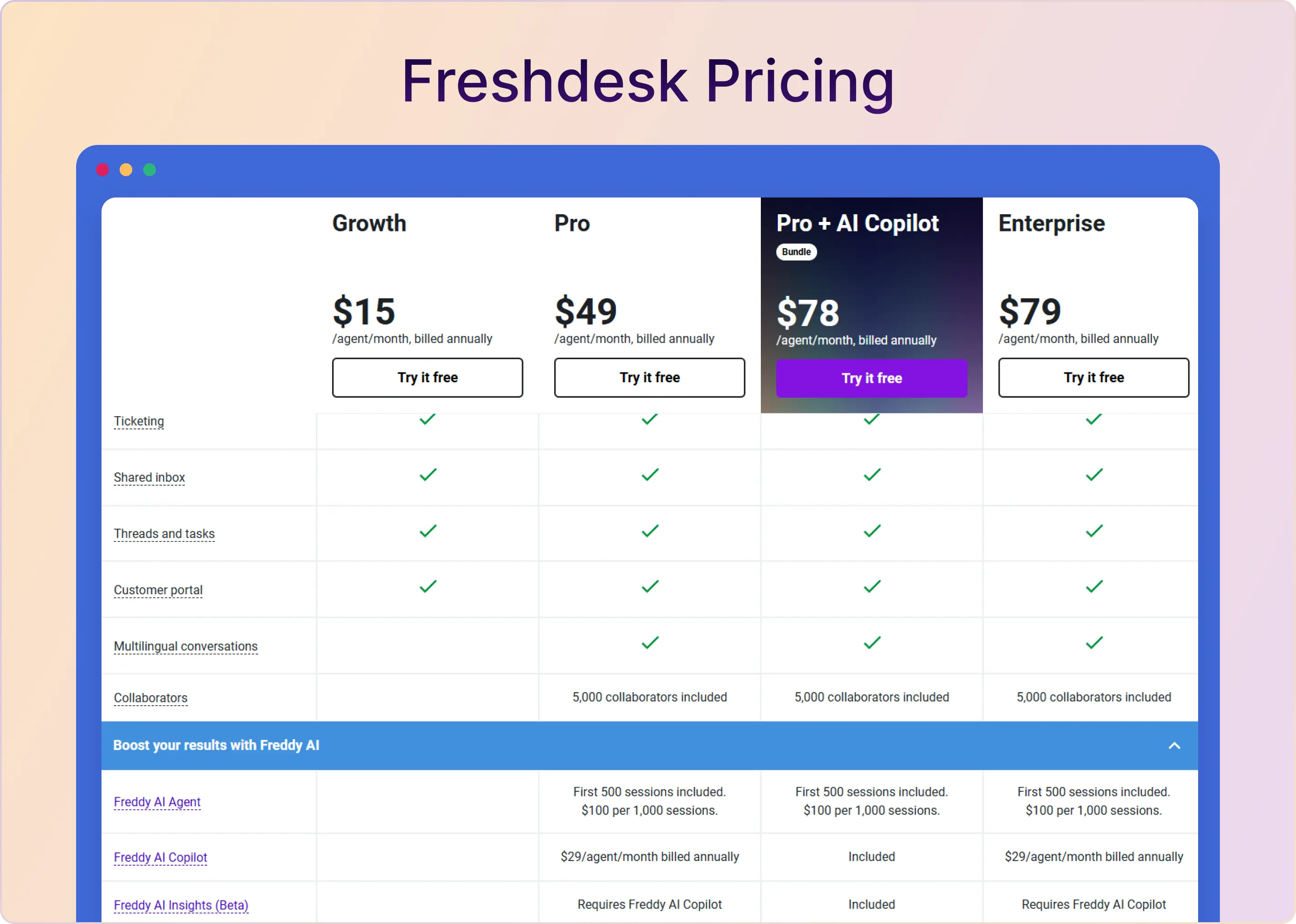
As of May 2026, Freshdesk's Auto Triage feature is available on Freshdesk Pro (starting at $55/agent/month) and Enterprise (starting at $89/agent/month), and on Freshdesk Omni Pro and Enterprise; Free and Growth are not listed as supported plans.
Freddy AI Copilot is a flexible add-on, meaning it can be purchased for a subset of agents instead of every agent in the account. Freddy AI Copilot is available at $29/agent/month on annual billing or $35/agent/month on monthly billing, and notes that this pricing applies to Freshdesk, Freshchat, and Freshdesk Omnichannel.
For a 10-agent team where every agent receives the Freddy AI Copilot add-on, the public annual-billing equivalent would look like this:
- Pro base plan: $55/agent/month x 10 agents = $550/month, billed annually.
- Freddy AI Copilot add-on: $29/agent/month x 10 agents = $290/month, billed annually.
- Pro + Freddy AI Copilot for all 10 agents: $840/month equivalent, or $10,080/year.
- Enterprise base plan: $89/agent/month x 10 agents = $890/month, billed annually.
- Enterprise + Freddy AI Copilot for all 10 agents: $1,180/month equivalent, or $14,160/year.
The actual number may be lower if only some agents need Copilot licenses, and it may change if you choose monthly billing or Freshdesk Omni instead of standard Freshdesk. The ROI depends on how many tickets require repetitive field classification, how often suggestions are accurate enough to trust, and whether the suggested fields drive downstream routing, SLA, or reporting workflows.
Limitations of Auto Triage
Freshdesk Auto Triage can help with ticket hygiene, but it has practical limits that matter when you are evaluating it as an investment:
- Dependence on historical data: Freshdesk explicitly checks whether existing ticket data is sufficient before enabling suggestions for new fields, and fields can be marked Insufficient Data.
- Setup is not always instant: Admins can request additional default or custom drop-down fields, but Freshdesk processes those requests before they become Ready.
- Plan and add-on gating: Auto Triage is shown for Pro and Enterprise, and the current docs position it under Freddy AI Copilot, so Free and Growth users should not assume it is available by default.
- Suggestions still need governance: Agents can accept, ignore, or reject suggestions, and automatic updates should be enabled only after the team is comfortable with the accuracy for a given field.
- It is a Freshdesk-centered workflow: If your support motion starts in Slack, Slack Connect, Teams, email, or customer channels, Freshdesk Auto Triage does not by itself solve the problem of collecting, collaborating on, and syncing those conversations across systems.
In short, Auto Triage is worth considering when Freshdesk is already the team's main operating surface and ticket-field cleanup is a real bottleneck. If the bigger challenge is support work happening across Slack, Slack Connect, MS Teams, email, portal, web chat, and Freshdesk, a Slack-first triage layer like ClearFeed may be a better fit.
Explore the Benefits of ClearFeed's Advanced Triage Channel
ClearFeed is a Slack-first conversational helpdesk and support operations platform for teams that support customers and employees across Slack, Slack Connect, email, Microsoft Teams, customer portal, web chat, and API. It can be used as a standalone helpdesk with ClearFeed tickets, or as an integration layer that keeps existing tools such as Freshdesk, Zendesk, Intercom, Salesforce Service Cloud, Jira, Linear, HubSpot, GitHub, ClickUp, and Asana in the workflow.
This matters because the pain teams raise on support and sales calls are rarely just "we need a field suggestion." They are trying to stop context switching, avoid missed Slack/Teams requests, assign ownership without extra responder steps, classify incoming work for routing and reporting, and keep Freshdesk or engineering tools updated without copy-paste.
ClearFeed's Triage Channels act as the agent command center in Slack. Agents can manage requests and tickets from Slack, update status, priority, assignee, and custom fields, reply publicly, keep internal discussion private, create or link external tickets/tasks, and use AI assistance where enabled.
Features of ClearFeed Triage Channel:
- Central Slack triage for multiple channels: ClearFeed can route requests from Slack, MS Teams, email, portal, web chat, and API into dedicated Slack triage channels, so agents can work from a single queue instead of manually monitoring every customer or internal channel.
- Private collaboration controls: Depending on triage settings, replies can be public by default, with private messages marked with the lock emoji, or private by default, with public replies explicitly marked for the requester. For linked Freshdesk tickets, ClearFeed can sync internal triage comments to Freshdesk as private notes, and Freshdesk private notes can sync back into the triage channel.
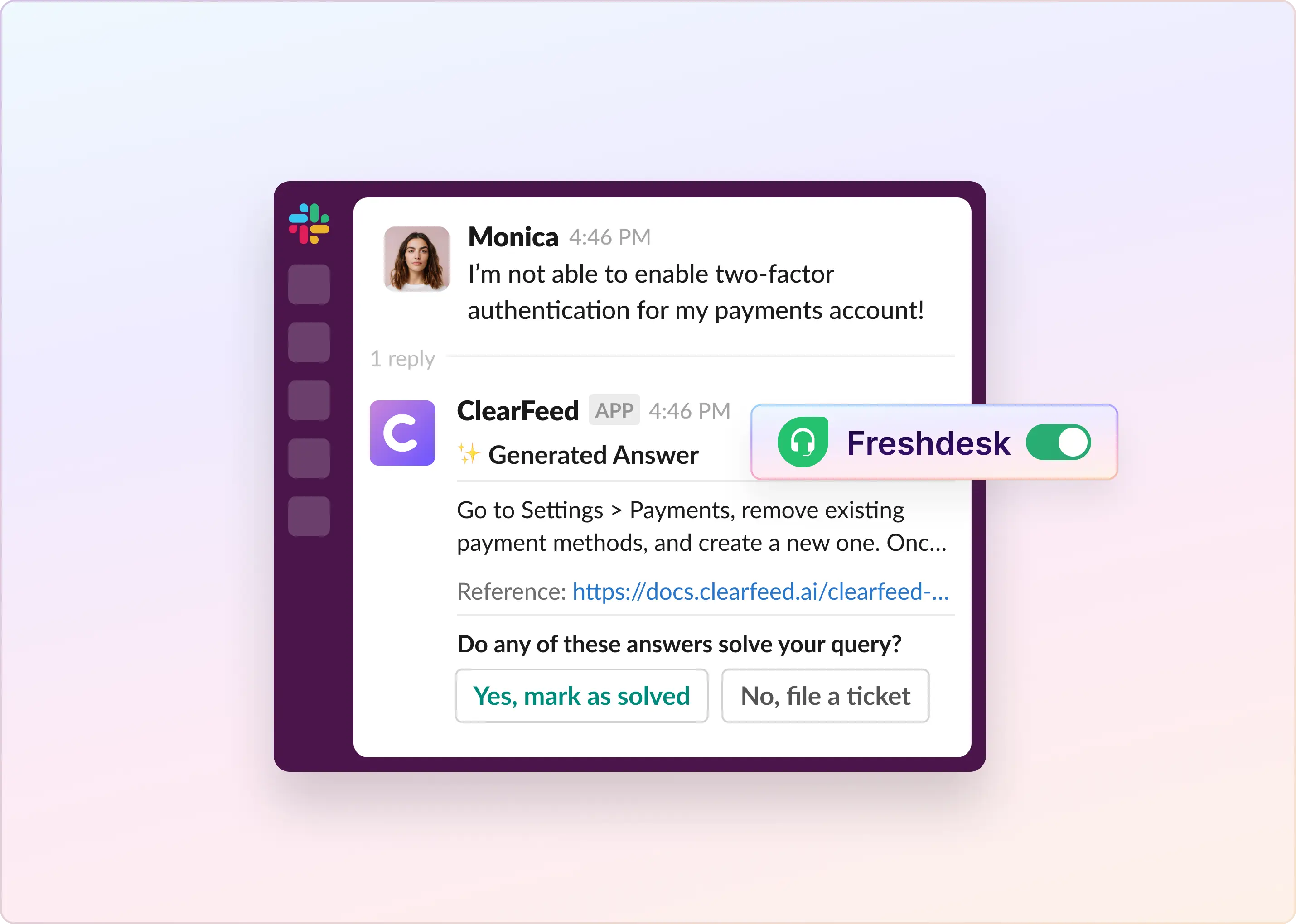
- Freshdesk ticket creation from Slack: ClearFeed can create Freshdesk tickets manually with an emoji, automatically for new request-channel conversations, or directly from the triage channel. When a Freshdesk ticket is created, the Slack thread can show the Freshdesk ticket title, ID, URL, and status.
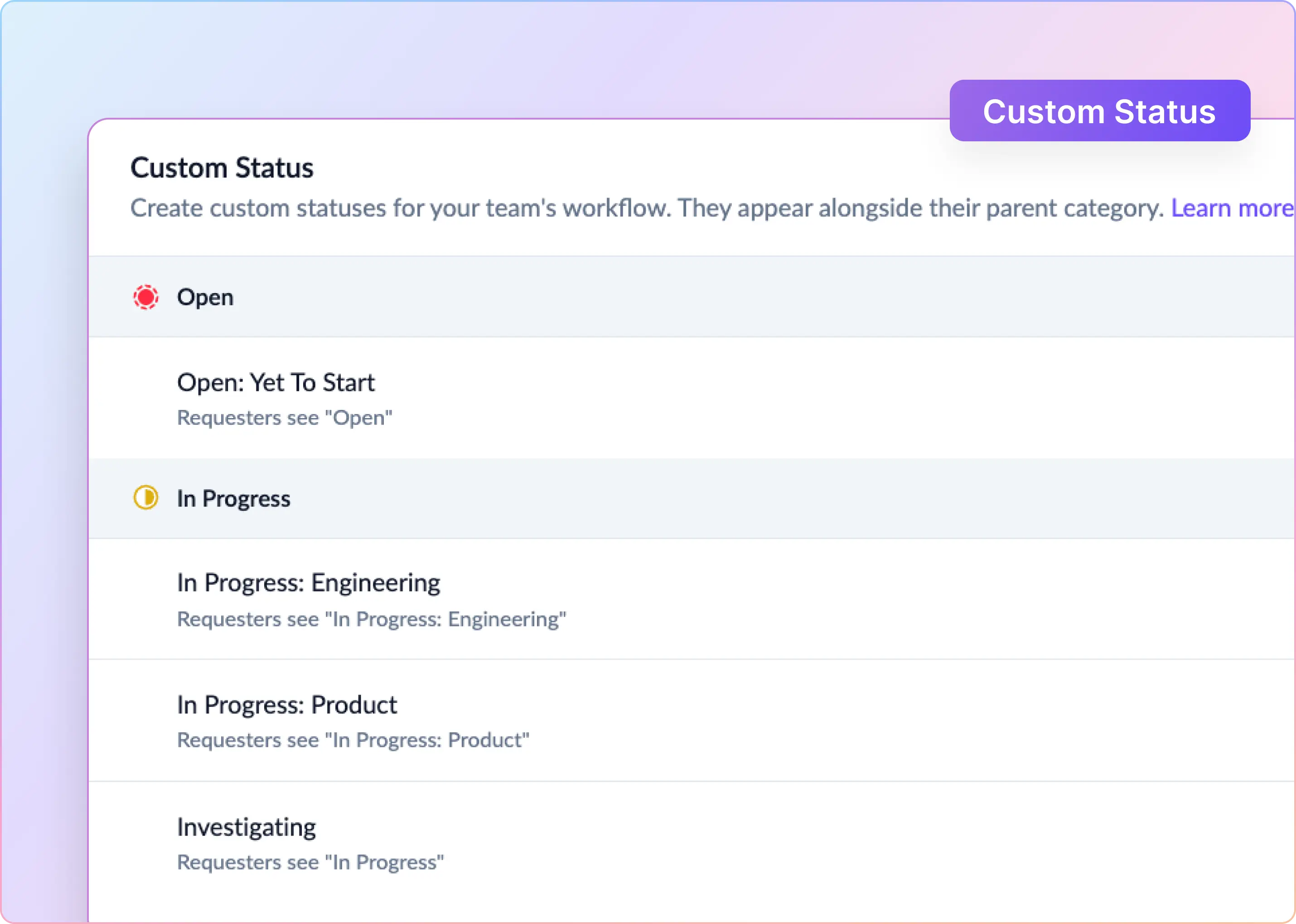
- Configurable Freshdesk sync: Replies between Slack and Freshdesk can sync bidirectionally; Freshdesk status changes can be reflected in Slack; Freshdesk custom statuses are shown in Slack; and teams can configure message-sync and status-sync modes for all tickets or individual tickets.
- AI classification and field automation: ClearFeed AI Fields can classify support requests by category, urgency, sentiment, or your own custom field logic. Automation Action AI Fields can also be used temporarily inside automations, for example, to decide whether a request should create a ticket, update priority, or trigger an escalation.
- SLA and operations visibility: ClearFeed supports business schedules, SLA policies, reminders, digests, Insights, CSAT surveys, workload reports, and breakdowns by collection, channel, assignee, customer, and custom fields.
Benefits of ClearFeed Triage Channel:
- Better fit for Slack-first support: Freshdesk Auto Triage helps inside Freshdesk, while ClearFeed helps when the work starts in Slack or related channels and needs to become trackable support operations.
- Fewer missed requests: Requests from customer channels, internal channels, Teams, email, portal, and web chat can be pulled into a shared triage workflow instead of living only where they were first posted.
- Freshdesk without copy-paste: Teams that keep Freshdesk as their system of record can still create, update, and sync Freshdesk tickets from Slack through ClearFeed.
- AI that connects to workflow: ClearFeed's AI classification can feed automations, custom fields, views, reports, and escalation decisions, rather than only suggesting ticket property values.
- Flexible operating models: ClearFeed supports standalone ClearFeed ticketing, external ticket sync, internal helpdesk workflows, and usage-based or agent-based pricing models, depending on the edition.
For teams evaluating Freshdesk Auto Triage, the decision is not simply "Freshdesk or ClearFeed." Use Freshdesk Auto Triage when the main problem is classifying Freshdesk tickets with more consistent field values. Consider ClearFeed when the bigger problem is triaging conversations across Slack-first support channels, collaborating privately, syncing to Freshdesk, and turning AI classification into routing, SLA, and reporting workflows.
Want to see the Triage Channel in action? Get started here or book a demo to talk to the ClearFeed team.