🚀 Looking for a Halp alternative?
See how we compare

DezignStack helps businesses grow through high-quality web experiences and integrated digital marketing. Company focuses on delivering well-designed, SEO-optimized websites and marketing solutions that attract more customers, reduce acquisition costs, and drive sustainable revenue growth.
Digital Services
Challenge
As the DezignStack grew, its use of separate tools for client communication and project management created a major operational gap. While Slack was effective for real-time client conversations, critical requests and feedback often got lost in channels and were never formally tracked. Internally, the team used ClickUp to manage tasks, but there was no efficient way to turn Slack messages into actionable, assigned items. This led to manual follow-ups, missed items, and unreliable tracking. The process became unsustainable as client volume increased.
Solution
The team implemented ClearFeed to add structure to Slack-based client support while continuing to execute work in ClickUp. ClearFeed centralized Slack requests into a triage view, consolidated conversations into trackable requests, and enabled two-way synced ClickUp task creation directly from Slack. Automated reminders and clear ownership ensured reliable follow-through without changing how clients or internal teams worked.
Impact
With ClearFeed, Slack and ClickUp now work together as a single, reliable workflow. Client requests move cleanly from conversation to execution, response discipline has improved, and manual oversight has been significantly reduced, allowing DezignStack to scale client support with confidence.
(*Company name is anonymized to protect customer confidentiality)
DezignStack is a global development and creative services team delivers 24/7 design, development, and SEO support to multiple brands. Their work involves continuous client interaction, fast turnarounds, and close coordination across distributed teams.
Client requests and discussions take place in Slack, where the team collaborates directly with customers. Once requirements are clear, work is planned and executed in ClickUp, with Hubstaff supporting time tracking and reporting. Like many teams, they relied on the native ClickUp Slack integration. But as their business scaled and the number of active client conversations increased, the team struggled to track all client requests happening in Slack and reliably connect them to ClickUp tasks.
Slack worked well early on for real-time client communication. Requests, feedback, and clarifications flowed naturally through channels and threads. But as the number of clients and parallel conversations grew, the lack of structure started to create real operational risk. On the client communication side:
Internally, the team uses ClickUp to manage task execution. However, connecting Slack conversations to ClickUp tasks was inconsistent and manual:
As a result, the team had to manually scan Slack channels and follow up with the team to ensure nothing slipped through, a process that became increasingly hard to sustain as request volume grew.
The team didn’t want to introduce a new portal or change how clients worked. Slack was already the right interface for communication. What was missing was a request management layer that could sit on top of Slack and work cleanly with ClickUp. That’s when their team adopted ClearFeed to make Slack-based client requests reliable, trackable, and execution-ready without disrupting existing workflows.
1. Centralize all client requests into a triage view: Instead of manually scanning 40+ Slack channels and threads, ClearFeed consolidates all client requests into a single triage view. This gives the team a clear, real-time picture of what’s open, in progress, or completed from one place.
2. Consolidate scattered Slack messages into a single request: Client requests often span multiple messages and clarifications. ClearFeed intelligently groups related Slack messages into one trackable request with AI-based merging, making it easier for their team to understand the request and track it through completion.
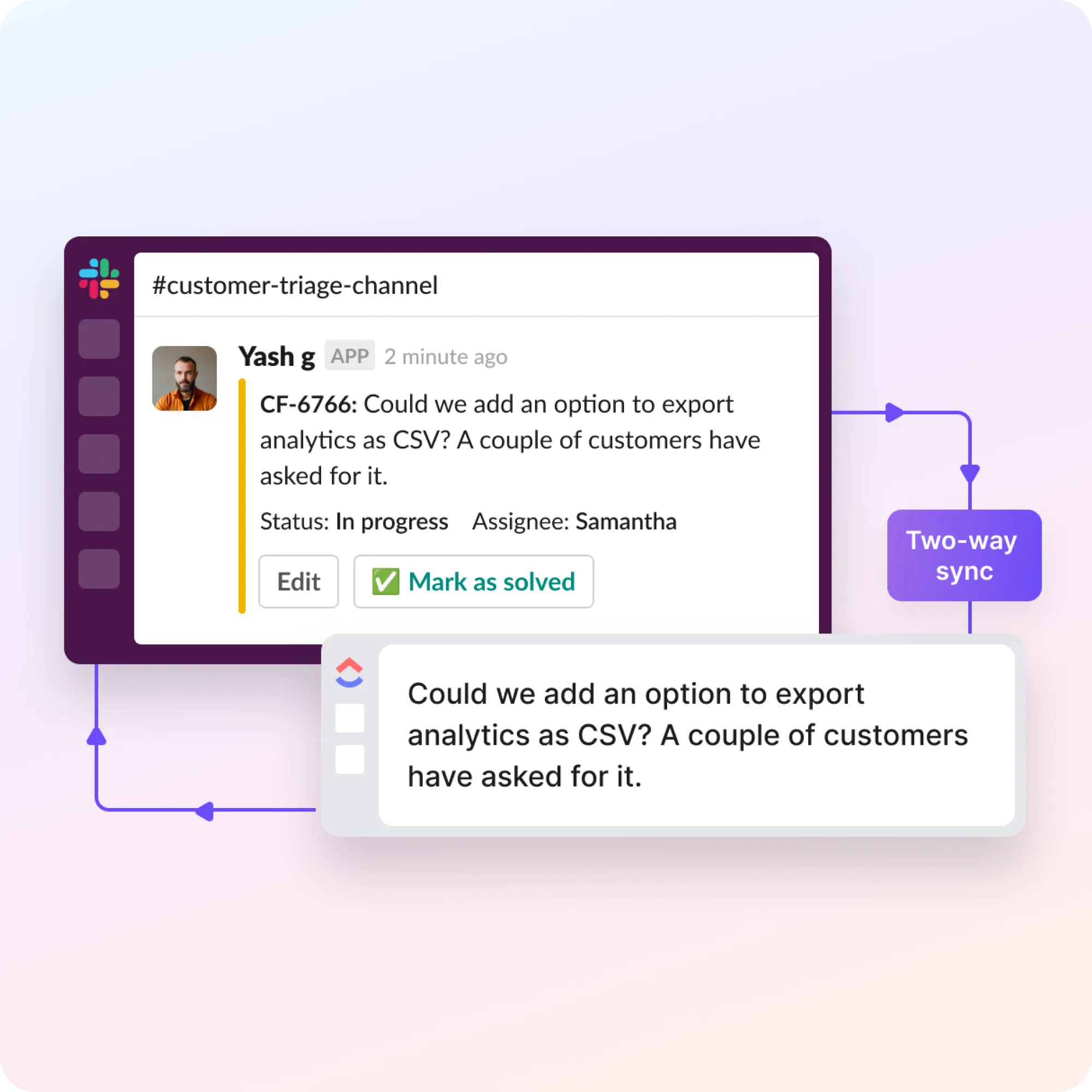
3. Create a ClickUp task from Slack: ClearFeed acts as the connective layer between Slack and ClickUp, ensuring that client requests raised in Slack can be converted into ClickUp tasks or linked to existing ones - with updates flowing both ways. This keeps execution in ClickUp while preserving full context from Slack, avoids duplicate task creation, and ensures every client request has a clear path from conversation to delivery.
4. Ensure no client request goes unanswered with SLA Alerts: ClearFeed continuously tracks whether a client request has received a response or follow-up in Slack. If a message is left unanswered or a promised follow-up doesn’t happen within a set time window, ClearFeed automatically reminds the team with AI-Powered SLA Alerts and Reminders, removing the need for manual monitoring.
5. Clear ownership on every request: With multiple team members managing client interactions, it was easy for accountability to get blurred. ClearFeed made it easy to assign requests to team members directly from Slack, ensuring no issue was left unattended.
As an example, the team is now able to see the status of all customer Slack requests within Slack using a Dashboard built using Slack Lists (to which ClearFeed can sync data):
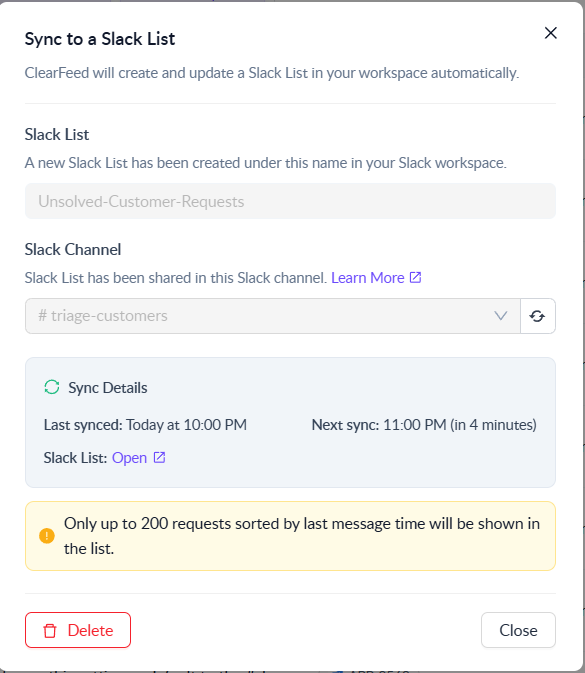
Syncing Requests in ClearFeed to Slack Lists
For teams evaluating how to connect ClickUp and Slack beyond basic notifications, this approach shows how a ClickUp Slack integration can support real client-facing workflows at scale. ClearFeed provides the missing layer that makes the two systems work together reliably. By turning unstructured Slack conversations into trackable requests, keeping them connected to ClickUp tasks, and enforcing follow-through with automation, ClearFeed helped this agency eliminate missed requests, reduce operational risk, and scale client support with confidence.
If you’d like to learn how ClearFeed can streamline support across Slack and ClickUp for your team, reach out at support@clearfeed.ai or book a free personalized walkthrough.