Table of Contents

Does your support team still bounce between Slack and HappyFox every time a customer issue comes in? A HappyFox and Slack integration can turn that support ping-pong into a cleaner handoff: the message starts in chat, becomes a ticket, and gets re-explained before anyone can solve it.
Instead of recreating the same conversation in two places, your team can keep updates connected, reduce context switching, and move faster without losing the thread. In this step-by-step guide, we’ll walk through how the integration works, how to set it up, and what to watch for along the way.
Why Should You Integrate Slack With HappyFox?
Connecting your Slack workspace with HappyFox offers numerous advantages that can significantly improve your team's customer service. Here are a few reasons to consider it:
- Improved team collaboration: Teams across departments can communicate and collaborate seamlessly in Slack, staying up to date on ticket statuses and chat inquiries without switching platforms.
- Real-time notifications: Support agents receive instant alerts in designated Slack channels for new tickets, updates, or incoming chats, ensuring no important information is missed.
- Faster issue resolution: Centralizing communication in Slack helps reduce response times by enabling agents to quickly address tickets and chats without toggling between apps.
- Enhanced real-time collaboration: Teams can solve problems more efficiently by brainstorming, escalating issues, and sharing information directly in Slack.
- Automated notifications: Set up workflows that automatically notify relevant channels about ticket creation or updates, keeping everyone informed with minimal effort.
Next, let's explore the specific features that make this integration powerful.
Features of HappyFox-Slack Integration
HappyFox-Slack integration through HappyFox's native app offers a range of features that significantly improve communication and optimize ticket management across your organization.
- Instant Notifications: You can automatically send notifications about ticket updates (like new tickets, assignments, category changes, etc.) directly to any Slack channel you choose.
- Manage Tickets in Slack: You can create, respond to, and modify help desk tickets right from within your Slack workspace.
- Smart Rules: Set up rules to automatically post specific ticket notifications based on conditions you define.
- Knowledge Base Search: Use slash commands in Slack to search for external Knowledge Base articles.
- Flexible Notification Settings: You can map Slack channels to receive notifications for various ticketing events, giving you flexibility in managing notifications across multiple categories.
- Integration Control: You can verify your Slack Workspace details and manage the integration status from within HappyFox.
- Public and Private Channels: Initially, only public channels are shown for notifications. However, you can add the HappyFox Slack App to any private channel and include it in the notification list.
- Temporary Disablement: You can temporarily disable the integration to pause notifications without losing your configuration.
- Permanent Unlinking: If needed, you can permanently unlink the Slack integration from HappyFox, which will delete the current configuration and allow you to link a different Slack workspace.
Before you get started with the integration process, there's an important requirement to keep in mind:
Ensure you have administrator-level access to both Slack and HappyFox. This is essential, as you will need permission to modify settings, authenticate apps, and configure them.
Steps to Integrate Slack with HappyFox
Once you’ve confirmed that you have the necessary prerequisites, you’re ready to begin the process. There are two ways to connect HappyFox with Slack: The native app method and the Zapier method.
Method 1: Via Native App
- Begin by logging into your HappyFox account. From the dashboard, go to the Apps > Chat. This will display a list of apps that can be added to HappyFox.
- Search for the Slack integration option from the list of available integrations. Click on Install to start the setup process. You will be redirected to a screen prompting you to authorize the connection.
- On the next screen, you will see the option to "Add to Slack." Click this button, and you will be redirected to Slack’s login page. Log in to Slack, select the workspace you want to add to the HappyFox bot, and click on Authorize.
- Now select the Slack channel or DM where you want HappyFox notifications to appear. This will be the space where new ticket notifications, updates, and other alerts will be posted.
Note: Only public channels appear in the "Channels" dropdown by default. To see a private channel in the list, simply add the "HappyFox Slack App" to it.
- Once you’ve selected your preferred Slack channel, click "Install." After authorization, you’ll be redirected back to HappyFox’s app management page.
In the "Basic Settings" section, you can confirm the integration details. You should see your Slack workspace name, workspace ID, and the "Integration Status," indicating everything is set up correctly.
And that’s it! Your HappyFox account is now successfully connected with your Slack workspace, allowing you to manage support tickets more efficiently right from Slack.
While the integration offers many benefits, it's important to be aware of potential challenges you might face.
Challenges of Using HappyFox-Slack Integration
With HappyFox-Slack integration, you may encounter some challenges that could affect the user experience or workflow. Here are the key ones to consider:
- Limited to One Slack Workspace: Currently, HappyFox supports integration with only one Slack workspace. For organizations that use multiple Slack workspaces, this limitation can create issues in managing customer support across different teams or departments.
- Limited Ticket Property Modifications: Only three ticket properties (assignee, priority, and status) can be modified from Slack. Agents must switch to HappyFox for more detailed updates.
- Private Channel Visibility: By default, only public Slack channels appear in the "To Channels" dropdown when configuring notifications. Agents must manually add the HappyFox app to private channels, which can be inconvenient, especially in organizations with complex channel structures.
- Potential for Missed Updates: If notifications are not properly mapped or if Slack settings are misconfigured, critical updates, such as new tickets or SLA breaches, may be missed. This can result in delayed responses and negatively impact customer satisfaction.
If these challenges seem significant for your use case, there's an alternative method using Zapier that might better suit your needs.
What Can You Do With HappyFox-Slack Integration Using Zapier?
By using Zapier to connect HappyFox and Slack, you gain access to several basic automation options. For example:
- Add a reminder for yourself or your teammate
- Send a message to a private channel
- Set the topic of any channel
Now that you understand what's possible with the Zapier integration, let's walk through how to set it up:
How To Integrate HappyFox With Slack Using Zapier?
- From your Zapier dashboard, click on the “+Create” button and then select “Zaps” to start creating your integration.
- Choose HappyFox as the Trigger App.
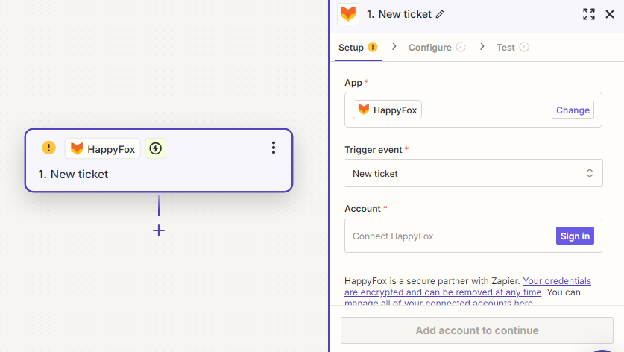
- Next, choose a trigger event (such as New Ticket) that will initiate the automation when a new ticket is created in HappyFox.
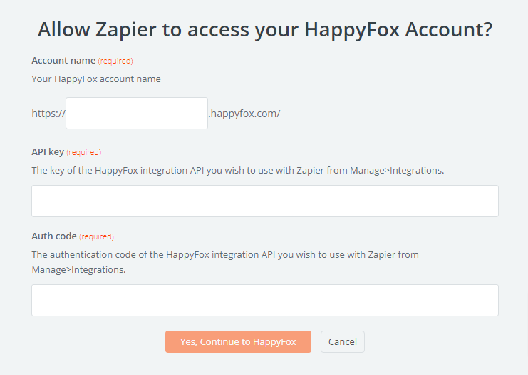
- Follow the prompts to connect your HappyFox account by providing the necessary credentials and API keys.
- In the "Action" section, search for and select the Slack app.
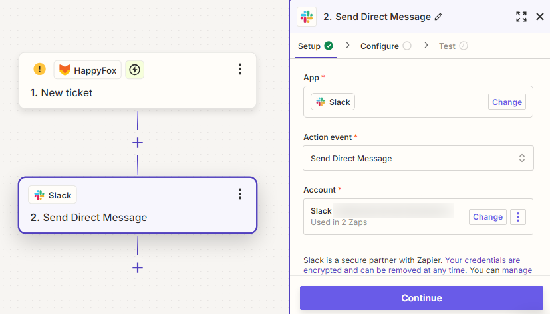
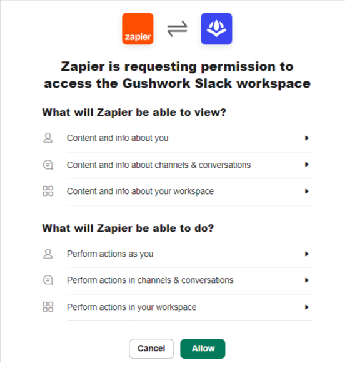
- Depending on what you want to automate, choose an action event, such as Send Channel Message or Add Reminder. Authorize Zapier to access your Slack account by logging in and granting permissions.
- Set up the details of your Slack action, such as selecting the channel to send messages to and customizing the message content.
- Run a test to ensure everything is set up correctly, then click Publish to finish the setup. Now you will start receiving alerts in Slack whenever your trigger is activated in HappyFox.
While HappyFox's Slack integration can meet very basic business needs via Zapier, some organizations require additional features or flexibility. And this is where ClearFeed comes into the picture.
Introducing ClearFeed: A Slack-Native Alternative to HappyFox and Slack Integration
If you are evaluating the HappyFox and Slack integration primarily to manage support from Slack, ClearFeed offers a more complete Slack-native helpdesk layer. Instead of only sending ticket alerts into Slack, ClearFeed helps teams create, triage, assign, respond to, escalate, and measure support work directly from Slack.
ClearFeed can be used as a native ticketing system in Slack, or it can connect Slack conversations with the ticketing and task management tools your team already uses. This is especially useful when support, customer success, IT, product, and engineering teams all collaborate in Slack but still need structured tickets, SLAs, reporting, and escalation workflows.
ClearFeed Features To Consider Beyond the HappyFox-Slack Integration
- Create and manage tickets from Slack: Agents can turn Slack messages or threads into ClearFeed tickets, preserve the conversation context, include attachments, and update fields such as status, priority, assignee, title, and custom fields without leaving Slack.
- Centralized triage channels: ClearFeed triage channels act as a command center for agents. New requests from Slack, MS Teams, email, customer portal, web chat, and API can be routed into dedicated Slack triage channels where agents can reply, add private notes, update ticket fields, and coordinate internally.
- Ticketing and task integrations: ClearFeed connects Slack workflows with systems such as Zendesk, Freshdesk, Intercom, Jira Service Management, Salesforce, Jira, Linear, ClickUp, Asana, HubSpot, and GitHub. Depending on the integration and configuration, replies, comments, status changes, and linked work can stay connected across Slack and external systems.
- Custom ticket forms and conditional fields: ClearFeed forms let teams standardize ticket intake from Slack. You can add custom fields, required fields, default values, hidden fields, and conditional fields so that users see only the questions relevant to the type of request they are submitting.
- SLA management and business schedules: ClearFeed lets teams define first-response, resolution, and one-touch-resolution targets based on business hours, holidays, priority, assignee, request type, or customer segment. This helps support leaders track response performance more reliably than relying on Slack notifications alone.
- Slack-native workflows and reminders: Teams can configure workflows that send Slack reminders, post automated responses, DM assignees, or call webhooks when a request meets specific conditions. ClearFeed can also keep Slack reminders up to date as the underlying ticket state changes, reducing alert noise.
- AI assistance for support teams: ClearBot Assist helps agents summarize long threads, find previous requests from the same customer, use quick replies, and generate answers from configured knowledge sources. ClearFeed also supports AI fields that can classify requests by category, sentiment, urgency, or other custom criteria for routing and reporting.
- Knowledge base and AI agents: ClearFeed AI Agents can answer questions by drawing on connected knowledge sources, including documentation and internal support history. Teams can use AI to suggest responses privately to agents or to automatically respond in Slack, depending on how the workflow is configured.
- CSAT surveys in Slack: ClearFeed can automatically send Slack-native CSAT surveys when a request or ticket is solved. Teams can choose between emoji ratings and thumbs-up/down feedback, ask for additional comments, and review CSAT results alongside the request.
- Engineering escalation without losing support context: When a support issue needs product or engineering help, ClearFeed can create linked tasks in Jira, Linear, GitHub, Asana, or ClickUp. Agents can mark tasks as blockers so critical dependencies are completed before a ticket is closed.
When ClearFeed Is a Better Fit
The native HappyFox Slack integration is useful if your main requirement is to receive notifications and perform basic ticket actions from Slack. ClearFeed is a stronger fit when Slack is where your support work actually happens, and your team needs deeper workflows: structured intake, triage ownership, internal collaboration, SLAs, AI assistance, CSAT, reporting, and task escalation.
In short, HappyFox connects your help desk to Slack. ClearFeed turns Slack into a full support workspace.
Schedule a demo to see how ClearFeed can help your team manage Slack-based support with fewer handoffs and better visibility.