Table of Contents

Slack is a great communication tool, but it can feel overwhelming when juggling time zones, endless messages, and ever-growing to-do lists. Sound familiar? If so, you're not the only one feeling strained. The good news is that Slack has a built-in solution: Scheduled Messages. This feature is more than just a nice extra - it's a big help.
By scheduling your Slack messages in advance, you can work when it suits you best and avoid being glued to your screen 24/7. No more racing against the clock in different time zones. No more constant interruptions derailing your focus. Scheduled messages let you plan your workday and collaborate smoothly with colleagues worldwide.
This article will show you how to use this feature, from timing your messages perfectly to sending important notifications to customers with ClearFeed. With these tips, you can transform Slack from a distraction into an asset. Let's jump in and get started!
TL;DR
Slack scheduled messages help teams send updates at the right time, while ClearFeed adds bulk scheduling, targeting, tracking, and follow-up workflows for support teams.
The gist
- Slack lets users draft a channel or DM message and schedule it from the send-button dropdown.
- Scheduled messages can be viewed under Drafts & sent, then edited before delivery.
- Recurring messages require Slack Workflow Builder, third-party scheduler apps, or the Slack API.
- ClearFeed Announcements adds bulk scheduled messages across customer channels, segments, and collections.
- ClearFeed also tracks delivery, replies, reactions, engagement by channel, and follow-up requests.
Worth knowing: Native Slack scheduled messages are useful for simple timing, but they do not cover support-grade broadcasting, audience targeting, engagement metrics, or request tracking.
What Is Slack’s Scheduled Message?
Slack’s Scheduled Message feature allows users to compose a message and set a specific time for it to be sent automatically. This feature helps coordinate communication across different time zones, plan reminders, or ensure messages are delivered at the most effective time for recipients.
How To Schedule a Slack Message?
Want to send a Slack message at the right time? Here’s what you can do with these simple steps.
- Head to the channel or DM where you want your message to appear. Click in the message field and type away—add attachments, emojis, mentions, whatever you like.

- Click the little arrow next to the paper airplane before hitting send. This opens up options for the perfect date and time to deliver your message.
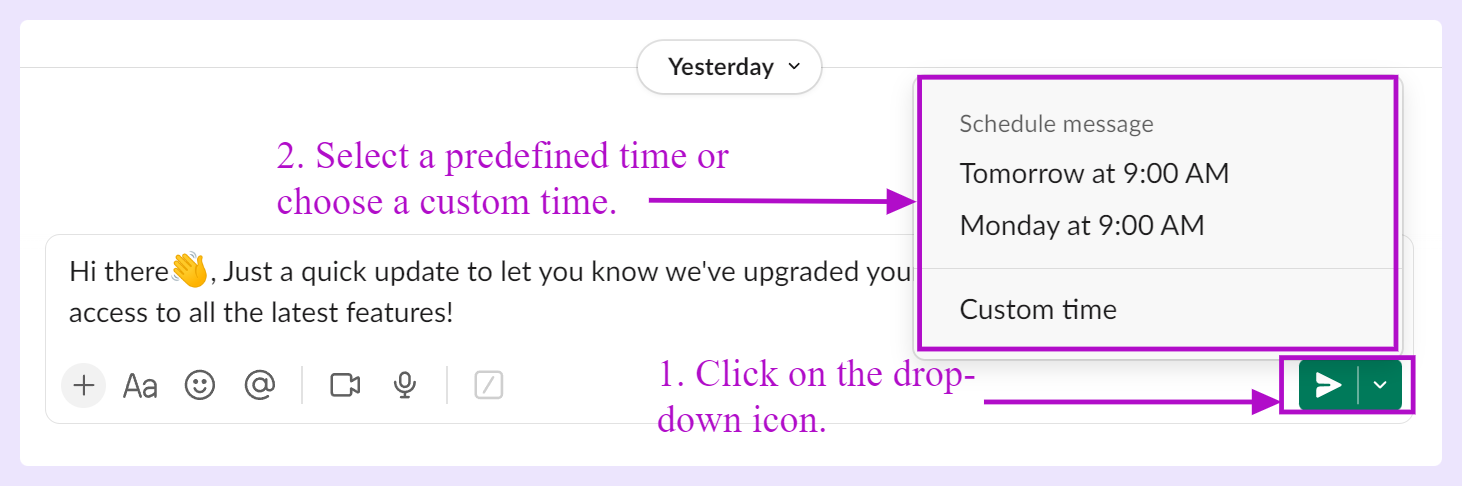
- Once you've set the schedule, a confirmation pops up. Give it a click to lock in your settings. Now sit back and relax, knowing your Slack message will appear when you want it to.
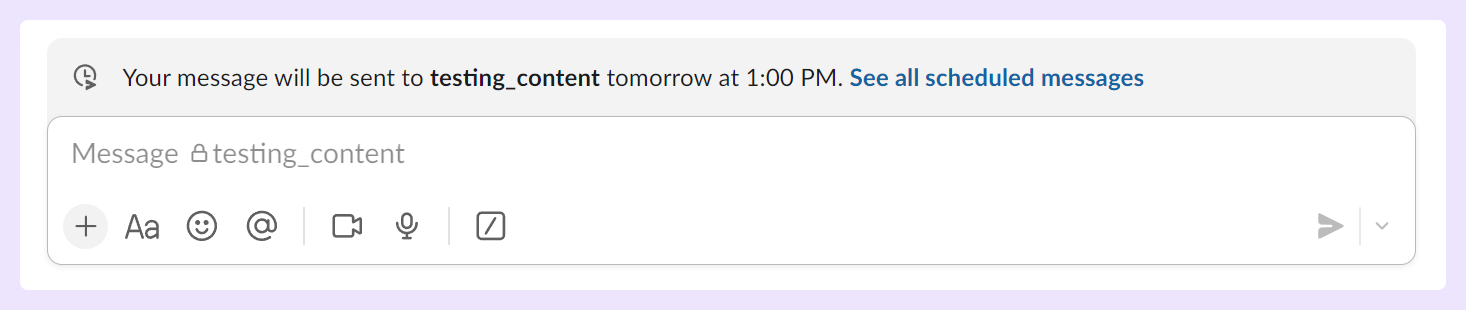
Note: The option to schedule messages to threads is unavailable in Slack.
How To View the History of Scheduled Messages in Slack?
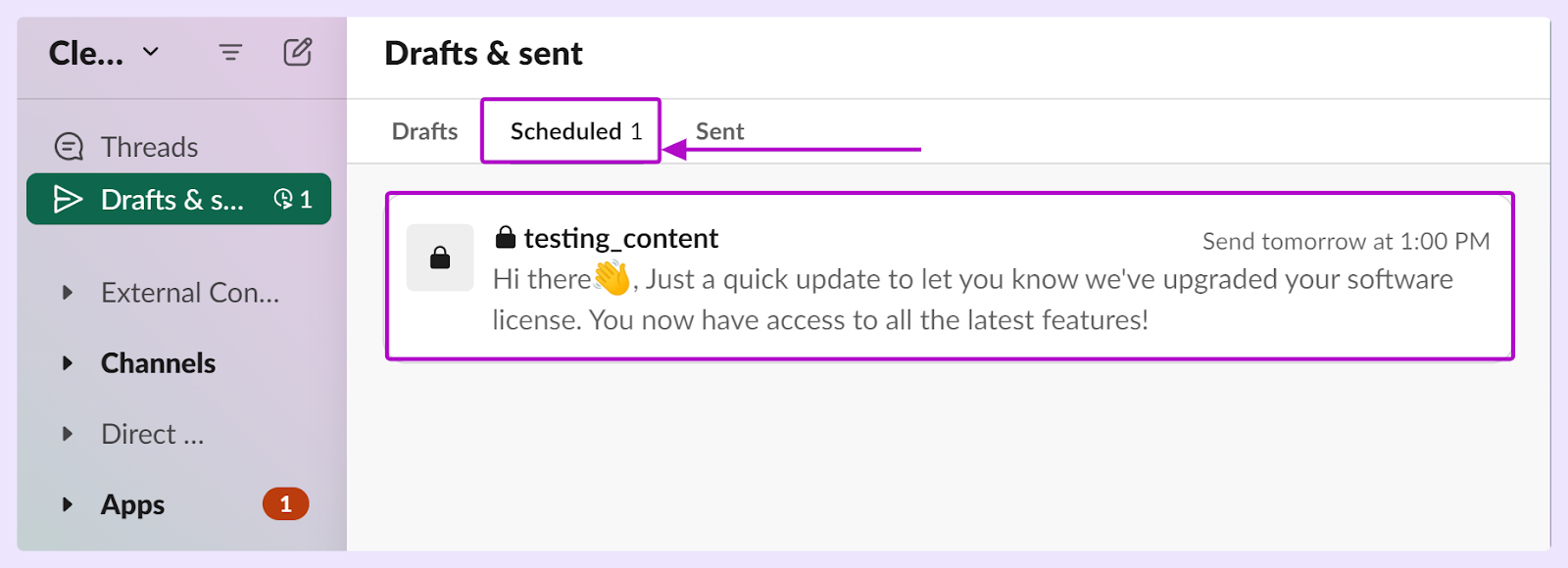
To look at your scheduled messages, you can simply choose the 'View all scheduled messages' option."

All your planned messages are listed under 'Drafts & sent.' You can find messages sent in the 'Sent' category, while messages intended for future delivery can be seen under the 'Scheduled' tab.
How To Edit a Scheduled Message in Slack?
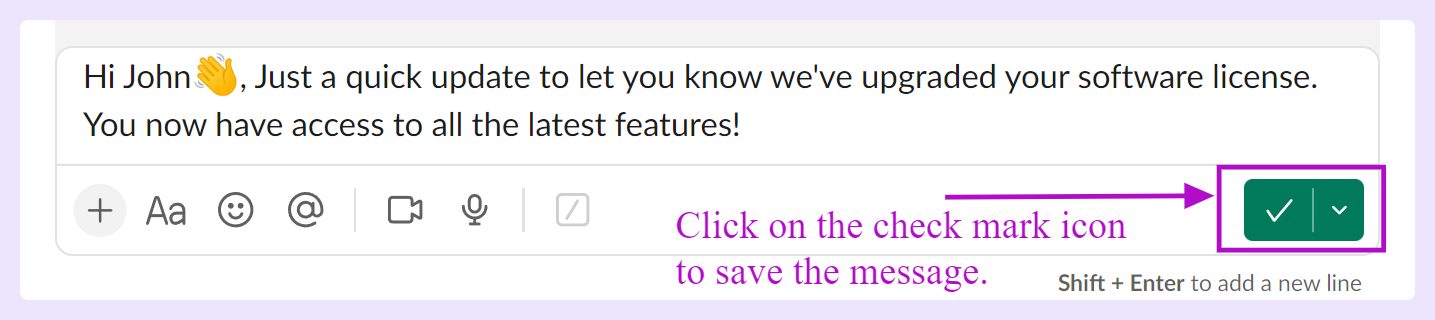
To modify a scheduled message, simply position your cursor over the message and select the pencil icon. This will direct you towards the message field, enabling you to initiate edits. Upon completion, securing your changes is as simple as hitting the checkmark icon.
How To Set up Recurring Scheduled Messages in Slack?
You can use the built-in Workflow builder or third-party tools to set up recurring scheduled messages in Slack. Here are the steps for both methods:
Method #1: Using Slack’s Workflow Builder

- Next, choose Messages and select the Slack channel(s) where your message will occur regularly. Then, augment the workflow by adding interactive elements like a button or other important actions tailored to your needs. You can also send scheduled messages to a person or a thread.
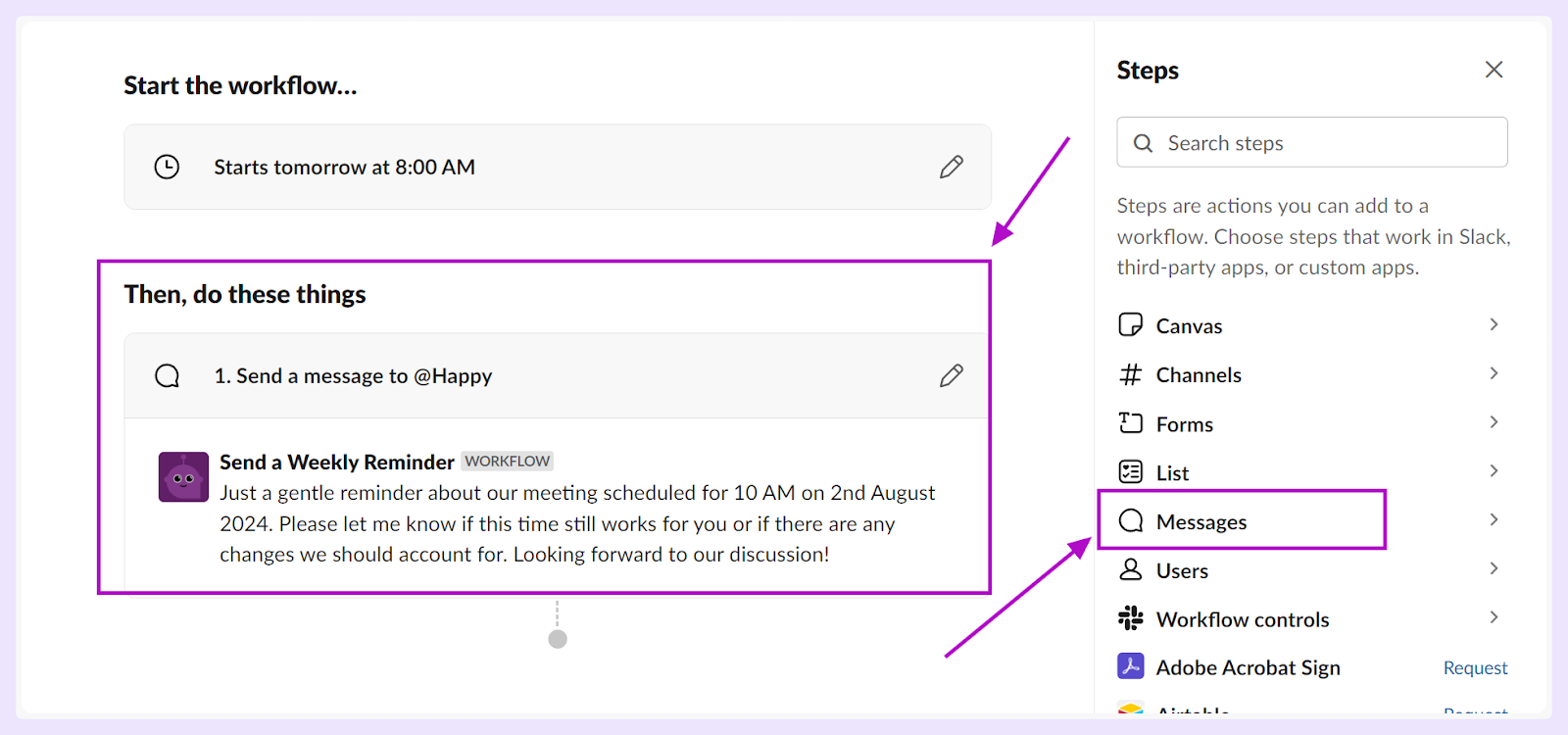
- After adding all the necessary details to your workflow, click 'Finish Up' to save all your work. Your newly recurring message workflow is now saved and can be managed directly within your Slack workspace. To make your workflow live, simply press 'Publish.' Your recurring messages will now operate according to the schedule and parameters you've set.
Method #2: Using Third-party Integrations or Slack API
By using third-party app integrations like Message Scheduler, Tiny, or Easy Message Scheduler, you can set up recurring scheduled messages. It is important to note that some tools may require a paid subscription for advanced features or high usage. Another method to set up the Scheduled Message feature on Slack is using Slack's API. However, its implementation might require assistance from someone well-versed in technology or your IT support team.
Sidenote: ClearFeed offers seamless integration with Slack, which empowers users to craft and schedule messages for delivery at specific times. We’ll discuss more about it later in this blog.
What Are the Benefits of Slack Scheduled Messages?
Slack's scheduled messages can significantly boost the efficiency and effectiveness of remote collaboration in numerous ways. For example,
- Promotes Work-Life Balance: Scheduling Slack messages during work hours prevents after-hours stress, respects colleagues' time, and helps avoid burnout while maintaining balance.
- Efficient Cross-Time Zone Communication: Use Slack's message scheduling to easily coordinate with global teams, ensuring messages are sent when everyone is online, thus smoothing cross-time zone collaboration.
- Reduction of Interruptions: Scheduling non-urgent Slack messages can minimize interruptions, promote focused work time, and boost productivity by enabling longer uninterrupted periods.
- Encourages Asynchronous Communication: Slack's scheduling feature lets you send messages at the recipient's convenience, enhancing communication without needing immediate replies, and is linked to a 3% boost in productivity.
Even though Slack's built-in message scheduling can be quite handy, ClearFeed goes a step further. But before showing you how that works, let's first look at what ClearFeed is all about.
ClearFeed is an AI-powered platform that helps customer support, IT, and engineering teams deliver better support via Slack and Microsoft Teams. It converts Slack channels into a single queue of requests, uses AI to flag requests that require a response, and allows responders to update and manage them. It is designed to integrate with Slack and enhance various Slack features to optimize efficiency and collaborative power for support teams.
Now that we've covered the basics, it's a good time to dig further into a key aspect of ClearFeed: Announcements. In the following sections, we will look at this feature's advantages and understand how it can enhance your team's communication and make you more productive.
Enhancing Slack's Scheduled Messaging With ClearFeed
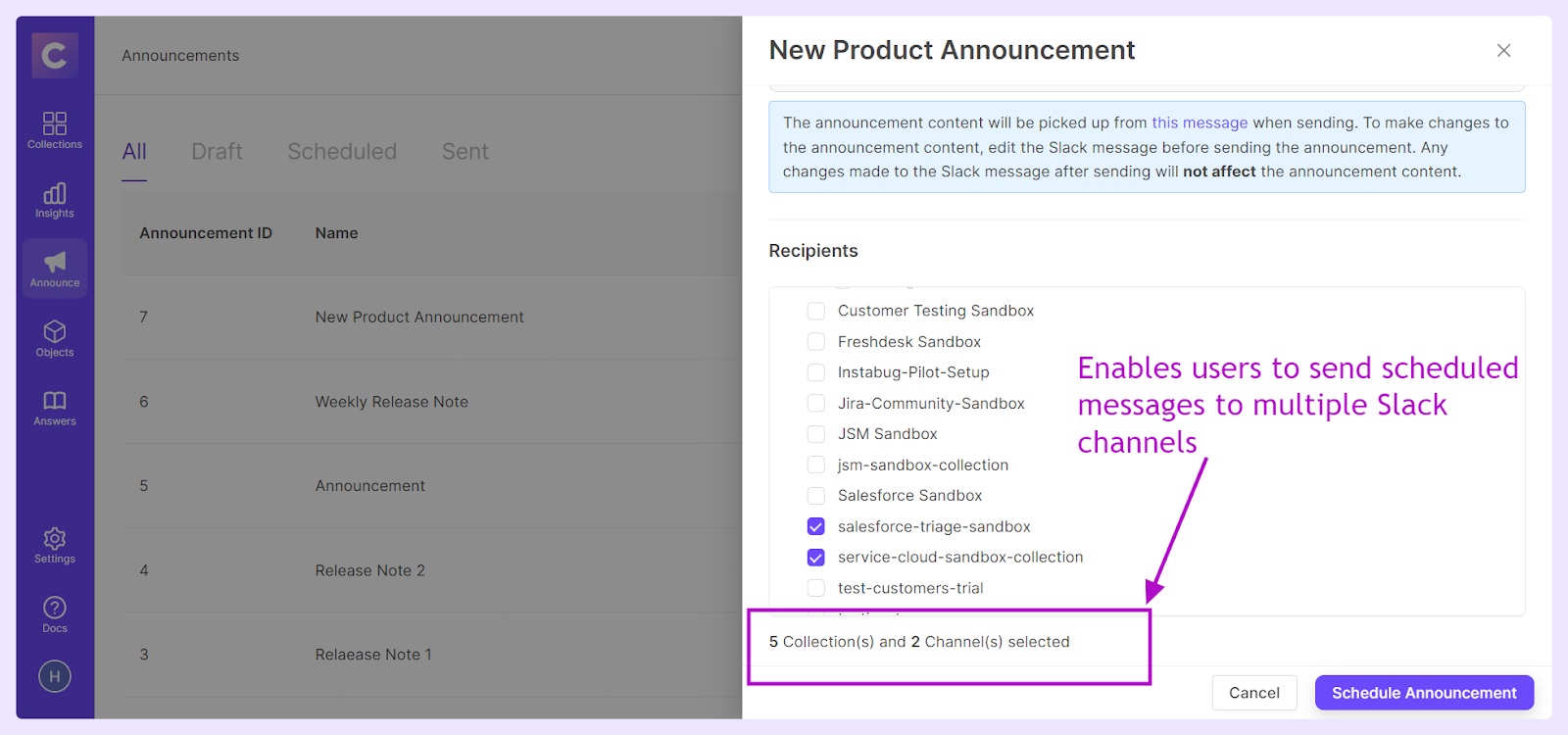
ClearFeed Announcements significantly improves Slack messaging by equipping businesses with a robust bulk message-scheduling feature. This integration with Slack transforms how teams communicate, both internally and externally, by providing an organized approach to mass messaging. Here’s how it elevates the experience:
- Broadcast Product Updates: The feature addresses the challenge of mass communication across customer channels. You can:
- Draft your message.
- Schedule a suitable delivery time.
- Monitor the status and engagement metrics — all streamlined in a user-friendly workflow.
2. Optimal Timing for Message Dispatch: With ClearFeed, you can:
- Time your messages when your employees, customers, or external vendors are most active, thereby amplifying their reception and impact.
- Schedule and forget: there is no need to be online at a specific time, which improves overall productivity.
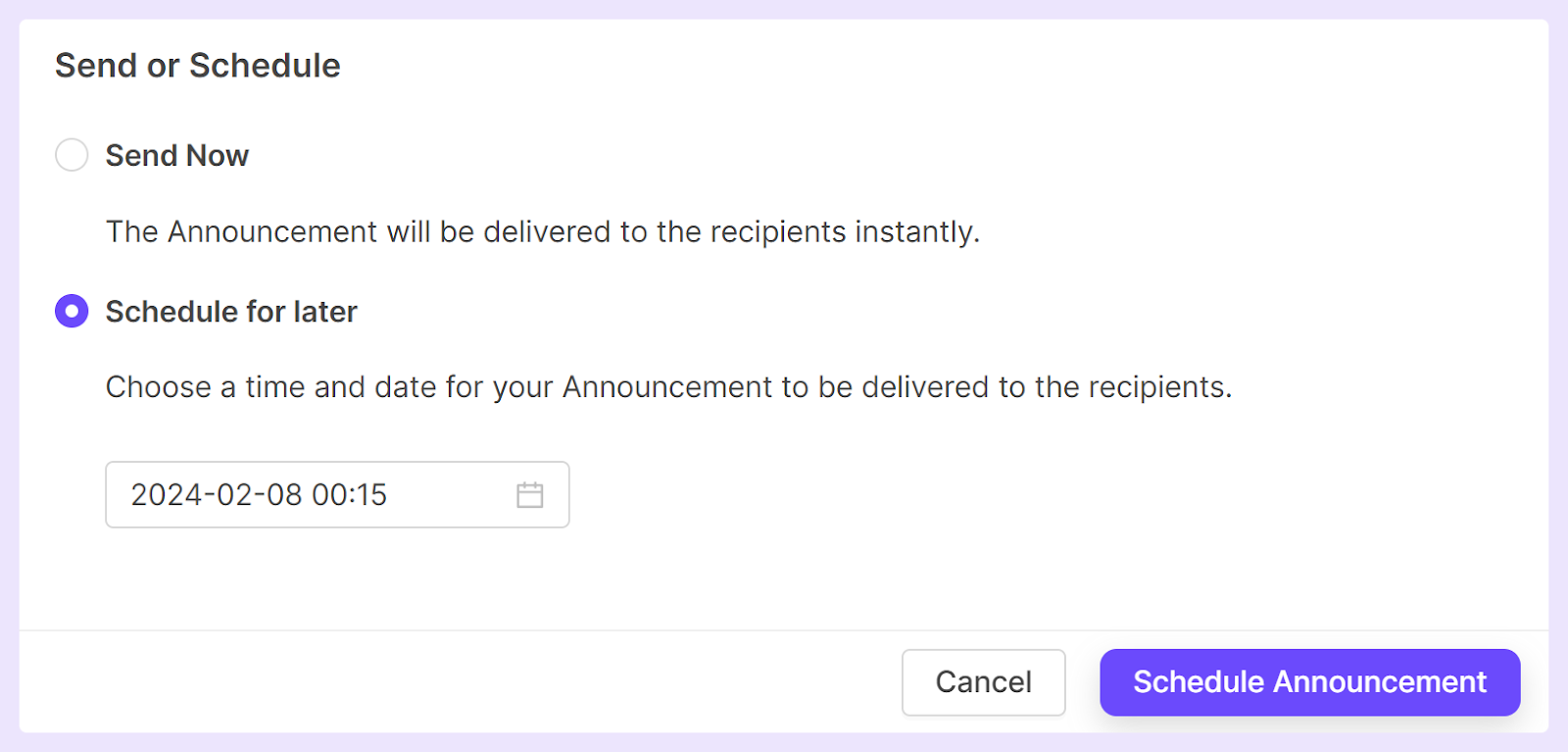
3. Real-time Delivery Notifications: ClearFeed’s integration with Slack provides:
- Instantaneous notifications upon message delivery, ensuring a sense of completion.
- Freedom from constant status checks, freeing you to focus on other tasks.
- Efficient communication through quick responses or timely follow-ups.
4. Centralized Management Dashboard: The Announcement feature offers an organized viewing platform so you can:
- Supervise all stages of messaging — drafts, scheduled messages, and delivered ones.
- Stay updated on what has been communicated and what's next to aid effective communication planning.
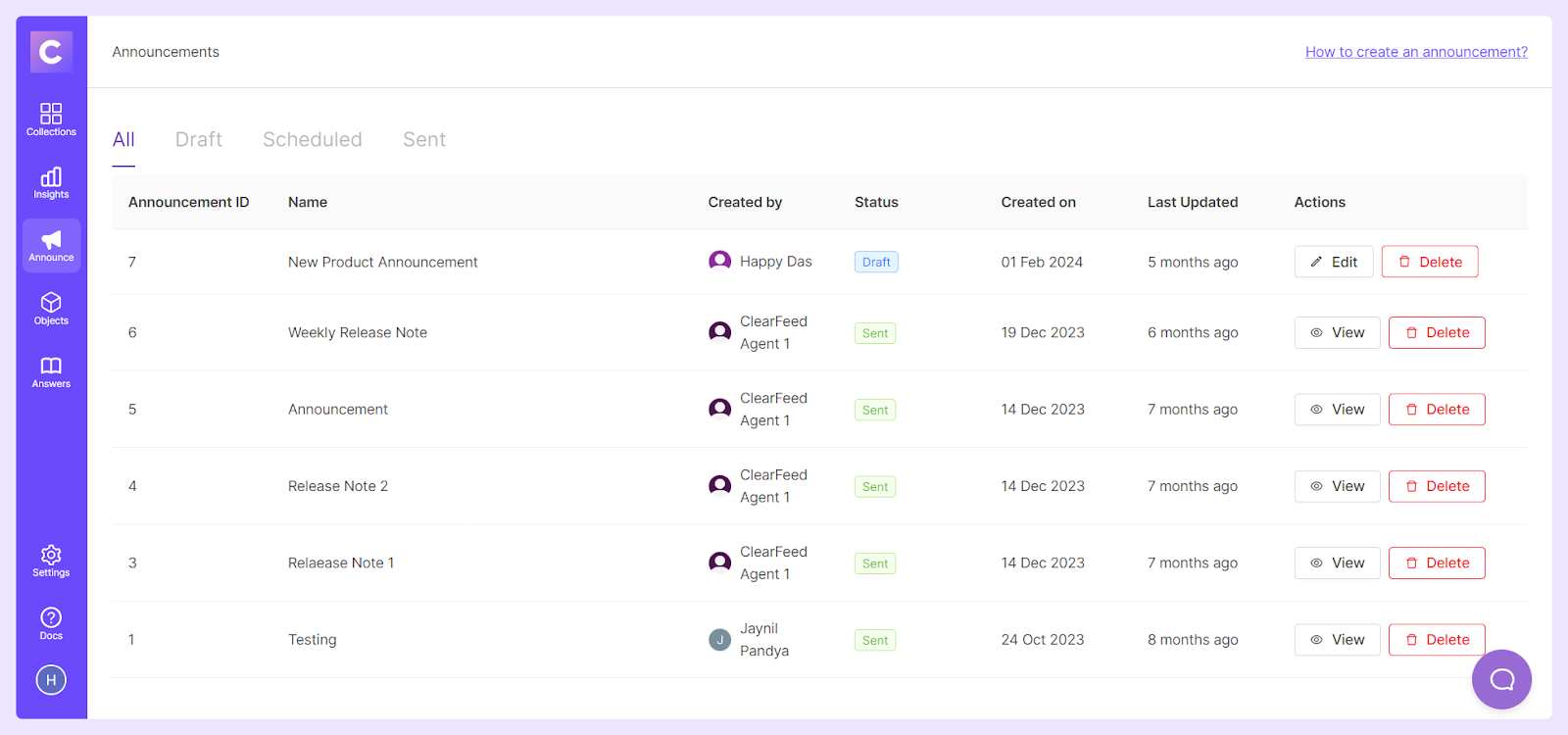
5. Test Announcements/Messages: Before broadcasting to a larger audience, ClearFeed allows you to:
- Send test versions of your announcement to selected recipients or yourself.
- Ensure the message's appearance and content meet your standards.
- Catch and resolve errors or technical glitches to ensure seamless, efficient delivery.
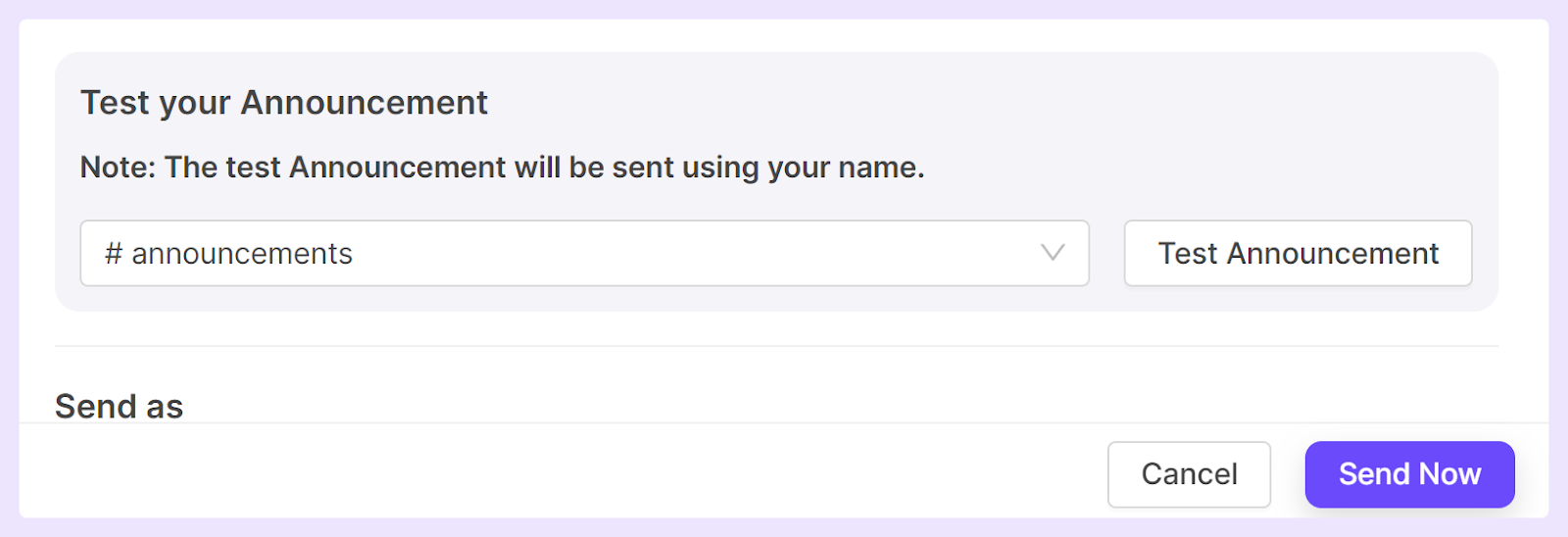
Beyond basic scheduling, ClearFeed also lets teams create announcements directly from Slack. You can draft the announcement in a dedicated Slack channel, use ClearFeed Actions to turn that message into an announcement, and then finish recipient selection, testing, sending, or scheduling from the ClearFeed web app. This keeps the drafting experience familiar while giving teams more control before a message goes out broadly.
- Targeted Customer and Channel Selection: Instead of sending the same update to one channel at a time, ClearFeed lets you choose individual Slack channels, entire Collections, or customer segments. You can filter recipients by Customer Owner or custom fields such as plan type, region, lifecycle stage, or other account data. This is especially useful for sending downtime notices only to impacted customers or release notes only to the teams that use a specific feature.
- Flexible Sender Options: ClearFeed announcements can be posted as the ClearFeed bot, a selected user, the Channel Owner, or the Customer Owner. This helps the message feel more personal in customer channels while still giving admins a centralized way to prepare and schedule the broadcast.
- Replies Can Become Trackable Requests: Slack's native scheduled messages stop at delivery. ClearFeed can go further by tracking meaningful customer replies to an announcement as requests, which the support team can then handle or convert into tickets, depending on the Collection settings. Low-effort reactions like “cool” or “thanks” can be filtered out, so teams are not flooded with noise.
- Engagement Metrics by Channel: After an announcement is sent, ClearFeed shows how many channels it reached, which channels reacted or replied, the top emoji reactions, and links to the relevant Slack threads. This gives teams a practical way to see whether a scheduled customer message actually landed.
- Cleaner Follow-ups and Message Maintenance: ClearFeed supports sent-announcement updates by resyncing from the source Slack message, and announcements posted by the ClearFeed bot can be collapsed or expanded to reduce channel clutter. For follow-up workflows, ClearFeed Automations can also send delayed Slack messages based on request or ticket status, priority, assignee, customer, business hours, or custom fields.
Eager to learn more about how utilizing the Announcement feature simplifies communication across multiple Slack channels? Dive deeper into this topic with our comprehensive guide and study our detailed feature documentation here.