Slack is where most support and internal teams already talk. Zendesk is where tickets, SLAs, and CSAT get tracked. Connecting the two removes copy-paste, keeps requesters in Slack, and gives agents one system of record. This guide covers the current setup path for Zendesk’s official Slack app, the settings worth enabling on both sides, and how ClearFeed extends the native integration when your team needs deeper workflow, forms, triage, and reporting inside Slack.
What You Get From a Native Slack + Zendesk Connection
Zendesk’s official Slack app covers three core patterns:
- Post Zendesk ticket events (new tickets, status changes, comments) into designated Slack channels via Zendesk triggers.
- Create a Zendesk ticket from a Slack message using a message action.
- Handle a ticket-linked side conversation from Slack so agent context stays attached to the ticket in Zendesk.
That covers awareness and light collaboration. It does not cover conversational support inside customer or internal Slack channels, structured intake forms, private triage, or CSAT sync — those need either heavy trigger engineering or a purpose-built layer like ClearFeed.
Prerequisites
Zendesk
- An active Zendesk Suite or Support plan.
- Admin access to Zendesk Admin Center — specifically the ability to install apps and configure triggers and webhooks.
Slack
- An active Slack workspace and permission to install apps. If app installs are restricted, coordinate with a Workspace Owner or Admin.
- The same email address on both Slack and Zendesk for the person authorizing the integration — especially relevant later if you layer ClearFeed on top, which requires the connecting user to exist in both systems under the same address.
A Note on Slack Connect and Shared Channels
Zendesk’s native Slack app is designed for a company’s own Slack workspace. If your support model relies on Slack Connect channels shared with customers, plan for a layered setup: use the native app for internal notifications and use a tool like ClearFeed to convert customer messages in shared channels into Zendesk tickets with bi-directional sync.
Install Zendesk’s Slack App
Zendesk maintains the current install path in its own Help Center — the specific URLs and screens change over time, so use the vendor’s Zendesk Slack app listing as the source of truth. The high-level steps are stable:
- Sign in to Slack as a user with permission to install apps.
- Open the Zendesk Slack app from Zendesk’s Marketplace and start the install flow. Grant the requested Slack permissions.
- Enter your Zendesk subdomain (for example, yourcompany.zendesk.com) and authorize with a Zendesk Admin account.
- In Zendesk Admin center, open Apps and integrations → Integrations, locate Slack, and choose which Slack channels should receive which ticket events.
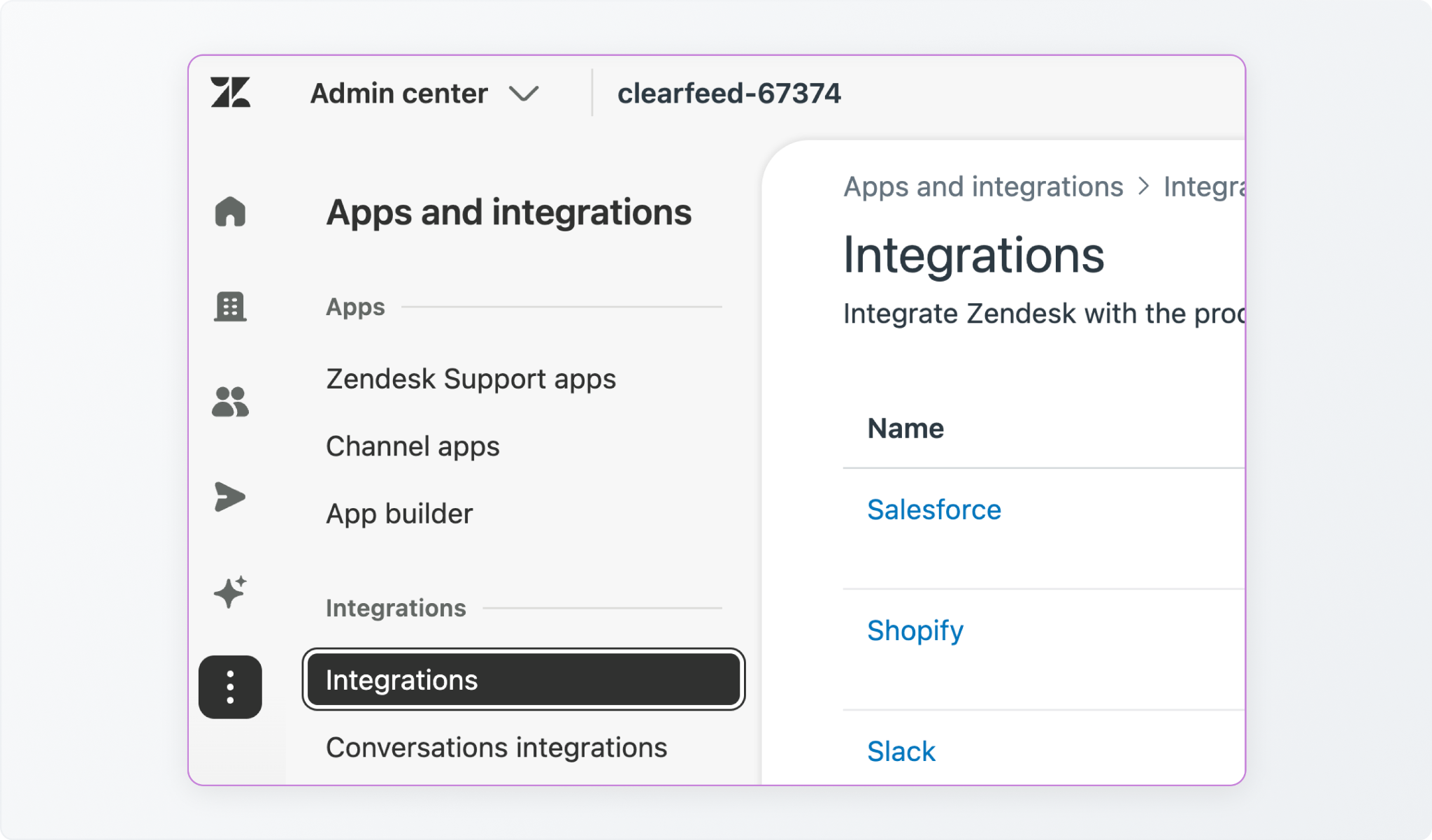
- Optionally create Zendesk triggers that fan out specific events (new ticket, priority change, tag applied) to the right Slack channel.
Once the app is installed, test with a Zendesk trigger that posts a low-noise event (for example, a ticket tagged with slack-test) to a private Slack channel before rolling out to production channels.
Tips To Get More From the Native Integration
- Route by product or team, not one firehose. Build separate triggers per product area or priority so each Slack channel stays relevant. A single “all tickets” channel gets muted within a week.
- Use side conversations for ticket-scoped chatter. When agents need a quick input from engineering or product on a specific ticket, a Slack side conversation keeps that thread linked to the ticket in Zendesk instead of losing it in a DM.
- Keep ‘create ticket from Slack’ behind a shortcut, not automatic. The native Slack app converts a message on demand. If you want automatic conversion of every new thread in a channel, that’s a workflow the native app doesn’t provide — see the ClearFeed section below.
- Pair with Zendesk’s AI Agents for deflection. Zendesk’s current AI features (AI Agents, autoreply, generative replies) sit inside Zendesk itself; the Slack app is the transport layer. Configure deflection in Zendesk first, then decide which interactions warrant a Slack notification.
Where the Native Integration Stops
The native Slack app is a strong notification and light-touch collaboration layer. It does not handle:
- Support delivered inside Slack — customer Slack Connect channels, internal IT / HR / Ops help channels, or DMs to a support bot.
- Bi-directional message sync between a Slack thread and a Zendesk ticket, so replies made in Slack are added as public comments or internal notes on the ticket.
- Structured intake — forcing requesters to fill in required fields before a Zendesk ticket is filed.
- Private triage on a customer conversation without leaving the customer’s Slack thread.
- CSAT collected in Slack and synced back onto the corresponding Zendesk ticket.
Teams that need any of the above typically add ClearFeed on top of the native integration.
Extend the Integration With ClearFeed
ClearFeed sits between Slack and Zendesk and turns Slack channels — customer Slack Connect, internal support, DMs — into a first-class intake and triage surface for Zendesk. Below is what ClearFeed adds beyond the native app, grounded in the current ClearFeed documentation for the Zendesk integration.
1. Bi-Directional Slack ↔ Zendesk Sync, Configurable per Ticket: ClearFeed synchronizes replies both ways between a Slack thread and its linked Zendesk ticket. Sync mode is configurable at the ticket level: two-way, Slack-to-Zendesk only, Zendesk-to-Slack only, or off. Zendesk status changes (including custom statuses) surface back in the Slack thread; message edits from Slack sync into the linked Zendesk ticket as Internal Notes when private-comment sync is enabled.
2. Create Zendesk Tickets From Slack — Emoji, Automatic, or via a Triage Channel: Each ClearFeed Collection can be set to file Zendesk tickets in one of two trigger modes: Emoji (a responder reacts with a configurable emoji to convert a thread) or Automatic (every new thread in a monitored channel becomes a ticket). Tickets can also be filed from a private triage channel using the More Actions → File a Zendesk Ticket option. Slack messages and attachments in the thread are attached to the ticket. Private ticket creation via DM or the /cf-file shortcut is available in the Internal Helpdesk and Integrations editions.
3. Structured Intake With Zendesk Forms: ClearFeed can present a File Ticket form in Slack that maps directly to Zendesk field types — text, multi-line text, email, phone, number, date, drop-down, multi-select, checkbox, tags, and attachments — along with Zendesk system fields (Subject, Description, Requester Email, Status, Priority, Assignee, Group). Multiple forms per account are supported, with a picker shown to the requester when more than one form is configured. Fields Zendesk marks as “Required to solve a ticket” are enforced through a Solve dialog in Slack.
4. Private Triage Channels Attached to a Customer Thread: Every request can have a paired private triage channel where responders discuss the ticket without the requester seeing. Public triage comments sync to Zendesk as public replies; private triage comments sync as Internal Notes when configured. This preserves the customer-facing Slack thread while giving the internal team room to coordinate.
5. Edit Zendesk Ticket Fields From Slack: Responders can update the linked Zendesk ticket — title, priority, assignee, custom fields exposed on the Edit form — from the Slack triage channel using an Edit Ticket action. They can also mark tickets solved directly from the request channel; a Solve dialog captures any Zendesk-mandatory fields before the transition.
6. CSAT Collected in ClearFeed, Synced Back to Zendesk: ClearFeed can post CSAT survey responses collected in Slack onto the corresponding Zendesk ticket. Both legacy 2-point and current Zendesk multi-point CSAT (up to 5-point) are supported; the ClearFeed survey format must match the Zendesk configuration. CSAT sync requires Zendesk’s impersonation scope, which is prompted for during setup, and Zendesk must trigger the CSAT survey record first for both systems to stay in sync.
7. AI-Driven Status Transitions and AI-Summarization: Optional AI settings let ClearFeed move a Zendesk ticket to Pending when a responder replies and re-open it when a requester replies with something substantive (skipping thanks-only messages). When enabled, ClearFeed can also generate a summarized Title and Description for the Zendesk ticket when the source Slack thread exceeds 150 characters; shorter threads fall back to the default non-summarized behavior.
8. Reverse Zendesk Flow (Work on Email and Help Center Tickets From Slack): Tickets that originate outside Slack — email, Zendesk Help Center, web form — can be surfaced into a designated Slack channel using a Slack webhook workflow and a Zendesk trigger. ClearFeed then treats those tickets like any other request: bi-directional sync of comments and status, agents responding from Slack, edits from the triage channel, and optional form imports so Zendesk form values render in Slack.
9. Emoji Rules, Assignment Rules, and Follow-Ups:
- Configurable emoji rules let responders assign a Zendesk ticket or move it to Done from Slack.
- Auto-assign-to-first-responder assigns both the ClearFeed request and the linked Zendesk ticket to the first eligible team member who replies in the Slack thread.
- If a solved Zendesk ticket receives a new substantive reply in Slack from a non-responder, ClearFeed can auto-create a follow-up ticket in Zendesk instead of re-opening the closed one.
How ClearFeed Shows Up in Zendesk
Tickets created by ClearFeed are tagged with clearfeed, the source Slack channel name, and the form used to create them — safe to reference in Zendesk triggers and automations (for example, if tag clearfeed is present, skip auto-assign so ClearFeed’s own assignment runs). Applying the cf-disabled tag on a ticket stops ClearFeed sync for that ticket. Public replies are posted under the author’s own Zendesk identity when possible; internal notes from end-users or Light Agent public replies fall back to the integrator with a “Sent by <name>” prefix.
Rollout Checklist
- Install Zendesk’s Slack app in a test Slack workspace or against a Zendesk sandbox before touching production.
- Decide up front which Slack channels are “awareness only” and which are “work happens here” — that decision drives whether the native app is enough or ClearFeed belongs in the mix.
- List the fields Zendesk requires to solve a ticket. If any of those fields need to be captured at intake, plan for a form layer (ClearFeed Forms) rather than post-hoc edits.
- Agree on tagging conventions — source channel, product area, priority — before you build Zendesk triggers, so both native and ClearFeed-created tickets are routable from day one.
- If you plan to sync CSAT, align the survey format (point scale) on both sides before enabling the sync.
Ready to Extend the Integration?
See how ClearFeed extends Slack + Zendesk or book a demo to walk through the setup for your team.