Most support conversations start in Slack, long before anyone opens Freshdesk. Filing a ticket for every one of them should be a single click from the thread, not a context switch into another tab.
There are two ways to do that: Freshdesk's native Slack app has a built-in ticket shortcut, and ClearFeed layers a Slack-first ticket flow on top of Freshdesk with emoji triggers, forms, and two-way sync.
This guide covers both. For the install walkthrough that sits upstream of this one, see how to configure the Slack-Freshdesk integration; for the broader business case, see our Slack-Freshdesk integration overview.
Option 1: Create a Freshdesk ticket with the native Slack app
Once the Freshdesk Slack app is installed and your Freshdesk domain is linked, any workspace member can turn a Slack message into a Freshdesk ticket in two ways. Both open the same modal, and both pre-fill the ticket description with the content of the Slack message you started from.
Method A: From the message actions menu
- Hover over the message you want to file
- Click the More actions (three-dots) → Connect to apps → More message shortcuts.
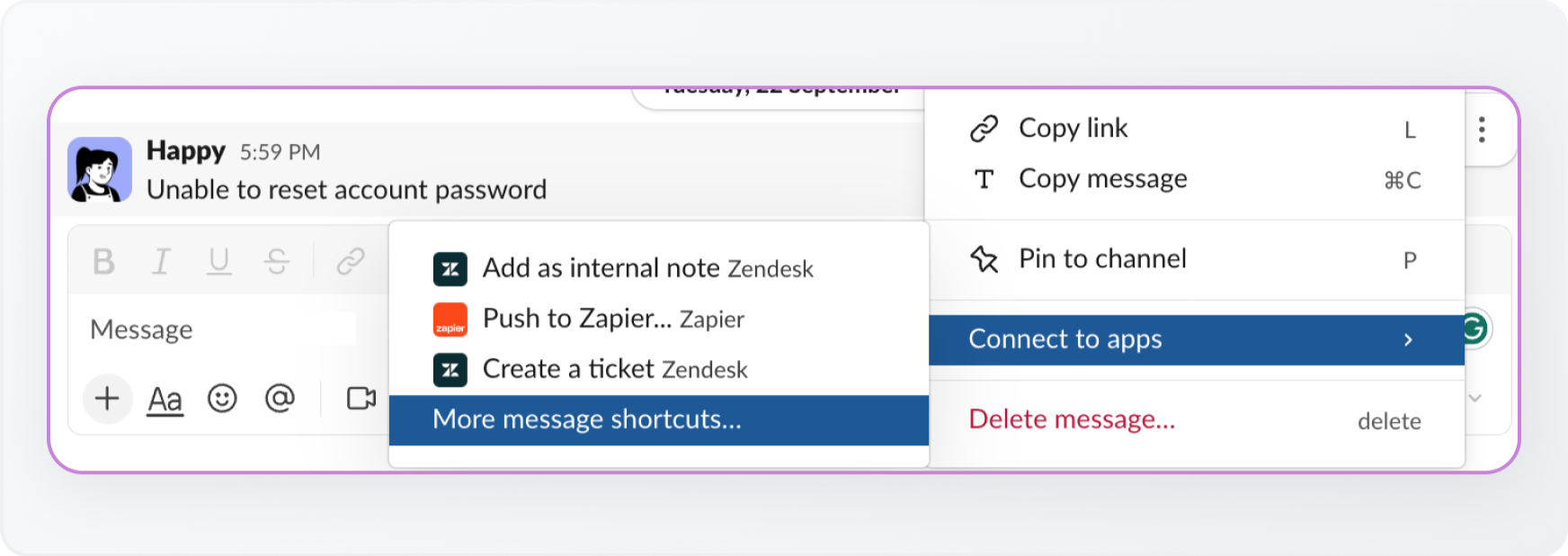
- Select Create a ticket. The ticket description is pre-filled with the message body.
Method B: From the message input shortcut
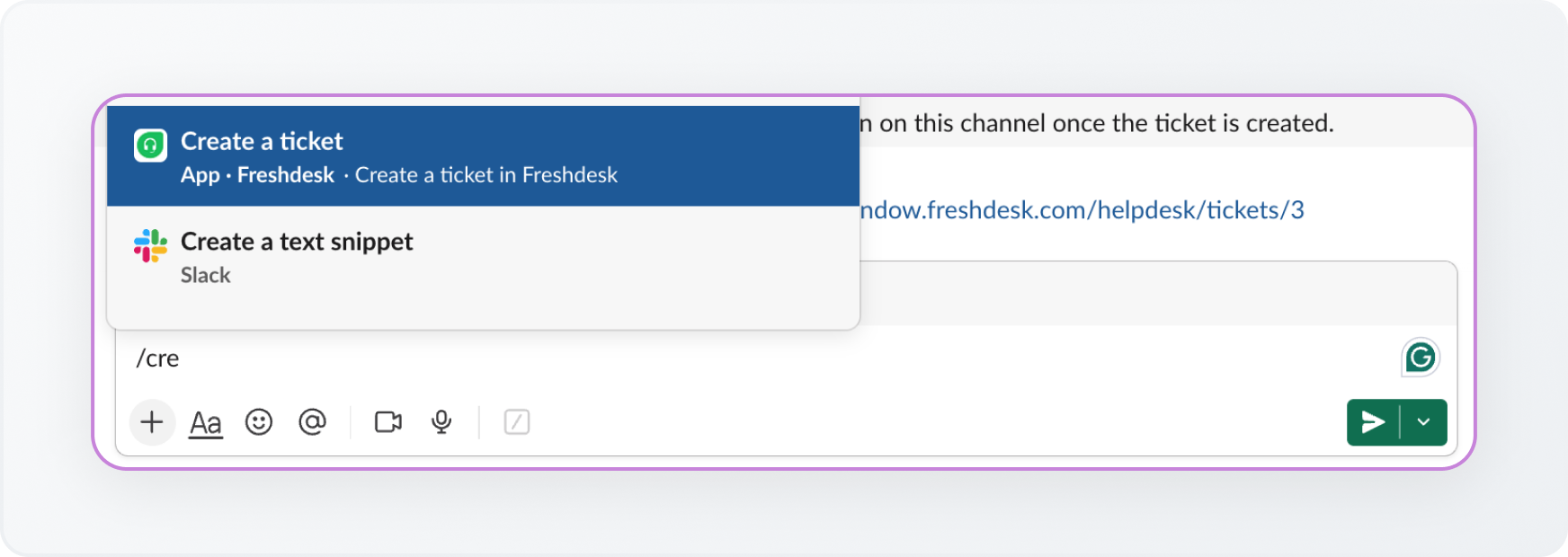
In the message input area, open Shortcuts and run /Create a ticket. The modal opens with an empty description you fill in by hand.
In the ticket modal, fill in the requester, subject, group, status, priority, and any other required Freshdesk fields, then click Create. The ticket is filed in Freshdesk, and the Slack message is linked to it.
The native app is well suited to one-off tickets that an individual agent files from a Slack thread. Replies and status updates still happen in Freshdesk, and the Slack thread isn't kept in sync with the ticket conversation.
Option 2: Create Freshdesk tickets with ClearFeed's Slack-first flow
If more than a handful of your tickets are born in Slack, pushing each one through a modal gets expensive. ClearFeed treats Slack as the primary intake surface: a channel is monitored, messages become ClearFeed requests, and requests can be converted into Freshdesk tickets with one of five triggers.
Automatic ticket creation
Turn on Automatic Ticketing on a Collection, and every new conversation in a monitored channel becomes a Freshdesk ticket without any manual action. ClearFeed posts the ticket ID and status in the Slack thread so the requester sees it immediately.
Emoji reaction
With manual ticketing, react to the first message in a thread with 🎫 (:ticket:) to file a Freshdesk ticket on demand. The default emoji is configurable, and you can scope reactions to responders only or allow any user. React with 📌 (:pushpin:) if you want to log a ClearFeed request now and promote it to a Freshdesk ticket later.
Slash command
Type /cf-file in any monitored channel to open the ticket modal, pick the form you want, fill it in, and ClearFeed files the Freshdesk ticket and posts the ticket details back in the channel.
Message Bar button
Enable the Message Bar on a Collection to show a persistent File a Ticket button below the channel’s latest message. The button opens the same ticket modal as the slash command, so users don’t have to remember the command.
For sensitive requests, the Message Bar also offers a File a Private Ticket button. It sends the ticket to the triage channel without posting anything publicly in the request channel.
Bot tagging
Enable the bot-tagging trigger, and anyone can file a ticket by mentioning @ClearFeed in the top-level message of a thread. Tagging the bot in replies does not create a ticket; those invocations are routed to the Virtual Agent instead.
Forms that match your Freshdesk fields
Each ticket trigger can pop a Slack-native form before the Freshdesk ticket is filed. Besides the standard Contact Email, Subject, and Description fields, ClearFeed forms support Freshdesk's Priority and Source fields, as well as field-level properties for defaults, hidden fields, and responder-only edits. If all required fields have default values or are responder-only, ClearFeed can file the ticket without showing the requester a form.
What ClearFeed creates in Freshdesk
When ClearFeed creates a ticket, it uses the requester’s Slack email to find or create a Freshdesk contact. The ticket appears to have been created by the person who connected Freshdesk to ClearFeed. The reporter is the person whose email is sent to Freshdesk’s API.
When someone’s email matches a Freshdesk agent or contact, their Slack replies post to the ticket under that identity. Freshdesk replies sync back to the Slack thread.
Internal notes also sync in both directions. Freshdesk and Zendesk are the only integrations that support two-way private note sync between Slack and the ticketing system.
Which approach to pick
Use Freshdesk’s native Slack app if your team works mainly in Freshdesk and turns just a few Slack messages into tickets each week. Use ClearFeed if your team creates, replies to, and resolves tickets in Slack. Emoji actions, the Message Bar, forms, and two-way sync keep the main conversation in the Slack thread while Freshdesk remains the system of record.
For more on how ClearFeed connects the two tools, read our overview of how ClearFeed streamlines Slack-Freshdesk integration. You can also book a call to see the workflow with your own Freshdesk instance.