There are two ways to remove Zendesk’s Answer Bot from a Slack channel, and they do different things. The surgical way — done inside Zendesk Admin Center — deletes just the Answer Bot configuration for that channel and leaves the rest of the Zendesk app in place. The nuclear way — a single Slack slash command — removes the entire Zendesk app from the channel, taking Answer Bot with it along with any ticket notifications and side conversations. Neither is recoverable once you confirm.
This guide walks through both, plus what happens to your existing tickets and channels afterward, and clears up a naming confusion that’s sending some teams to the wrong help doc in 2026.
First: make sure “Answer Bot” is actually what you want to remove
Zendesk has run three different Slack-related bot products under overlapping names, and the removal path is different for each:
If you’re here because a bot is posting suggested article answers in a Slack channel and you want it to stop, you’re in the right place. If the bot is a DM-only conversational agent, or if you’re trying to silence ticket notifications, follow the parent-integration path further down instead.
Option 1: Remove Answer Bot from one channel (Zendesk Admin Center)
Use this when you want to keep the rest of the Slack for Zendesk Support integration running — ticket notifications, side conversations, and manual ticket creation — and only stop the Help Center autoreplies in a specific channel.
- Sign in to Zendesk as an Admin and open the Admin Center.
- Go to Apps and integrations → Integrations → Integrations.
- Find Slack in the list, click the Edit .
- Open the Answer Bot tab. Each Slack channel that has Answer Bot enabled appears as its own row.
- Hover over the channel you want to clean up, open its options menu, and click Delete.
- Confirm with Delete configuration.
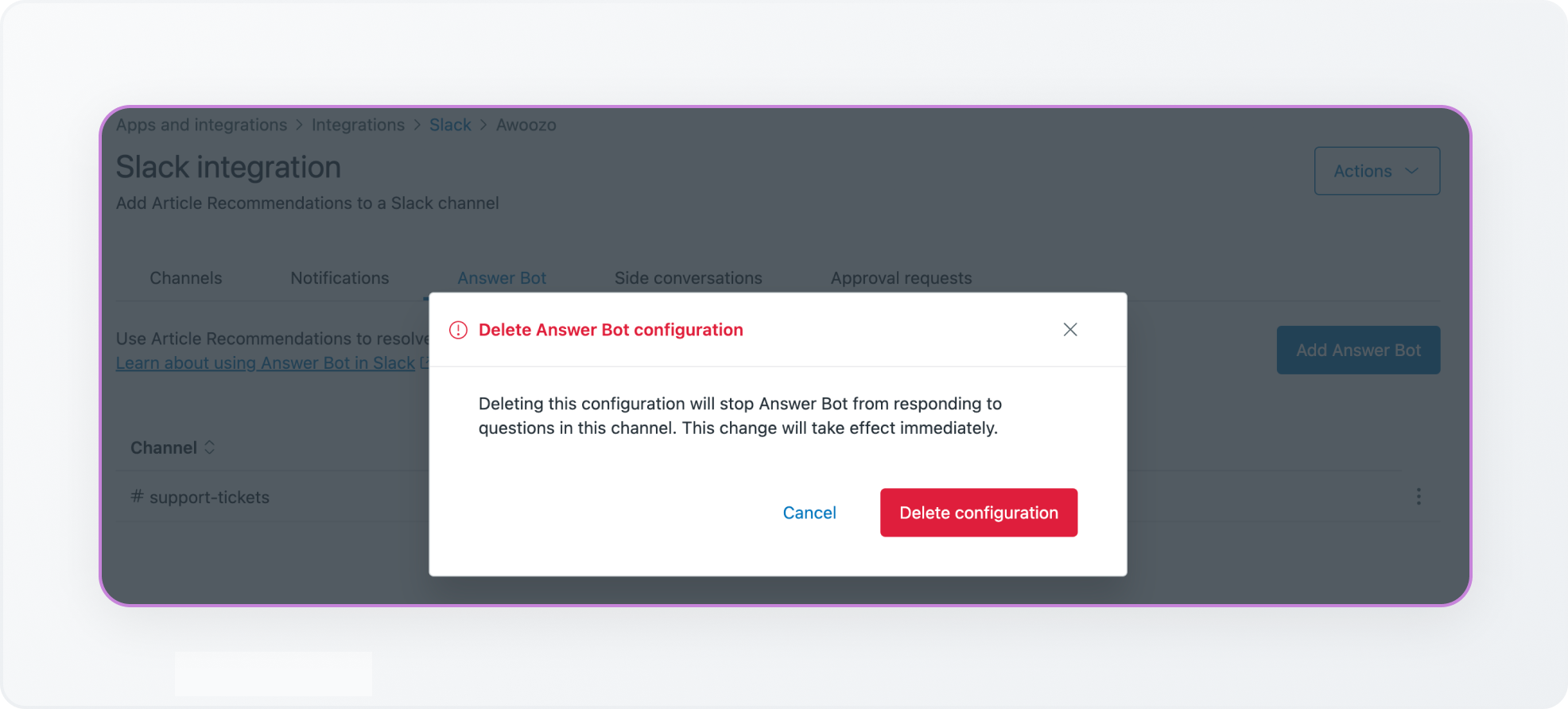
The change takes effect in Slack immediately. Zendesk’s own docs are blunt about the tradeoff: “You can’t recover it after you delete it.” If you had customised the answer prompts, response templates, or the list of Help Center brands the bot could draw from, those settings are gone with the row. Screenshot the config first if you might want to rebuild.
Option 2: Remove the entire Zendesk app from the channel (Slack slash command)
Use this when you want the Zendesk bot to stop doing anything in a given channel — Answer Bot suggestions, ticket notifications, side-conversation replies, and message-to-ticket shortcuts. This is a channel-level uninstall, not a workspace-level one.
- Open the Slack channel you want to clean up.
- In the message box, type /remove @Zendesk and press Enter.
- On the confirmation prompt, click Remove.
Zendesk documents this behavior directly: once the app is removed from the channel, it can no longer post notifications, provide side conversations, or run Answer Bot there. Other channels that still have the app installed are unaffected.
you remove the appIf Workspace Owners have restricted app management in your Slack workspace, the command may need approval before it takes effect.
What happens to your existing tickets, triggers, and channels
- Zendesk tickets are unaffected. Removing Answer Bot from a Slack channel doesn’t delete or edit any tickets, macros, or views on the Zendesk side.
- Other Slack channels keep working. Both options above are scoped to a single channel. Answer Bot continues to run in any other channel where it’s still configured.
- Ticket notifications keep flowing (Option 1 only). Deleting the Answer Bot configuration in Admin Center doesn’t affect the parent Slack for Zendesk Support integration. If you used the slash command in Option 2, those notifications stop too.
- Triggers with a “notify Slack” action stay active. They keep firing on the Zendesk side. If the target channel no longer has the Zendesk app, delivery fails silently — worth cleaning those up so the activity log stays useful.
- Reinstalling starts from scratch. Neither option preserves the deleted Answer Bot configuration. Rebuild the per-channel setup (channel selection, brands, prompts) from a fresh state.
Why teams remove Answer Bot from a channel
A quick sanity check first — some of these have a config fix that’s smaller than a removal:
- The bot is answering questions it shouldn’t. Narrow the Help Center brand/scope it’s pulling from in the same Admin Center tab, rather than removing it entirely.
- Answers are stale or wrong. Answer Bot is only as current as the Help Center content behind it — updating or unpublishing outdated articles usually fixes this faster than deleting the bot.
- It’s too noisy in the wrong channel. You can remove it from that one channel while leaving others alone; both options above are per-channel, not global.
- You’re migrating off Zendesk entirely. If so, you likely also want to disconnect the parent Slack for Zendesk Support integration on the Zendesk side and uninstall the Zendesk app from the Slack workspace. Those are separate steps beyond the scope of this guide.
Before you rebuild: what Answer Bot for Slack couldn’t do
A lot of the teams who arrive at this page aren’t leaving the idea of a Slack bot — they’re leaving Answer Bot specifically because it hit the ceiling of what it was designed to do. If any of the following sound like the reason you’re removing it, it’s worth taking a fresh look at how a Slack Q&A bot could work before you decide to run without one:
- Only your Zendesk Help Center counts as knowledge. Answer Bot for Slack pulls from the Help Center brands you connect. If your real answers live in Confluence, Notion, Google Drive, Guru, or an internal wiki, the bot can’t see them.
- You can’t choose who sees the answer. The bot posts publicly in the channel. If a wrong answer lands in front of a customer or a stakeholder, you can’t claw it back.
- It suggests articles but can’t take action. If the resolution requires creating a Jira issue, updating a HubSpot record, or provisioning access in Okta, the bot stops at the suggestion — a human still has to switch tools and do it.
- Handoff to a ticket isn’t clean. Answer Bot doesn’t decide when a question deserves a ticket, doesn’t collect the intake fields you need, and doesn’t carry the Slack conversation into the ticket in a structured way.
- Configuration is Slack-only. If the same team also handles Microsoft Teams, email, or web-chat requests, Answer Bot for Slack can’t cover them — each surface needs its own separate bot.
How ClearFeed handles this
ClearFeed offers two related things that map onto the two ways teams typically use a bot in a support channel:
- ClearFeed AI Agents (Virtual Agent mode) post answers directly in the Slack channel — the same behavior as Answer Bot — but the knowledge source isn’t restricted to a Zendesk Help Center. AI Agents can be grounded on Confluence, Notion, Google Drive, Zendesk / Freshdesk / Intercom help centers, Guru, Coda, Document360, ReadMe, GitHub, Salesforce, public HTML sites, and other sources documented in the AI Agents setup guide. They can also connect to tools like Jira, Zendesk, HubSpot, Okta, JumpCloud, BambooHR, and Kandji to take an action after answering, rather than only retrieving an article.
- ClearFeed AI Agents (Agent Assistant mode) and ClearBot Assist are the private versions: the AI suggests an answer or drafts a reply to a member of your support team inside the triage channel, and the team decides whether to post, edit, or ignore it. This is the pattern teams reach for when they want AI help without letting an unvetted answer go straight to the customer.
Both modes are configured per Collection (a group of channels with shared settings), so different customer or internal teams can run different agents against different knowledge, without touching one another’s setup. And because Collections aren’t Slack-only — they can also include Microsoft Teams channels, support email addresses, and web-chat widgets — the same AI Agent configuration extends to those surfaces without a rebuild.
A note on the 2026 Zendesk AI deprecations
Zendesk has been consolidating its Answer Bot / bots / AI agents lineage since 2023, and some end-of-life dates are close enough in 2026 to matter for planning:
- The AI agent for the Slack Direct Messages channel moved to legacy status on July 31, 2025, and will be fully discontinued on December 10, 2026.
- Zendesk states explicitly that this deprecation does not apply to the Slack for Zendesk Support integration — the one Answer Bot for Slack lives inside. That integration is not on the same retirement timeline.
In other words: removing Answer Bot from a Slack channel today is a configuration choice, not a deprecation-forced move. If your bot lives in DMs rather than channels, though, you’re on a different clock — and how ClearFeed handles Slack + Zendesk is a useful place to start, or book a demo for a 20-minute walkthrough of the AI Agents setup on your own knowledge base.