Zendesk Answer Bot is Zendesk's built-in AI feature that suggests Zendesk Guide articles when someone asks a question covered in a Guide article. Added to a Slack channel, it surfaces those articles in the thread so a Slack user can self-serve without a support agent stepping in. This guide walks through setting Answer Bot up in a Slack channel, tips for getting more from it, and where teams typically extend the AI story with ClearFeed.
Prerequisites
- Answer Bot is available on select Zendesk plans — make sure your tier includes it before proceeding.
- You'll need administrator privileges on both your Zendesk account and your Slack workspace to access the required settings.
Set up Answer Bot for a Slack channel
- Go to the Admin center in Zendesk, click Apps and integrations in the sidebar, then select Integrations.
- In the Slack section, click Edit.
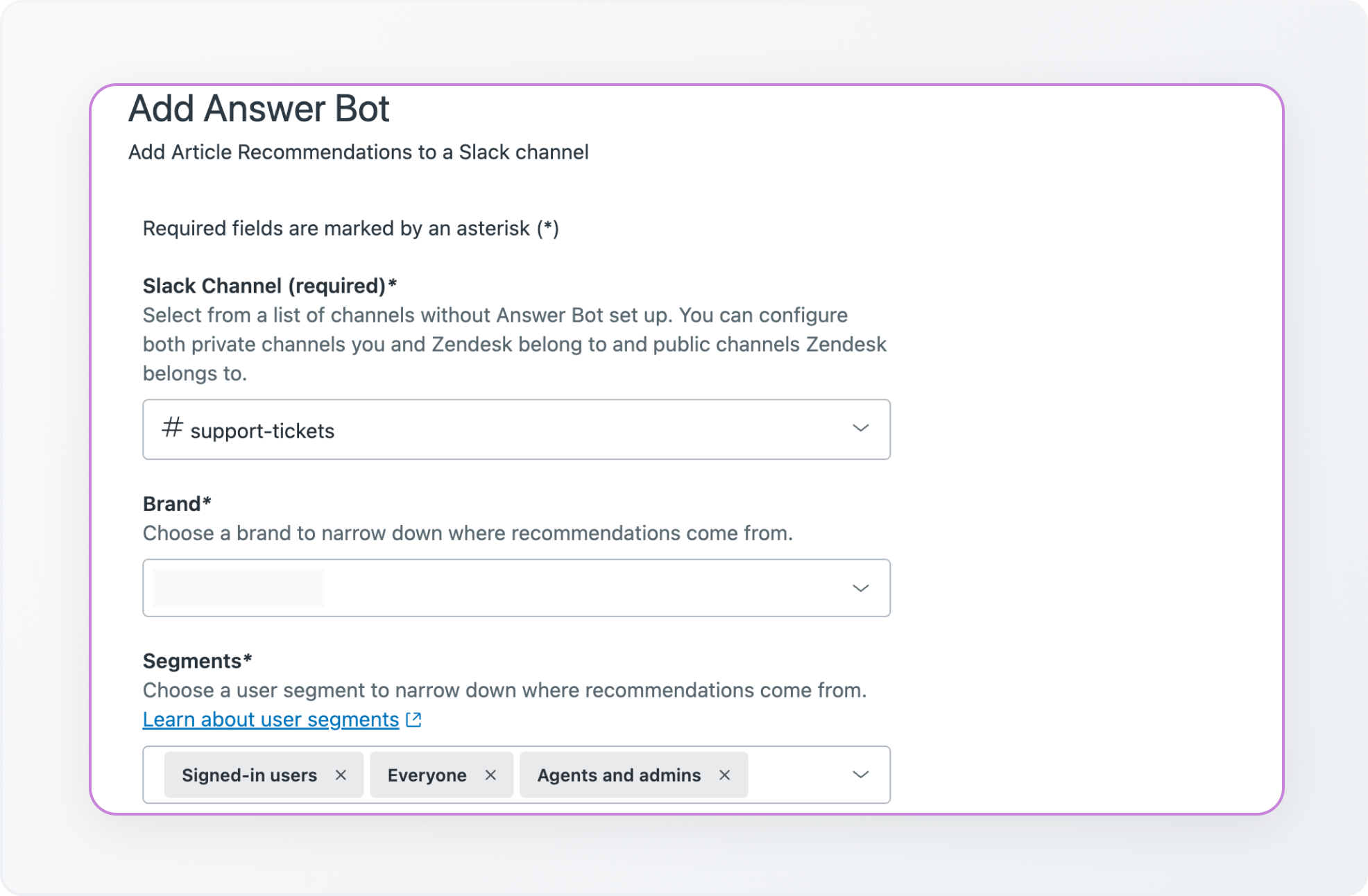
- Select Answer Bot tab and select Add Answer Bot. You will be required to provide the following information:
- Slack Channel: The channel where you want the Answer Bot to be present.
- Brand: A collection of customer touchpoints, such as agents' email addresses, a help center, messaging web widgets, etc.
- Segments: A group of agents and end-users defined by a specific set of attributes. There are three built-in user segments by default:
- Everyone: All members
- Signed-in users: All members who are signed in to your Help Center.
- Agents and managers: All agents and guides with administrator access.
Save the settings. Answer Bot is now active in the selected Slack channel and will surface Zendesk Guide articles in response to matching questions.
Getting more from Answer Bot
- Keep your Zendesk Guide clean and structured. Answer Bot only suggests what's indexed in Zendesk Guide. Well-tagged articles with clear titles surface more often than long, generic pages.
- Watch what doesn't get answered. Questions Answer Bot fails on are the sharpest signal for what's missing from Zendesk Guide.
- Know the limits. Answer Bot suggests articles — it doesn't converse, doesn't take actions like creating a ticket or looking up a user record, and doesn't read screenshots. When those become recurring asks, that's the signal to look at a broader AI setup.
Beyond Answer Bot: ClearFeed AI Agents in the Slack ↔ Zendesk flow
Zendesk Answer Bot does one specific thing well — surface a Zendesk Guide article to a Slack user when their question matches one. For a team with a single, well-maintained Zendesk help center that mostly deflects "where is X documented?" questions, that's often enough.
The moment a workflow needs more — knowledge that lives outside Zendesk Guide, multi-turn conversations, private drafts for agents to send, or the AI actually taking an action — teams layer ClearFeed AI Agents on the same Slack ↔ Zendesk connection.
Where ClearFeed AI Agents go further:
- Broader knowledge base. An Answer Agent pulls from Zendesk Guide and Confluence, Notion, Google Drive, and other sources — with primary-source tagging so trusted docs are consulted first, and per-customer access rules so segments only see the docs they're entitled to.
- Two conversation modes. Virtual Agent replies to the customer publicly in the Slack thread; Agent Assistant drafts a private suggestion for the responder to review, edit, and send — same agent, different mode per team or per channel.
- Real conversations, not just article links. Interactive Agent Mode asks clarifying questions, holds context across turns, and hands off cleanly when a human steps in.
- Actions across the stack. Beyond answering, an Answer Agent can create or update Jira issues, search or update Zendesk tickets, or read from Okta, BambooHR, and JumpCloud — resolving a request end-to-end from Slack rather than pointing at a doc.
- Reads screenshots. When a Slack user pastes an error screenshot, the agent reads the image for context — banners, IDs, URLs, and the screen the user is on.
And where the two systems meet: when a Slack conversation does become a Zendesk ticket, ClearFeed writes an AI-generated title and description from the thread, and AI-driven status transitions move the Zendesk ticket to Pending or re-open it based on the intent of the next reply. The ticket lands in Zendesk pre-triaged, not raw.
See how ClearFeed's AI Agents work in the Slack + Zendesk integration, or book a walkthrough.